Sunday, February 1, 2009

The Lazarus Parable Is Not About the Afterlife


Adapted from Chapter 4 in Heaven for Skeptics by Bert Gary, Copyright 2010 for FaithWalk Publishing


Luke 16:19-31

Did you notice that a character in this parable has a name? Lazarus. Did you know that there are only two named persons in any parable told by Jesus in your Bible? And both are in this parable. They are Lazarus and Abraham. In none of his other parables are characters named. As my Australian friends say, “Funny that.”

Now it could be a coincidence, I suppose, but one of Jesus’ best friends just happens to be named Lazarus (mentioned 13 times in John 11:1-12:17); he had sisters named Mary and Martha; they lived in Bethany (near Jerusalem); and Jesus frequented their home. I count maybe a half dozen visits to their house recorded; I think there were more (not recorded) because I believe Jesus stayed over the years at their home when he visited nearby Jerusalem for festivals. John called Lazarus “the one whom Jesus loved.” (John 11:3) Obviously they were close. Mary and Martha’s scenes with Jesus always show that they too shared close friendships. (Luke 10:38-42; Mark 14:3; John 11:1-12:17)

I don’t think that Jesus named only one of his main parable characters (excluding Abraham’s supporting role) for nothing. I think Jesus’ sense of humor was in high gear. I believe the setting for the telling of this parable was in Bethany, in Jesus’ well-to-do friend Lazarus’ presence, perhaps in his very home, around his table, with Martha and Mary present too, and many disciples. Why? I think Jesus was being creative and having fun. (Gasp!)


In the context of Lazarus’ home, the naming of this character in the parable makes perfect sense. Lazarus of Bethany is probably well off financially. He has a spacious home able to accommodate many visitors at once. About $30,000 worth of nard happens to be stored in the cupboard. (John 12:3) Lazarus’ funeral drew a crowd of dignitaries, Judean officials from Jerusalem. (John 11:19) He was buried in an expensive rock-cut tomb similar to the one in which Jesus was buried---also a rock cut tomb made by another wealthy man, Joseph of Aramathea. (Matthew 27:57-60 and John 11:38) So, to give the name Lazarus to the poverty-stricken character would have brought a smile to everyone’s face, especially the way Jesus set it up.

“There was a rich man who was dressed in purple and fine linen and who feasted sumptuously every day.” (Luke 16:19)

Everyone at the table probably looked at the host, Lazarus, at that point, making a quick assumption that Jesus was connecting his beloved friend, Lazarus, with the wealthy man in the story. But they were too quick to judge. There’s a zinger in the second line.

I can imagine Jesus saying, And every day right there at the rich man’s gate, there was a poor man named . . . (Everyone probably got quiet. He’d never named a person in a parable before. Whose name will he choose?) . . . let’s see . . . what shall I call the poor man . . . oh, I’ve got it. His name was . . . Lazarus!

You know they all laughed. Lazarus was the poor man, not the rich bloke? There's a twist! They had to have laughed. Now they were glued to the story. (When were they not glued to Jesus’ stories? I would have been.) Jesus used the name of his rich best friend whom he raised from the dead for a “parable character” who is poor, lonely, diseased, defiled, licked on by dogs, and right away dies. What a whopper! You know that they laughed and loved it. But that was just the set-up.

Then the rich nameless guy in the parable also dies. And—get this—they don’t “go” to the same place after they die, says Jesus’ tale. In fact their afterlife experiences are a hodgepodge of Hebrew scripture and Greek mythology, both of which, as we will see again, Jesus was very familiar with, and his listeners must have recognized too—all the more reason not to take his story literally. Those present for the telling never would have.

Let’s start with the parable character Jesus named Lazarus after his buddy. He dies, but Jesus says, Poor Lazarus was carried away by angels to be with Abraham on the far side of a canyon (chasma in Greek – chasm in English – meaning a wide space).

Jesus may have been drawing on an image from a popular apocryphal scroll called today 4 Esdras:

4 Esdras ..7:36.. The pit of torment shall appear, and opposite it shall be the place of rest; and the furnace of hell (gehenna) shall be disclosed, and opposite it the paradise of delight.

Whether Jesus was familiar with and using 4 Esdras, he pictures the afterlife in a similar way. Gehenna (see my blog: Hell Defined 2), the burning Valley of Hinnom, is viewed by Esdras as a burning pit. On the far side of the burning valley is a paradise.


But Jesus’ parable throws in two curve balls. 1) Jesus doesn’t say that the canyon is burning. He says that on one rim or side of the canyon there is tormenting fire, and on the other rim or side there is paradise. And 2) Jesus doesn’t call the buring side Gehenna (the term 4 Esdras chose); he calls the burning side Hades, the boring mythological underground abode of the dead. Both of these details created strange, dare I say playful, contradictions. We’ll get to these in a sec.

Notice this irony too. Jesus’ listeners would have. The real Lazarus of Bethany was buried. The parable-Lazarus was not. He was carried away to the rim of the canyon by angels. (John 16:22).

So what is Lazarus doing in his new paradisaical location on the canyon rim? Nothing, it seems. He’s more being than doing. He’s standing next to Abraham—“in his bosom” means by his side or in his embrace. Parable-Lazarus does nothing in the afterlife. He says nothing. He’s just there, seemingly content in proximity to (in close relationship with) the Patriarch Abraham. Perhaps true contentment doesn’t have to do or say anything.

Then, Jesus said, the rich man, unlike Lazarus, was buried. Yet while his body is buried, somehow he’s also present in the Greek mythological underworld called Hades. Incredibly, Jesus places Hades on the opposite side of the aforementioned canyon. Jesus doesn’t place Hades underground! Which brings up the aforementioned contradictions.

When Jesus wants to speak of a place of suffering and fire, he always uses the word “Gehenna,” not “Hades” (see the blogs: Hell Defined 1 and Hell Defined 2). When he uses the word Hades, he is either referring to “the grave” paralleling the word “Sheol” in the Old Testament, though once he also referred intentionally to the Greek pagan mythological underworld. He did this at Caesarea Philippi:

And Jesus answered him, "Blessed are you, Simon son of Jonah! For flesh and blood has not revealed this to you (that Jesus is the Messiah), but my Father in heaven. 18 And I tell you, you are Peter, and on this rock I will build my church, and the gates of Hades will not prevail against it. (italics mine) (Matthew 16:17-18)
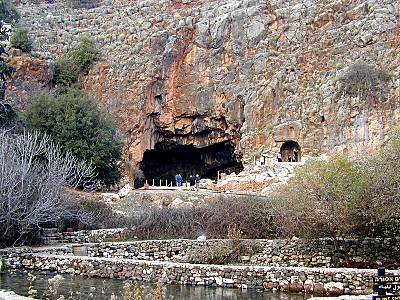
Caesarea Philippi was the ancient city of Paneas named for the god, Pan. Jesus would have seen the temple of Pan standing in front of a cave from which the headwaters of the Jordan River flowed. I’ve taught at this ruin many times, pondering the yawning cave that once greeted Jesus and his disciples. Within the cave there stood a huge statue of Pan. Pan is in the cave because it was his job, according to the myth, to guard the entranceway to Hades—the Greek mythological underground abode of the dead. Get the connection?

In Caesarea Philippi, a city dominated by the view of the temple of Pan—a Greek god who guarded the entrance to Hades--, Jesus refers to the gates of Hades as a metaphor for the church’s power to prevail even against death and the grave. One more time:

And I tell you, you are Peter, and on this rock I will build my church, and the gates of Hades will not prevail against it.” (italics mine) (Matthew 16:17-18) [a[|dhj hades {pronounced hah'-dace}]

All this is to say that when Jesus said Hades, even at Caesarea Philippi, he meant the grave. He was saying that his church will be victorious over death and the grave, using Hades in the Old Testament sense of Sheol (see Hell Defined 1 and Five Coincidences at Caesarea Philippi)

The term Hades occurs only ten times in the New Testament (Matthew 11:23, 16:18..; Luke 10:15, 16:23; Acts 2:27; 31; Revelation 1:18, 6:8, 20:13; 14—eleven if you include 1 Corinthians 15:55, which you can’t). In all but one of those ten occurrences Hades means the grave. Guess which one is different? That’s right. The one that’s different is in the Parable of Poor Lazarus and the Rich Man. There, as in all his parables, Jesus gets creative. There Hades means the abode of the dead, meaning the equivalent of Greek Mythology’s underworld.

Does Jesus believe in Hades, the Greek mythological underground abode of the dead? Of course not. And he proves it. He places Hades not underground in his imaginative story, but on the far rim of a canyon. And he does more.

To me what’s most peculiar is that Jesus adds the notion of tormenting flame being in the rich man’s Hades, which is downright humorous. Hades wasn’t a place of fiery torture in Greek mythology and philosophy. “Punishment for wrongdoing in the old (Pre-Plato) Greek stories . . . was not generally an after-death affair.” (Turner, 28) Hades was just drab.

Later, however, Plato did introduce some elements of suffering to Hades. While good souls went to the Elysian Fields to ride horses, play games, and play lyres in flowered meadows, bad souls went to a place in the basement of Hades called Tartarus (mentioned in 2 Peter 2:4—see Hell Defined 2). (29)

In utter contradiction to this dualism (good/bad; Elysian Fields/Hades), however, Plato sometimes sounded very Hindu or Buddhist, speaking of souls proving themselves worthy through a series of reincarnations to go finally up (!) to “the true Hades” to be bodiless forever with the gods. But bad souls are reincarnated as donkeys, wolves, ants, wasps, or the like. (31) The punishment in this sense is on earth.

Yet, back to the dualism, Plato saw souls that were neither particularly good nor bad being sent to Hades to be purified for a time. This may be where the concept of Purgatory comes from, though the Zoroastrian hell is also for purifying, and the Islamic hell is also purifying for some at death. It’s hard to tell who was borrowing from whom. But Plato claims that very bad people are thrown into Tartarus in the depths of Hades where the Titans are chained (32). It’s a prison. But he adds at the end of The Republic that in Hades sinners are met by wild men who “drag them off and flay them with scourges and thorns.” (33) But a fiery Hades? It’s not to be found.

“The Greek underworld is more like a musty closet than a furnace; it is a dark, sterile, and humorless realm, where the departed wander about aimlessly as shades of their former selves—the dead seem more devitalized and bored than tormented.” (Lewis, 174)

Gehenna [ge,enna geenna {pronounced gheh'-en-nah}] is a New Testament word that Jesus used just eleven times (and James once). It is definitely a place of fire. (On this 4 Esdras agrees.) No wonder. It was Jerusalem’s burning dump. Gehenna, or ge-hinnom in Hebrew, meaning The Valley of Hinnom, is a ravine that runs from the west side down and along the south end of Jerusalem’s Old City wall. Even though it’s not the safest place in the world today, I’ve walked its length. In biblical times, it is the place where garbage and sewage were burned. Continuously burning garbage and sewage is the perfect metaphor for a wasted life in a hellish existence, don’t you think?

Jesus—being intentionally and playfully contradictory in his Lazarus parable—places the rich man not in a fiery Gehenna Valley but in a nonsensical fiery Hades on a canyon rim. Why a fiery Hades for the rich man? You will not believe this:

Hades was the lord of the underworld and of the dead. His realm was also called Hades, and his name means unseen. But the ancient Greek god had two other names, both prominent in Roman times—the time of Jesus. The Romans called him Pluto, which means wealthy. Borrowing from the Celts, the Romans also called him Dives Pater (shortened to Dis Pater or just Dis). Dives Pater means Father Rich Man. (Turner, 36)

Hades/Pluto was equated with Dis Pater probably because in mythology he mined the earth for gold and such. Being the god of mining and underground wealth connected him to the underground abode of the dead. Therefore the god of mined wealth also became the god of the dead.

So let that sink in. Hades is Dives Pater, Father Rich Man. Jesus’ parable, “Poor Lazarus and the Rich Man,” is traditionally called, “Lazarus and Dives.” Folks, that is not a coincidence. Jesus put the rich man in his parable in Hades, a place in mythology that is ruled by the god Hades who is also called Father Rich Man! Are you getting this?

Upon death, the rich man (Dives) in Jesus’ parable is sent to Hades, the realm of Father Rich Man (Dives Pater). This playful parallel is not accidental. The layers of Jesus’ creativity and humor are astonishing.

But look at the many contradictions that occur when you literalize this parable. Lazarus dies. His burial isn’t mentioned, and he is transported by angels over to Abraham’s side of a canyon. He’s asked later in the parable to dip his finger in water, so wherever Lazarus is, Jesus portrays him as a physical being throughout, not a disembodied soul. The rich man’s body is buried, however. No transport is mentioned for him at all. Suddenly he’s in two places at once, in the grave and in Hades (which biblically should be the same thing, since Hades is the Greek word for Old Testament Sheol, meaning the grave). The rich man is definitely not a disembodied soul in either place. And note that Jesus’ parable-Hades isn’t underground. It’s on the opposite rim of the canyon from Lazarus. And the rich man is being tormented by flames physically in Hades, which introduces other inconsistencies. Hades is not known for flames. Moreover, Greco-Roman Hades was a place specifically for souls, not bodies. The rich guy asks for water on his tongue. So he definitely has a body in Hades, but he’s also buried—two bodies?

None of this is very sensical, is it? Taking it literally pushes it to absurd contradictions. But what if that is Jesus’ exact intention. It’s a clever parable, remember, a cartoonish and playful parable, just as Jesus meant for it to be. His listeners no doubt delighted in its colorful, comedic paradoxes and plays on words.

Does that freak you out? Sorry. But it’s clear to me that Jesus meant for his parables to be instructive and entertaining, not internally consistent and logical and factual. (Can a camel literally go through the eye of a needle?) Jesus’ audience that day, an audience of friends and disciples, probably enjoyed the hodgepodge of Hebrew, Greek, and Roman afterlife names and concepts as much as they enjoyed the use of rich, real life Lazarus’ name for a fictional poor man.

Why have we (in the church) intoned Jesus in somber voice and projected his image in super-seriousness on the screens of our minds? Take a deep breath and lighten up, for goodness sake. Relax. It’s a playful parable! Enjoy Jesus’ salty teaching at its best.

Jesus continues, From Hades the rich man looked way across to the other side of the gorge,* and there stood poor Lazarus (Now the rich man recognizes Lazarus! But he never recognized or acknowledged him, ironically, on the sidewalk of his own home while they were alive!) with Abraham.

But Bert, you might complain, it says that the rich man looked up to see Lazarus and Abraham, doesn’t it? Nope. The Greek New Testament reads evpa,raj tou.j ovfqalmou.j auvtou/, which literally translates as “he lifted up his eyes.” Those who interpret this parable literally assume that this means that the rich man literally looked up into the sky to see Abraham and Lazarus “in heaven.” That’s a misunderstanding of the phrase.

Yes, evpai,rw epairo {pronounced ep-ahee'-ro} can mean literally lift up, raise, or elevate. But frequently the term is used figuratively. Here are some examples from our New Testament Gospels. In Luke 11:27 a woman “raised her voice.” This cannot mean that she took her larynx from her throat and lifted it over her head! No, it’s an idiom, an expression that means something beyond the literal words. To raise your voice is to shout or cry out. In Luke 21:28 Jesus tells his listeners to “lift up your heads.” Does he mean to take your head off and hold it in the air? Does he even mean literally to look up at the sky? No on both counts. It’s an idiom. It means have courage or take heart, similar to our idioms in English to “hold your head up high” or “keep your chin up.” In John 13:18 Jesus said, “He who is eating the bread with me, did lift up against me his heel.” (YLT) Does Jesus mean that one of the disciples is going to stomp on him? Again, no. It’s an idiom. It’s often translated into English as “turned against me.” He’s speaking of Judas’ betrayal. Now look at Matthew 17:8:

6 When the disciples heard this, they fell to the ground and were overcome by fear. 7 But Jesus came and touched them, saying, "Get up and do not be afraid." 8 And when they looked up, they saw no one except Jesus himself alone. (italics mine)

By “looked up,” did Matthew mean literally that they looked up into the sky? No. Again, it’s an idiom. It means to look closely or to notice. It’s the same in our parable. Here’s Young’s Literal Translation of Luke 16:23:

YLT Luke ..16:23.. and in the hades having lifted up his eyes, being in torments, he doth see Abraham afar off, and Lazarus in his bosom, (italics mine)

Now we see that “having lifted up his eyes” is an idiom meaning to take notice. Besides, he can’t be literally looking up to the sky because Jesus places the rich man and Lazarus on opposite sides of a canyon. The characters are at eye level. Jesus is simply telling us that in his tale, the rich man looks around and notices that Lazarus and Abraham are over on the opposite rim of Jesus’ much misunderstood and much literalized gorge. (Friberg Lexicon; Thayer’s Greek Lexicon)

And the man cries out, “Mr. Abraham, sir, I beg you, show me a little compassion. Let Lazarus dip his finger in some water and come over here to cool my tongue. Man, it’s hot as hell over here!

This is ridiculous—intentionally. First, if you’re really on fire, you don’t use reason to try and talk your way out of it. Second, how much help is one drop on your tongue when your whole body is blazing? Third, how do Lazarus and Abraham hear him at such a great distance? Maybe it’s a really small chasm! Either that, or their cell phones have a good signal, for Abraham responds to the rich man’s finger-in-water request with a resounding No:

Son, remember how you had it good during your lifetime, and Lazarus had it really bad? But now he has it good here, and you have it really bad there. And this grand canyon separates us so that if anyone wants to cross from here to you, he can’t, and if you want to come over here, you can’t. [As if the rich man hadn’t already noticed all this! Maybe the reason he wants water is not to cool his tongue but to get the abundant life on the other side, referring to the “living water” mentioned by Jesus in John’s Gospel (4:10-14, 7:38) and in the Book of Revelation (7:17, 21:6, 22:1-2 and 17).]

So the rich man says, Sir, again I beg you, let me run home real quick and warn my five brothers so they won’t end up here. [Is he really concerned about his brothers, or is this another excuse used to escape his place of torment, or maybe just another attempt at a reprieve from the heat? Jesus’ listeners were probably saying, No, Abraham, No! Don’t let him go. He’s making an excuse to escape!]

Your brothers don’t need you, said Abraham to the rich man. They’ve got Moses and the prophets to show them the way.

No, Sir Abraham, I know those guys. They aren’t going to read old laws and prophesies. But I truly believe that if you let me go to them personally, when they see that I’m raised from the dead, I think they’ll believe me and change their minds. [That’s what repent means literally—mind-change.]

Here comes the zinger. Don’t you know Jesus’ friend Lazarus loved this last line?

Hey, Rich Boy, if they don’t listen to Moses and the prophets, they won’t listen even if someone were to rise from the dead! said Abraham. THE END.


Look at the levels of meaning. Not only had Lazarus of Bethany been raised from the dead causing many notables to believe (John 11:43-48 and John 12:10-12), but Jesus himself would rise. And Jesus cleverly ends the story with a humdinger referencing coming back to life. He tells the truth. Even the resurrection won’t impress or convince everybody. Obviously so, even today.So what’s this story about? You choose. Multiple choice. Luke 16:19-31 is:

A.     a literal description of a historical event.
B.     an eyewitness report from heaven and hell.
C.     a parable about failure to love your neighbor.

I go with C. It’s a parable about the danger of failing to love your neighbor. If you can’t love now, when are you going to do it? This parable says love today. Don’t blow your present opportunities to love. Because a compassionless existence is a living hell, though one may not realize it until it’s too late.

“The choice is between a living death and a dying life.” (Kreeft, p. 164)

The purpose of the parable is to awaken Life-filled, self-sacrificing compassion now, and to fulfill the law and the prophets by loving your neighbor now:

. . . you shall love your neighbor as yourself. . . (Leviticus 19:18)

As you probably know, this parable is often touted as a documentary on the afterlife. Why? Because there are too many humorless literalists in the world today, and because of them, the church has all but missed the fun. And moreover, the literalists are desperate for afterlife material, as there is much less afterlife emphasis in the Bible than people have been led to believe.

In the Parable of Poor Lazarus and the Rich Man, Jesus has given us a crafty afterlife cartoon designed to tickle and tease the imaginations of those who have ears. Jesus is piercing the heart with a playful drama. It’s a life and death caricature of the failure to love. How desperate must you be for afterlife “data” to turn this delightful, intimate, love-your-neighbor farce into an unsmiling eyewitness report on the hereafter news channel?

The chasm between greed and generosity, between callousness and compassion, between neighborly neglect and neighborly love can and must be crossed in this life.


Plain Truth Magazine published this article as The Lazarus Parable--Just for the Hell of It?

For more on Jesus' parables see my blogs The Absurd Parable of the Unforgiving SlaveThe God Who GamblesParable of the Vine and BranchesThe Crooked ManagerThe Friend at MidnightHeaven Is Like a Crazy FarmerHe Speaks Of . . .Salted With FireTalking Sheep and GoatsIs Your Eye Evil?Two Prodigals and Their Strange FatherThe Lazarus Parable Is Not About the Afterlife,and Jesus Used Parables Like a Sieve.

Sunday, January 25, 2009

Names In the Book of Life


Adapted from Chapter 9 of Heaven for Skeptics © 2008 by Bert Gary for FaithWalk Publishing

The theme of John’s vision is Jesus, just like the rest of the New Testament. But rather than presenting the story of his life as the four gospels do, and rather than interpreting him doctrinally as the various New Testament letters do, the artist—John the Revelator—paints Jesus with symbolic images. He’s a radiant Son of Man, he’s the Lion of Judah, he’s a standing slaughtered Lamb, he’s a newborn, he’s a conquering horseman, he’s the Morning Star, he’s the temple, he’s the lamp, he’s the book of Life, and more.

The subject of this blog is the book of Life. Our text is Revelation 20:11-15. Let me summarize.

John sees the Great White Throne again. But the one on the throne is not alone. All stand before him. Then books are opened. These books are the accumulation of everybody’s deeds. But there is an additional book, and it is different. It’s called the book of Life. (Later we are told that it’s the Lamb’s book of Life. Revelation 21:27) The moment John envisions is resurrection day. Those buried in the ground and those who died at sea are raised for judgment. Everyone is judged by their works found in the record books. Then John sees that Death (Thanatos) and the Grave (Hades) are destroyed in the lake of fire. And if your name is not in the Lamb’s book of Life, you are thrown in to the lake of fire. (See my blog, The Lake of Fire Defined.)

In this next-to-the-last scene in the final vision, out pop the record books. Can you feel the dread? Everyone is judged by their deeds listed in John’s symbolic scrolls. There appears to be no hope. Just as there was no hope in Revelation 5 because there was no one found to open the seven seals of the scroll of the Father’s eternal plan, here in Revelation 21 there is no hope for humanity because its deeds are evil. Again, it appears there is no hope. If no one is righteous and everyone has sinned and fallen short of God’s glory, as the Scriptures insist (Rom 3:10 & 23), then who can stand in this judgment? Absolutely no one! That’s John’s point.

Our deeds are judged as evil, as they must and should be. Do the math. We’re all goners if the record of our deeds is the sole criterion by which we are judged. But, according to John, there is another single volume that appears containing humanity’s only hope. All hope is in this one little book. It’s called the Lamb’s book of Life.

The Lamb’s book, logically, contains the accomplishments of the Lamb. What accomplishments? Oh, little things like . . . he took away the sin of the whole world. Unlike our sad records, there are no black marks in the record of Jesus’ life. All of humanity’s hefty scrolls are full of sin, but not the Lamb’s little scroll. So what in the world does this vision of John’s mean?

It means that while our sins are judged, and thus we are all judged as guilty sinners, there is another book that stands in for humanity’s pitiful record. We have a pinch hitter. It’s the Lamb’s blemish-less book. So what is the Lamb’s judgment on humanity’s fate? It’s his own Life. The Lamb’s book of Life trumps all the other books. Life is the point and the criteria for everything. Look again at John 12:

John 12:48 “[O]n the last day the word that I have spoken will serve as judge,”

John 12:49 “[T]he Father who sent me has himself given me a commandment about what to say and what to speak.”

John 12:50 “And I know that his commandment is eternal life.” (italic mine)

Life is the word that judges. Jesus says that he is the Life. So if the Lamb’s book of Life is a symbol of Jesus’ judgment on the last day, then doesn’t that mean we’re covered? He gave us Life already. He took away our sin already. There’s no point in trying to fix a totaled car. So hitch a ride with the Lamb. The only way to miss this Life is to continue embracing non-Life, that is, sin, death, and evil, even though the Lamb’s book already made those things null and void. Our evil works are condemned by Life, true. Our deeds are evil, true. We are wrecked and totaled, true. But not even sin and death can stand against Life.

Let’s go ahead and clear this up. John’s books of deeds aren’t literal books (or scrolls). They are a symbol of the voluminous record of sin against us all. The Lamb’s book of life then is not a literal book either. It is the Life of the Lamb himself. His Life both judges sin and blots out sin. John shows in pictures that Jesus is greater than our sin. Just as he is the bread of Life in John 6:35 & 48, here in Revelation 20 Jesus is the book of Life.

It took Jesus’ Life to cancel sin. It took his resurrection Life to cancel death. Life burns up sin and death and evil. Do you see it? It’s the Lamb’s book. It’s the Lamb’s lake of fire. And his book and his lake seem to be doing the same thing! They are judging sin and death and evil.

Is there a sense in which he is the slaughtered Lamb, he is the book of Life, and he is the lake of fire? I think so. John places the lake directly in front of the Son of Man’s (Jesus’) feet. (Revelation 14:10) The lake is a heavenly fire in the throne room of God. The fire of Life burns up sin and death and evil. If I’m right, and I think I am, then the lake is not a literal afterlife “hell” run by Satan, nor is it anything remotely akin to that. (See my blogs, Hell Defined 1 and Hell Defined 2, and The Lake of Fire Defined.) It’s the judgment of Jesus’ own white-hot fire of Life. It’s his “burning bliss”. (Caird, p. 258) Jesus said that his very purpose was to bring fire:

Luke 12:49 “I came to bring fire to the earth, and how I wish it were already kindled!”

So is your name in the book or not?

You might argue that John seems to want it both ways, however. On the one hand, you’re given grace (via the Lamb) regardless of what good or bad things you do. On the other, if you worship the beast and persecute Christians in 1st Century Ephesus, then you’re in trouble. Yet what John is showing you is that no matter what you do, grace is stronger. At the same time, however, if you remain an unrepentant, idolatrous, grace-rejecting meanie, you’re in grave danger spiritually. Does what you’ve done matter or not? Will your actions be held against you or not?

OK, so is your name in the symbolic book of Life or not? This book mentioned in six verses in the Book of Revelation. Here they are. I’m using Young’s Literal Translation here because I like the way that it calls the book of Life “the scroll of the life."

YLT Revelation 3:5 He who is overcoming -- this one --
shall be arrayed in white garments, and I will not blot out his name from the scroll of the life, and I will confess his name before my Father, and before His messengers.

YLT Revelation 13:8 And bow before it shall all who are dwelling upon the land, whose names have not been written in the scroll of the life of the Lamb slain from the foundation of the world;

YLT Revelation 17:8 'The beast that thou didst see: it was, and it is not; and it is about to come up out of the abyss, and to go away to destruction, and wonder shall those dwelling upon the earth, whose names have not been written upon the scroll of the life from the foundation of the world, beholding the beast that was, and is not, although it is.’

YLT Revelation 20:12 and I saw the dead, small and great, standing before God, and scrolls were opened, and another scroll was opened, which is that of the life, and the dead were judged out of the things written in the scrolls -- according to their works;

YLT Revelation 20:15 and if any one was not found written in the scroll of the life, he was cast to the lake of the fire.

YLT Revelation 21:27 and there may not at all enter into it any thing defiling and doing abomination, and a lie, but -- those written in the scroll of the life of the Lamb.

Note that you can get your name blotted out of the Lamb’s book of Life, or so says Revelation 3:5 above. But note what that implies. It must mean that your name must start out in the book, and you already have salvation in Jesus Christ. Guess what? That’s the Good News. Salvation was given to the world. Still, if you don’t want Life and grace and stuff like that because you hate God, or you love doing evil, or if you just think it’s unfair of God to save people who aren’t as good as you, then you have the right of refusal. You can exercise the free will he gave you (in love) to reject the salvation you had from the get-go.

It must be remembered that the book of Life is the Lamb’s book of life. (Revelation 21: 27) The Lamb of God took away the sin of the whole world. (John ..1:29.. & 36) That means everybody. So what’s the logical conclusion? Everyone’s name starts out in his symbolic book. Everyone’s. Can I give more prove of that? Yes.

John doesn’t give any instructions on how to get your name added to the Lamb’s book! Actually, you don’t have the power to get your name in there. But the Lamb did it for you, says Scripture. That’s why it’s his book. The Lamb’s book is Revelation’s symbol of gracious Life given to the world—every name in the
world. You don’t get this Life by striving or merit. No verse of the Bible says you have to do anything to get your name in there. But it specifically says you can get your name blotted out. Here’s 3:5 again:

Revelation 3:5 If you conquer, you will be clothed like them in white robes, and I will not blot your name out of the book of life; I will confess your name before my Father and before his angels.

Therefore, if there is no instruction in Revelation for getting your name added to the Lamb’s book of life, and if there is warning that you can get your name blotted out of the Lamb’s book of Life, then your name—and everyone’s name—must have started out in there. That supports the gospel proclamation that the Lamb saved everyone (the world) when he finished his work. (“It is finished.” John 19:30) He drew all men unto himself. (John 12:32) He fulfilled all righteousness as a gift. (Matthew 3:15) He reconciled all things to himself, and he made universal peace between God and humanity with his own flesh and blood. (Colossians 1:20) Scripturally, Jesus is indeed the savior of the world. (See my blog, You’re Saved.)

John 4:42 They said to the woman, "It is no longer because of what you said that we believe, for we have heard for ourselves, and we know that this is truly the Savior of the world.”

1 John ..4:14.. And we have seen and do testify that the Father has sent his Son as the Savior of the world.

Back to the contradiction

But this brings us back to the contradiction above: John seems to want it both ways. No matter what you do, grace is stronger. At the same time, however, if you remain an unrepentant, idolatrous, grace-rejecting persecutor of the church, you’re in grave danger spiritually. Does what you’ve done matter or not? Will your actions be held against you or not?

So, as we’ve seen, John affirms all names starting out in the Lamb’s book of life. Grace wins, period. But, strangely, then John also writes that some names weren’t in the Lamb’s book of life to begin with! How can this be? Could the Lord have created creatures damned from the get-go?

Revelation 13:8 and all the inhabitants of the earth will worship [the beast], everyone whose name has not been written from the foundation of the world in the book of life.

Revelation 17:8 The beast that you saw was, and is not, and is about to ascend from the bottomless pit and go to destruction. And the inhabitants of the earth, whose names have not been written in the book of life from the foundation of the world, will be amazed when they see the beast, because it was and is not and is to come.

Revelation 20:14-15 Then Death and Hades were thrown into the lake of fire. This is the second death, the lake of fire; 15 and anyone whose name was not found written in the book of life was thrown into the lake of fire.

Revelation ..21:27.. But nothing unclean will enter it, nor anyone who practices abomination or falsehood, but only those who are written in the Lamb's book of life.

For complete clarity’s sake, let me summarize John’s provocative contradiction:

  1. Since the Lamb of God was slain from the foundation of the world, that means that all sin was taken from the world, all were forgiven, and all names must start out in the Lamb’s book of Life. Since no one can make himself righteous, the Lamb did all the work. He finished it. There’s no way (and no need) to get your name added, but there’s a way to get it removed.
  2. Since some people worship the beast instead of the Lamb, this indicates that their names were never in the Lamb’s book of Life from the start.
How can both be true? It does seem that John is having it both ways. John affirms God’s eternal foreknowledge from God’s end, yet he also affirms our temporal free will from our end. I have a suggestion. Perhaps it is a matter of perspective.

From my perspective, my rejection of grace results in the blotting out of my name. But from God’s perspective, the absence of my name is from the beginning. Do you see it? Is this what John is telling us? I think so. It’s a temporal “both/and.”

Yes, all names start in the book because of the finished work of Christ from the foundation of the world. And yes, the absence of a name from the book is both foreknown by God and a result of a person choosing to have his name blotted. So what is John saying in a nutshell?

That which is clearly self-blotting to us is foreknown by God as absence from the beginning.

Let’s keep it simple. Here’s what I hear John saying step by step:

  1. From the Lamb’s perspective, all names are in his book of Life originally,
    affirming his gift of Life and redemption to all.
  2. Yet we can by our choosing get our names blotted out, affirming God’s gift of choice for all too.
  3. But at the same time, from God’s vantage point (which obviously includes the future), the self-blotted names were never in the Lamb’s book to begin
    with.
This is not predeterminism, however. God doesn’t create some folks just so he can hate and damn them. He allows self-condemnation and self-judgment to operate freely within our temporal flow. From your temporal perspective, the question is: Do you embrace the Life he gives or not? From his eternal perspective, however, he is from the beginning aware of who the blotters will eventually be, just as Jesus was aware from the beginning, it seems, that Judas, for example, was a betrayer.

Jesus didn’t create Judas just to damn him. He made him and loved him and chose him and taught him. Judas may have damned himself (Who am I to judge?), but Jesus’ foreknowledge didn’t cause it. Therefore:

  1. From the Alpha perspective (the beginning of time), all names begin in the book of life.
  2. Yet in the course of time (our present, temporal life-spans), some choose to blot their names out by rejecting Life.
  3. But at the same time, from the Omega perspective (the end of time), the blotters’ names were never in the book of life to begin with.
It sounds contradictory, I know. John’s paradoxical time perspective doesn’t fit neatly into our western, Enlightenment-locked, Newtonian mindsets. But it’s John’s intention to express 1) the universal gift of Life and atonement, and 2) the gift of human free will, and 3) the foreknowledge of God concerning who chooses Life and who doesn’t. Here’s an example that I think will help. Look at the crucifixion of Jesus:

  1. From the Alpha perspective (the beginning of time), Jesus was the non-bodily, pre-existent Word of God.
  2. Yet in the course of earth-time (during his lifetime), from a temporal
    perspective, Jesus was a human being crucified bodily.
  3. But at the same time, from the Omega perspective (the end of time), Jesus was “slain from the foundation of the world”, a human being slain bodily all along.
Again, it sounds contradictory. But John insists that Jesus Christ is both the pre-existent, non-corporeal Word of God and the forever-from-the-beginning crucified and risen corporeal, first century, flesh and blood human being named Jesus of Nazareth. The second letter to Timothy agrees:

2 Timothy 1:9 This grace was given to us in Christ Jesus before the ages began,

It’s about temporal perspective

I think I’ve demonstrated that for John it’s a matter of temporal perspective. From an eternal perspective, isn’t the blotting out of your name the same as it never having been there? Yes, it really does sound contradictory, but it’s really a mysterious paradox of time that John embraced. Just because God sees from the beginning that Billy’s name is not in the book does not mean that Billy’s choice to blot it out wasn’t real—especially to Billy.

So, how do you keep your name in the book of Life? To endure to the end without being awed by the beast, or seduced by the beast, is to know that your name is in the book of Life, says John to his churches. Again, Jesus and his message and his resurrection and his kingdom of heaven are all about love and Life. Remember how Young’s Literal Translation put it: “the scroll of the life.” The scroll of the Life is Revelation’s symbol for the completed redemptive work of Jesus Christ. “The Life” that we are talking about, remember, is Jesus. He is “the Life,” as he insists to his disciples in John 14:6.

Loving this Life, says John, is resisting and enduring the forces that resist this Life. That keeps your name in the Lamb’s symbolic book. To love this Life and to resist and endure the forces that resist this Life is to remain in this Life that has found you and embraced you.

I have a concern

There is an unfortunate emphasis today on decisional salvation—pressuring unbelievers to make “a decision for Christ.” Revelation in particular is used as a weapon to frighten and coerce unbelievers. But John’s book was not written to unbelievers at all! His message is for believers only. I might go so far as to say that the Book of Revelation was written to believers with advanced, mature understanding of the Christian faith.

I see zero evidence that John intended to use fear and death to get unbelievers to “make a decision for Christ.” “Decision for Christ” isn’t biblical language. And the subject matter in Revelation has nothing to do with who in the end will “make a decision for Christ” (again, a phrase not found in the Bible) and who won’t. John is addressing and encouraging believers, period.

John tells his churches that they are to continue resisting the pressure to worship the State, the Ruler, and his idolatrous, religio-political temple practices. (20:11-15) They are to continue to share the Good News that in Jesus you are already reconciled to God from his end, says John. And they are to continue to endure the persecution of those who react negatively, even violently, to the free and universal gift of light and Life-filled relationship to which they witness with their words, their lives, and sometimes even their deaths.

It’s not about a decision whereby you get Life. It’s about a relational Life that came and got you.

Postscript: God Hated Esau?

For those who’ve believed that God creates some people just to hate and damn them, let me add this postscript about Esau. It’s often said that God predetermined to hate Esau for no good reason. Some translations of Romans 9:13 seem to say that very thing.

Romans 9:13 As it is written, “I have loved Jacob, but I have hated (Hebrew: sane') Esau.”

Some see Romans 9:13 as an example of God creating someone to love and someone to hate—Jacob and Esau. Paul in Romans was quoting Malachi from the Old Testament:

Malachi 1:1-3 An oracle. The word of the LORD to Israel by Malachi. 2 I have loved you, says the LORD. But you say, "How have you loved us?" Is not Esau Jacob's brother? says the LORD. Yet I have loved Jacob 3 but I have hated (sane') Esau; I have made his hill country a desolation and his heritage a desert for jackals.

Yet loved and hated in this context mean chosen and rejected. It’s saying that God preferred Jacob over Esau concerning his first covenant. Some English versions of the Bible translate sane' as rejected:

NET Malachi 1:3 and rejected Esau.
NLT Malachi 1:3 but I rejected his brother, Esau,
TNK Malachi 1:3 and have rejected Esau.

Here’s a helpful example:

RSV Genesis 29:31 When the LORD saw that Leah was hated (sane' - here meaning un-preferred), he opened her womb; but Rachel was barren.

Jacob wouldn’t have born children with Leah if he literally hated her. He didn’t detest her. She’s his wife and the mother of his children. It’s just that Jacob preferred her little sister Rachel in his heart. He did from the moment he met her. Here’s another example:

Genesis 25:28 Isaac loved Esau because he was fond of game; but Rebekah loved Jacob.

See again how loved means preferred?

Paul then in Romans 9 uses the Malachi quote as an example of God’s freedom and right to choose whomever he wants to, not just including the Jews, but also in Jesus Christ choosing Gentiles too. This is the second or new covenant, the New Testament. It’s a covenant with the world.

For more on the Book of Revelation see my blogs 666Rapture InterruptedThe Giant Flying CubeThe MillenniumPearly Gates and Streets of Gold, and The Lake of Fire Defined.

Saturday, January 24, 2009

Five Coincidences?

Jesus and Pan at Caesarea Philippi

Greek mythology, Palestinian geography, and the biblical narrative come together in a most unusual way at ancient Banias, better known as Caesarea Philippi.

In the first century, Pan was known as the only god to have died "in our own time." Specifically, the god is recorded as having died during the reign of Tiberias, the Emperor of Rome at the time of Jesus' death. "Pan the great is dead," shouted a sailor, Tammuz, sailing off the coast of Italy. There were reports of great lamentation. When Tiberias heard of it, he believed it a mistake. It could not be that the great son of Hermes and Penelope was dead, he concluded, but a lesser demon by the same name.

Banias or Banyas---Arabic spellings of Paneas---is the ancient city at the foot of Mt. Hermon dedicated to the god, Pan. (Herod Philip, a son of Herod the Great, renamed the city Caesarea Philippi after himself.) The ruins of a temple dedicated to Pan are nearly obliterated now, yet the cave in which the god's great statue stood is still there, and votive niches in the cliff wall also remain.

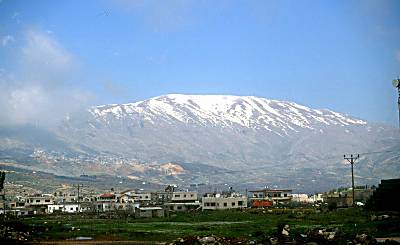
In the same way that Banias is named for Pan, Mt. Hermon is named for Pan's father, Hermes. The mountain straddles the modern Israeli-Syrian border. It rises to a height of over 9000 feet, and in the rainy months of December to March, is often snow-capped. (There is even a ski slope there now!) Only on a clear day---unusual during the winter---can you see it from the city of Tiberias on the Sea of Galilee (the Kineret). More often the view of it is obliterated even at close range in cold months by haze or mist or dense fog.

The god Hermes was the son of Zeus and Maia. Being best known probably as "the messenger of the gods," perhaps it is not surprising that Hermes' name (Mercury in Roman mythology) came to the English language in the word hermeneutic, which has to do of course with linguistic studies and interpretation and translation, most often associated with biblical exegesis.

However, Hermes was also the conductor of the souls of the dead to Hades, the place in Greek mythology where dead peoples' souls go to wander around in boredom.

Pan---the Greek word for "all"--- was among other things the guardian of thresholds. His job was to frighten you when you reached a threshold in life. That is where we get the word pan-ic! It was his job to panic anyone approaching a threshold, especially that of a cave.

Putting this together, in the Cave of Pan at Caesarea Philippi stands a statue of Pan, guarding the threshold to the cave. This cave is in Mt. Hermon, named for Hermes, the conductor of souls to Hades. The Cave of Pan logically came to be known as the "gateway to Hades." So, if you were to die and you did not get panicked by Pan, your soul would cross the threshold of the cave, and Hermes would take you to Hades from there! That was the mythology of this beautiful, natural setting. Interestingly, Pan was also the god of the pastoral and natural, thus our theological terms pantheism and panentheism. We in the English speaking world also have Pan to thank for pandemonium and pandering.


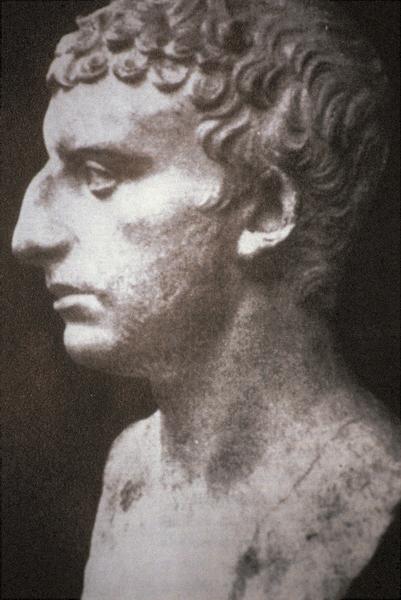
Josephus, the first century historian, wrote of Banias and the Cave of Pan. He recorded that the depth of the waters in the cave were beyond measure. The waters he wrote of are today called the Banias Spring. They are one of three major sources of the Jordan River. The water no longer comes from within the cave. An earthquake may have caused a cave-in. Instead, the water flows from beneath the rocks and ruins in front of the cave. It flows into the Jordan, then the Sea of Galilee, then the Jordan again, and finally the Dead Sea.

Jesus' time at Caesarea Philippi was in a way a Gethsemane in the north. He had left Herod Antipas' territory. Four reasons for heading north are mentioned in the Gospels. Jesus had just heard of the death of John the Baptist (Matthew 14:9-13); Herod was looking for him (Luke 9:9); the disciples were tired from their missionary journeys (Mark 6:30-31); and the crowds had tried to take him and make him king by force (John 6:15). Any one of these would be reason enough to bug out, but taken together, it is easy to see why Jesus needed time away.

Luke makes it clear that at Banias Jesus was alone in prayer, and the disciples were with him (9:18). It is in the context of problems and pain back in the Galilee, in seclusion and in prayer at this northern pagan city, that Jesus becomes circumspect about things to come. The nature of his ministry/messiahship are in focus again, as they were in the temptations in the Judean wilderness. In the story of Peter's confession and in the temptations of Jesus, Satan makes an appearance, and both are times of struggle and loneliness.

After Jesus told them he would go back to Jerusalem to die, and after he and Peter had "the screaming match at Caesarea Philippi" (Mark 8:31-33), Jesus stayed six days longer there (Mark 9:2). Six days longer. We have no way of knowing what went on that week. But in light of Jesus' revelation of suffering and death, there was probably not a lot of rest and relaxation.

After six days (Luke says eight), he took his "inner circle" with him up to a high mountain apart (Mark 9:2) by themselves (Matthew 17:1) to pray (Luke 9:28). Obviously the only high mountain in the vicinity is Har Hermon. (Mt. Tabor then is certainly a traditional site for pilgrims.) There he takes on an unearthly appearance, and he is visited by Moses and Elijah. The prophet of Mt. Sinai and the prophet of Mt. Carmel meet Jesus on Mt. Hermon. The servant of Yahweh who stood down Pharaoh, and the servant of God who stood down 450 prophets of Baal, spoke with Jesus concerning his upcoming confrontation with the Judean authorities on Zion, on Moriah, and on Calvary (Luke 9:31).


Moses and Elijah turned to leave, so Peter and company proposed booth construction, and immediately one of those thick mists rolled in. The voice proclaimed essentially what it had proclaimed at Jesus baptism (Matthew 3:17 and 17:5). It is interesting how the baptism and temptations are joined, and how the scene at Banias and Hermon are joined. At the southernmost point of the Jordan River, affirmation of God's voice led to struggle in the Judean wilderness (Mark 1:11-12). Conversely, at the Banias Spring (the northern headwaters of the Jordan River), struggle led to the affirmation of God's voice on Hermon. We have come full circle in the fullness of time, for the baptism and temptations mark the beginning of Jesus' Galilean ministry (at the end of the river), while the prediction and transfiguration mark the end (at the beginning of the river). After the events in the north, Luke says, he set his face toward Jerusalem (9:51). Mark says he began striding ahead of them, and the disciples were amazed and afraid (10:32).

Five coincidences? Is it a coincidence that it is on Hermon, named for the messenger god, that Jesus got the message from Moses and Elijah that steeled his nerve and sent him on his way, and three disciples got the message, from the highest source, of who Jesus was and that they should "listen" to him? Is it a coincidence that as Jesus stood at the threshold of his own fate, he struggled and hesitated six days before the Temple of Pan, the god of panic and thresholds? Is it a coincidence in Matthew, that in the vicinity of that cave known as the gateway to Hades, Jesus gave the keys to the kingdom to Peter, proclaiming that the gates of hell would not prevail against it? Is it a coincidence that Jesus would ponder his own death at "the gateway to Hades," a cavern yawning before him like a tomb? And is it a coincidence that during the reign of Tiberias, Pan was not the only "god" to have died, but in fact God incarnate, Jesus Christ, also died, and he is proclaimed by the Church as the living and eternal Lord of Pan/All?