Showing posts with label hades. Show all posts

Sunday, February 1, 2009

The Lazarus Parable Is Not About the Afterlife


Adapted from Chapter 4 in Heaven for Skeptics by Bert Gary, Copyright 2010 for FaithWalk Publishing


Luke 16:19-31

Did you notice that a character in this parable has a name? Lazarus. Did you know that there are only two named persons in any parable told by Jesus in your Bible? And both are in this parable. They are Lazarus and Abraham. In none of his other parables are characters named. As my Australian friends say, “Funny that.”

Now it could be a coincidence, I suppose, but one of Jesus’ best friends just happens to be named Lazarus (mentioned 13 times in John 11:1-12:17); he had sisters named Mary and Martha; they lived in Bethany (near Jerusalem); and Jesus frequented their home. I count maybe a half dozen visits to their house recorded; I think there were more (not recorded) because I believe Jesus stayed over the years at their home when he visited nearby Jerusalem for festivals. John called Lazarus “the one whom Jesus loved.” (John 11:3) Obviously they were close. Mary and Martha’s scenes with Jesus always show that they too shared close friendships. (Luke 10:38-42; Mark 14:3; John 11:1-12:17)

I don’t think that Jesus named only one of his main parable characters (excluding Abraham’s supporting role) for nothing. I think Jesus’ sense of humor was in high gear. I believe the setting for the telling of this parable was in Bethany, in Jesus’ well-to-do friend Lazarus’ presence, perhaps in his very home, around his table, with Martha and Mary present too, and many disciples. Why? I think Jesus was being creative and having fun. (Gasp!)


In the context of Lazarus’ home, the naming of this character in the parable makes perfect sense. Lazarus of Bethany is probably well off financially. He has a spacious home able to accommodate many visitors at once. About $30,000 worth of nard happens to be stored in the cupboard. (John 12:3) Lazarus’ funeral drew a crowd of dignitaries, Judean officials from Jerusalem. (John 11:19) He was buried in an expensive rock-cut tomb similar to the one in which Jesus was buried---also a rock cut tomb made by another wealthy man, Joseph of Aramathea. (Matthew 27:57-60 and John 11:38) So, to give the name Lazarus to the poverty-stricken character would have brought a smile to everyone’s face, especially the way Jesus set it up.

“There was a rich man who was dressed in purple and fine linen and who feasted sumptuously every day.” (Luke 16:19)

Everyone at the table probably looked at the host, Lazarus, at that point, making a quick assumption that Jesus was connecting his beloved friend, Lazarus, with the wealthy man in the story. But they were too quick to judge. There’s a zinger in the second line.

I can imagine Jesus saying, And every day right there at the rich man’s gate, there was a poor man named . . . (Everyone probably got quiet. He’d never named a person in a parable before. Whose name will he choose?) . . . let’s see . . . what shall I call the poor man . . . oh, I’ve got it. His name was . . . Lazarus!

You know they all laughed. Lazarus was the poor man, not the rich bloke? There's a twist! They had to have laughed. Now they were glued to the story. (When were they not glued to Jesus’ stories? I would have been.) Jesus used the name of his rich best friend whom he raised from the dead for a “parable character” who is poor, lonely, diseased, defiled, licked on by dogs, and right away dies. What a whopper! You know that they laughed and loved it. But that was just the set-up.

Then the rich nameless guy in the parable also dies. And—get this—they don’t “go” to the same place after they die, says Jesus’ tale. In fact their afterlife experiences are a hodgepodge of Hebrew scripture and Greek mythology, both of which, as we will see again, Jesus was very familiar with, and his listeners must have recognized too—all the more reason not to take his story literally. Those present for the telling never would have.

Let’s start with the parable character Jesus named Lazarus after his buddy. He dies, but Jesus says, Poor Lazarus was carried away by angels to be with Abraham on the far side of a canyon (chasma in Greek – chasm in English – meaning a wide space).

Jesus may have been drawing on an image from a popular apocryphal scroll called today 4 Esdras:

4 Esdras ..7:36.. The pit of torment shall appear, and opposite it shall be the place of rest; and the furnace of hell (gehenna) shall be disclosed, and opposite it the paradise of delight.

Whether Jesus was familiar with and using 4 Esdras, he pictures the afterlife in a similar way. Gehenna (see my blog: Hell Defined 2), the burning Valley of Hinnom, is viewed by Esdras as a burning pit. On the far side of the burning valley is a paradise.


But Jesus’ parable throws in two curve balls. 1) Jesus doesn’t say that the canyon is burning. He says that on one rim or side of the canyon there is tormenting fire, and on the other rim or side there is paradise. And 2) Jesus doesn’t call the buring side Gehenna (the term 4 Esdras chose); he calls the burning side Hades, the boring mythological underground abode of the dead. Both of these details created strange, dare I say playful, contradictions. We’ll get to these in a sec.

Notice this irony too. Jesus’ listeners would have. The real Lazarus of Bethany was buried. The parable-Lazarus was not. He was carried away to the rim of the canyon by angels. (John 16:22).

So what is Lazarus doing in his new paradisaical location on the canyon rim? Nothing, it seems. He’s more being than doing. He’s standing next to Abraham—“in his bosom” means by his side or in his embrace. Parable-Lazarus does nothing in the afterlife. He says nothing. He’s just there, seemingly content in proximity to (in close relationship with) the Patriarch Abraham. Perhaps true contentment doesn’t have to do or say anything.

Then, Jesus said, the rich man, unlike Lazarus, was buried. Yet while his body is buried, somehow he’s also present in the Greek mythological underworld called Hades. Incredibly, Jesus places Hades on the opposite side of the aforementioned canyon. Jesus doesn’t place Hades underground! Which brings up the aforementioned contradictions.

When Jesus wants to speak of a place of suffering and fire, he always uses the word “Gehenna,” not “Hades” (see the blogs: Hell Defined 1 and Hell Defined 2). When he uses the word Hades, he is either referring to “the grave” paralleling the word “Sheol” in the Old Testament, though once he also referred intentionally to the Greek pagan mythological underworld. He did this at Caesarea Philippi:

And Jesus answered him, "Blessed are you, Simon son of Jonah! For flesh and blood has not revealed this to you (that Jesus is the Messiah), but my Father in heaven. 18 And I tell you, you are Peter, and on this rock I will build my church, and the gates of Hades will not prevail against it. (italics mine) (Matthew 16:17-18)
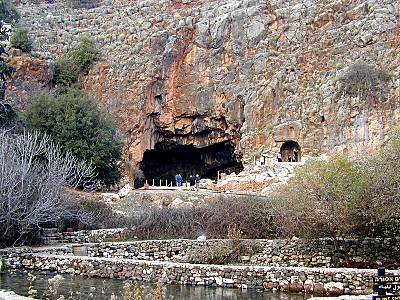
Caesarea Philippi was the ancient city of Paneas named for the god, Pan. Jesus would have seen the temple of Pan standing in front of a cave from which the headwaters of the Jordan River flowed. I’ve taught at this ruin many times, pondering the yawning cave that once greeted Jesus and his disciples. Within the cave there stood a huge statue of Pan. Pan is in the cave because it was his job, according to the myth, to guard the entranceway to Hades—the Greek mythological underground abode of the dead. Get the connection?

In Caesarea Philippi, a city dominated by the view of the temple of Pan—a Greek god who guarded the entrance to Hades--, Jesus refers to the gates of Hades as a metaphor for the church’s power to prevail even against death and the grave. One more time:

And I tell you, you are Peter, and on this rock I will build my church, and the gates of Hades will not prevail against it.” (italics mine) (Matthew 16:17-18) [a[|dhj hades {pronounced hah'-dace}]

All this is to say that when Jesus said Hades, even at Caesarea Philippi, he meant the grave. He was saying that his church will be victorious over death and the grave, using Hades in the Old Testament sense of Sheol (see Hell Defined 1 and Five Coincidences at Caesarea Philippi)

The term Hades occurs only ten times in the New Testament (Matthew 11:23, 16:18..; Luke 10:15, 16:23; Acts 2:27; 31; Revelation 1:18, 6:8, 20:13; 14—eleven if you include 1 Corinthians 15:55, which you can’t). In all but one of those ten occurrences Hades means the grave. Guess which one is different? That’s right. The one that’s different is in the Parable of Poor Lazarus and the Rich Man. There, as in all his parables, Jesus gets creative. There Hades means the abode of the dead, meaning the equivalent of Greek Mythology’s underworld.

Does Jesus believe in Hades, the Greek mythological underground abode of the dead? Of course not. And he proves it. He places Hades not underground in his imaginative story, but on the far rim of a canyon. And he does more.

To me what’s most peculiar is that Jesus adds the notion of tormenting flame being in the rich man’s Hades, which is downright humorous. Hades wasn’t a place of fiery torture in Greek mythology and philosophy. “Punishment for wrongdoing in the old (Pre-Plato) Greek stories . . . was not generally an after-death affair.” (Turner, 28) Hades was just drab.

Later, however, Plato did introduce some elements of suffering to Hades. While good souls went to the Elysian Fields to ride horses, play games, and play lyres in flowered meadows, bad souls went to a place in the basement of Hades called Tartarus (mentioned in 2 Peter 2:4—see Hell Defined 2). (29)

In utter contradiction to this dualism (good/bad; Elysian Fields/Hades), however, Plato sometimes sounded very Hindu or Buddhist, speaking of souls proving themselves worthy through a series of reincarnations to go finally up (!) to “the true Hades” to be bodiless forever with the gods. But bad souls are reincarnated as donkeys, wolves, ants, wasps, or the like. (31) The punishment in this sense is on earth.

Yet, back to the dualism, Plato saw souls that were neither particularly good nor bad being sent to Hades to be purified for a time. This may be where the concept of Purgatory comes from, though the Zoroastrian hell is also for purifying, and the Islamic hell is also purifying for some at death. It’s hard to tell who was borrowing from whom. But Plato claims that very bad people are thrown into Tartarus in the depths of Hades where the Titans are chained (32). It’s a prison. But he adds at the end of The Republic that in Hades sinners are met by wild men who “drag them off and flay them with scourges and thorns.” (33) But a fiery Hades? It’s not to be found.

“The Greek underworld is more like a musty closet than a furnace; it is a dark, sterile, and humorless realm, where the departed wander about aimlessly as shades of their former selves—the dead seem more devitalized and bored than tormented.” (Lewis, 174)

Gehenna [ge,enna geenna {pronounced gheh'-en-nah}] is a New Testament word that Jesus used just eleven times (and James once). It is definitely a place of fire. (On this 4 Esdras agrees.) No wonder. It was Jerusalem’s burning dump. Gehenna, or ge-hinnom in Hebrew, meaning The Valley of Hinnom, is a ravine that runs from the west side down and along the south end of Jerusalem’s Old City wall. Even though it’s not the safest place in the world today, I’ve walked its length. In biblical times, it is the place where garbage and sewage were burned. Continuously burning garbage and sewage is the perfect metaphor for a wasted life in a hellish existence, don’t you think?

Jesus—being intentionally and playfully contradictory in his Lazarus parable—places the rich man not in a fiery Gehenna Valley but in a nonsensical fiery Hades on a canyon rim. Why a fiery Hades for the rich man? You will not believe this:

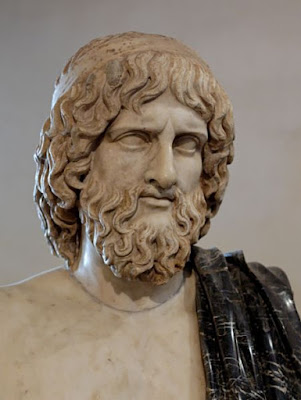
Hades was the lord of the underworld and of the dead. His realm was also called Hades, and his name means unseen. But the ancient Greek god had two other names, both prominent in Roman times—the time of Jesus. The Romans called him Pluto, which means wealthy. Borrowing from the Celts, the Romans also called him Dives Pater (shortened to Dis Pater or just Dis). Dives Pater means Father Rich Man. (Turner, 36)

Hades/Pluto was equated with Dis Pater probably because in mythology he mined the earth for gold and such. Being the god of mining and underground wealth connected him to the underground abode of the dead. Therefore the god of mined wealth also became the god of the dead.

So let that sink in. Hades is Dives Pater, Father Rich Man. Jesus’ parable, “Poor Lazarus and the Rich Man,” is traditionally called, “Lazarus and Dives.” Folks, that is not a coincidence. Jesus put the rich man in his parable in Hades, a place in mythology that is ruled by the god Hades who is also called Father Rich Man! Are you getting this?

Upon death, the rich man (Dives) in Jesus’ parable is sent to Hades, the realm of Father Rich Man (Dives Pater). This playful parallel is not accidental. The layers of Jesus’ creativity and humor are astonishing.

But look at the many contradictions that occur when you literalize this parable. Lazarus dies. His burial isn’t mentioned, and he is transported by angels over to Abraham’s side of a canyon. He’s asked later in the parable to dip his finger in water, so wherever Lazarus is, Jesus portrays him as a physical being throughout, not a disembodied soul. The rich man’s body is buried, however. No transport is mentioned for him at all. Suddenly he’s in two places at once, in the grave and in Hades (which biblically should be the same thing, since Hades is the Greek word for Old Testament Sheol, meaning the grave). The rich man is definitely not a disembodied soul in either place. And note that Jesus’ parable-Hades isn’t underground. It’s on the opposite rim of the canyon from Lazarus. And the rich man is being tormented by flames physically in Hades, which introduces other inconsistencies. Hades is not known for flames. Moreover, Greco-Roman Hades was a place specifically for souls, not bodies. The rich guy asks for water on his tongue. So he definitely has a body in Hades, but he’s also buried—two bodies?

None of this is very sensical, is it? Taking it literally pushes it to absurd contradictions. But what if that is Jesus’ exact intention. It’s a clever parable, remember, a cartoonish and playful parable, just as Jesus meant for it to be. His listeners no doubt delighted in its colorful, comedic paradoxes and plays on words.

Does that freak you out? Sorry. But it’s clear to me that Jesus meant for his parables to be instructive and entertaining, not internally consistent and logical and factual. (Can a camel literally go through the eye of a needle?) Jesus’ audience that day, an audience of friends and disciples, probably enjoyed the hodgepodge of Hebrew, Greek, and Roman afterlife names and concepts as much as they enjoyed the use of rich, real life Lazarus’ name for a fictional poor man.

Why have we (in the church) intoned Jesus in somber voice and projected his image in super-seriousness on the screens of our minds? Take a deep breath and lighten up, for goodness sake. Relax. It’s a playful parable! Enjoy Jesus’ salty teaching at its best.

Jesus continues, From Hades the rich man looked way across to the other side of the gorge,* and there stood poor Lazarus (Now the rich man recognizes Lazarus! But he never recognized or acknowledged him, ironically, on the sidewalk of his own home while they were alive!) with Abraham.

But Bert, you might complain, it says that the rich man looked up to see Lazarus and Abraham, doesn’t it? Nope. The Greek New Testament reads evpa,raj tou.j ovfqalmou.j auvtou/, which literally translates as “he lifted up his eyes.” Those who interpret this parable literally assume that this means that the rich man literally looked up into the sky to see Abraham and Lazarus “in heaven.” That’s a misunderstanding of the phrase.

Yes, evpai,rw epairo {pronounced ep-ahee'-ro} can mean literally lift up, raise, or elevate. But frequently the term is used figuratively. Here are some examples from our New Testament Gospels. In Luke 11:27 a woman “raised her voice.” This cannot mean that she took her larynx from her throat and lifted it over her head! No, it’s an idiom, an expression that means something beyond the literal words. To raise your voice is to shout or cry out. In Luke 21:28 Jesus tells his listeners to “lift up your heads.” Does he mean to take your head off and hold it in the air? Does he even mean literally to look up at the sky? No on both counts. It’s an idiom. It means have courage or take heart, similar to our idioms in English to “hold your head up high” or “keep your chin up.” In John 13:18 Jesus said, “He who is eating the bread with me, did lift up against me his heel.” (YLT) Does Jesus mean that one of the disciples is going to stomp on him? Again, no. It’s an idiom. It’s often translated into English as “turned against me.” He’s speaking of Judas’ betrayal. Now look at Matthew 17:8:

6 When the disciples heard this, they fell to the ground and were overcome by fear. 7 But Jesus came and touched them, saying, "Get up and do not be afraid." 8 And when they looked up, they saw no one except Jesus himself alone. (italics mine)

By “looked up,” did Matthew mean literally that they looked up into the sky? No. Again, it’s an idiom. It means to look closely or to notice. It’s the same in our parable. Here’s Young’s Literal Translation of Luke 16:23:

YLT Luke ..16:23.. and in the hades having lifted up his eyes, being in torments, he doth see Abraham afar off, and Lazarus in his bosom, (italics mine)

Now we see that “having lifted up his eyes” is an idiom meaning to take notice. Besides, he can’t be literally looking up to the sky because Jesus places the rich man and Lazarus on opposite sides of a canyon. The characters are at eye level. Jesus is simply telling us that in his tale, the rich man looks around and notices that Lazarus and Abraham are over on the opposite rim of Jesus’ much misunderstood and much literalized gorge. (Friberg Lexicon; Thayer’s Greek Lexicon)

And the man cries out, “Mr. Abraham, sir, I beg you, show me a little compassion. Let Lazarus dip his finger in some water and come over here to cool my tongue. Man, it’s hot as hell over here!

This is ridiculous—intentionally. First, if you’re really on fire, you don’t use reason to try and talk your way out of it. Second, how much help is one drop on your tongue when your whole body is blazing? Third, how do Lazarus and Abraham hear him at such a great distance? Maybe it’s a really small chasm! Either that, or their cell phones have a good signal, for Abraham responds to the rich man’s finger-in-water request with a resounding No:

Son, remember how you had it good during your lifetime, and Lazarus had it really bad? But now he has it good here, and you have it really bad there. And this grand canyon separates us so that if anyone wants to cross from here to you, he can’t, and if you want to come over here, you can’t. [As if the rich man hadn’t already noticed all this! Maybe the reason he wants water is not to cool his tongue but to get the abundant life on the other side, referring to the “living water” mentioned by Jesus in John’s Gospel (4:10-14, 7:38) and in the Book of Revelation (7:17, 21:6, 22:1-2 and 17).]

So the rich man says, Sir, again I beg you, let me run home real quick and warn my five brothers so they won’t end up here. [Is he really concerned about his brothers, or is this another excuse used to escape his place of torment, or maybe just another attempt at a reprieve from the heat? Jesus’ listeners were probably saying, No, Abraham, No! Don’t let him go. He’s making an excuse to escape!]

Your brothers don’t need you, said Abraham to the rich man. They’ve got Moses and the prophets to show them the way.

No, Sir Abraham, I know those guys. They aren’t going to read old laws and prophesies. But I truly believe that if you let me go to them personally, when they see that I’m raised from the dead, I think they’ll believe me and change their minds. [That’s what repent means literally—mind-change.]

Here comes the zinger. Don’t you know Jesus’ friend Lazarus loved this last line?

Hey, Rich Boy, if they don’t listen to Moses and the prophets, they won’t listen even if someone were to rise from the dead! said Abraham. THE END.


Look at the levels of meaning. Not only had Lazarus of Bethany been raised from the dead causing many notables to believe (John 11:43-48 and John 12:10-12), but Jesus himself would rise. And Jesus cleverly ends the story with a humdinger referencing coming back to life. He tells the truth. Even the resurrection won’t impress or convince everybody. Obviously so, even today.So what’s this story about? You choose. Multiple choice. Luke 16:19-31 is:

A.     a literal description of a historical event.
B.     an eyewitness report from heaven and hell.
C.     a parable about failure to love your neighbor.

I go with C. It’s a parable about the danger of failing to love your neighbor. If you can’t love now, when are you going to do it? This parable says love today. Don’t blow your present opportunities to love. Because a compassionless existence is a living hell, though one may not realize it until it’s too late.

“The choice is between a living death and a dying life.” (Kreeft, p. 164)

The purpose of the parable is to awaken Life-filled, self-sacrificing compassion now, and to fulfill the law and the prophets by loving your neighbor now:

. . . you shall love your neighbor as yourself. . . (Leviticus 19:18)

As you probably know, this parable is often touted as a documentary on the afterlife. Why? Because there are too many humorless literalists in the world today, and because of them, the church has all but missed the fun. And moreover, the literalists are desperate for afterlife material, as there is much less afterlife emphasis in the Bible than people have been led to believe.

In the Parable of Poor Lazarus and the Rich Man, Jesus has given us a crafty afterlife cartoon designed to tickle and tease the imaginations of those who have ears. Jesus is piercing the heart with a playful drama. It’s a life and death caricature of the failure to love. How desperate must you be for afterlife “data” to turn this delightful, intimate, love-your-neighbor farce into an unsmiling eyewitness report on the hereafter news channel?

The chasm between greed and generosity, between callousness and compassion, between neighborly neglect and neighborly love can and must be crossed in this life.


Plain Truth Magazine published this article as The Lazarus Parable--Just for the Hell of It?

For more on Jesus' parables see my blogs The Absurd Parable of the Unforgiving SlaveThe God Who GamblesParable of the Vine and BranchesThe Crooked ManagerThe Friend at MidnightHeaven Is Like a Crazy FarmerHe Speaks Of . . .Salted With FireTalking Sheep and GoatsIs Your Eye Evil?Two Prodigals and Their Strange FatherThe Lazarus Parable Is Not About the Afterlife,and Jesus Used Parables Like a Sieve.

Saturday, January 24, 2009

Five Coincidences?

Jesus and Pan at Caesarea Philippi

Greek mythology, Palestinian geography, and the biblical narrative come together in a most unusual way at ancient Banias, better known as Caesarea Philippi.

In the first century, Pan was known as the only god to have died "in our own time." Specifically, the god is recorded as having died during the reign of Tiberias, the Emperor of Rome at the time of Jesus' death. "Pan the great is dead," shouted a sailor, Tammuz, sailing off the coast of Italy. There were reports of great lamentation. When Tiberias heard of it, he believed it a mistake. It could not be that the great son of Hermes and Penelope was dead, he concluded, but a lesser demon by the same name.

Banias or Banyas---Arabic spellings of Paneas---is the ancient city at the foot of Mt. Hermon dedicated to the god, Pan. (Herod Philip, a son of Herod the Great, renamed the city Caesarea Philippi after himself.) The ruins of a temple dedicated to Pan are nearly obliterated now, yet the cave in which the god's great statue stood is still there, and votive niches in the cliff wall also remain.

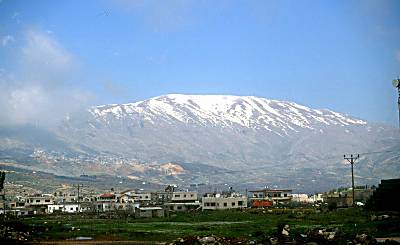
In the same way that Banias is named for Pan, Mt. Hermon is named for Pan's father, Hermes. The mountain straddles the modern Israeli-Syrian border. It rises to a height of over 9000 feet, and in the rainy months of December to March, is often snow-capped. (There is even a ski slope there now!) Only on a clear day---unusual during the winter---can you see it from the city of Tiberias on the Sea of Galilee (the Kineret). More often the view of it is obliterated even at close range in cold months by haze or mist or dense fog.

The god Hermes was the son of Zeus and Maia. Being best known probably as "the messenger of the gods," perhaps it is not surprising that Hermes' name (Mercury in Roman mythology) came to the English language in the word hermeneutic, which has to do of course with linguistic studies and interpretation and translation, most often associated with biblical exegesis.

However, Hermes was also the conductor of the souls of the dead to Hades, the place in Greek mythology where dead peoples' souls go to wander around in boredom.

Pan---the Greek word for "all"--- was among other things the guardian of thresholds. His job was to frighten you when you reached a threshold in life. That is where we get the word pan-ic! It was his job to panic anyone approaching a threshold, especially that of a cave.

Putting this together, in the Cave of Pan at Caesarea Philippi stands a statue of Pan, guarding the threshold to the cave. This cave is in Mt. Hermon, named for Hermes, the conductor of souls to Hades. The Cave of Pan logically came to be known as the "gateway to Hades." So, if you were to die and you did not get panicked by Pan, your soul would cross the threshold of the cave, and Hermes would take you to Hades from there! That was the mythology of this beautiful, natural setting. Interestingly, Pan was also the god of the pastoral and natural, thus our theological terms pantheism and panentheism. We in the English speaking world also have Pan to thank for pandemonium and pandering.


Josephus, the first century historian, wrote of Banias and the Cave of Pan. He recorded that the depth of the waters in the cave were beyond measure. The waters he wrote of are today called the Banias Spring. They are one of three major sources of the Jordan River. The water no longer comes from within the cave. An earthquake may have caused a cave-in. Instead, the water flows from beneath the rocks and ruins in front of the cave. It flows into the Jordan, then the Sea of Galilee, then the Jordan again, and finally the Dead Sea.

Jesus' time at Caesarea Philippi was in a way a Gethsemane in the north. He had left Herod Antipas' territory. Four reasons for heading north are mentioned in the Gospels. Jesus had just heard of the death of John the Baptist (Matthew 14:9-13); Herod was looking for him (Luke 9:9); the disciples were tired from their missionary journeys (Mark 6:30-31); and the crowds had tried to take him and make him king by force (John 6:15). Any one of these would be reason enough to bug out, but taken together, it is easy to see why Jesus needed time away.

Luke makes it clear that at Banias Jesus was alone in prayer, and the disciples were with him (9:18). It is in the context of problems and pain back in the Galilee, in seclusion and in prayer at this northern pagan city, that Jesus becomes circumspect about things to come. The nature of his ministry/messiahship are in focus again, as they were in the temptations in the Judean wilderness. In the story of Peter's confession and in the temptations of Jesus, Satan makes an appearance, and both are times of struggle and loneliness.

After Jesus told them he would go back to Jerusalem to die, and after he and Peter had "the screaming match at Caesarea Philippi" (Mark 8:31-33), Jesus stayed six days longer there (Mark 9:2). Six days longer. We have no way of knowing what went on that week. But in light of Jesus' revelation of suffering and death, there was probably not a lot of rest and relaxation.

After six days (Luke says eight), he took his "inner circle" with him up to a high mountain apart (Mark 9:2) by themselves (Matthew 17:1) to pray (Luke 9:28). Obviously the only high mountain in the vicinity is Har Hermon. (Mt. Tabor then is certainly a traditional site for pilgrims.) There he takes on an unearthly appearance, and he is visited by Moses and Elijah. The prophet of Mt. Sinai and the prophet of Mt. Carmel meet Jesus on Mt. Hermon. The servant of Yahweh who stood down Pharaoh, and the servant of God who stood down 450 prophets of Baal, spoke with Jesus concerning his upcoming confrontation with the Judean authorities on Zion, on Moriah, and on Calvary (Luke 9:31).


Moses and Elijah turned to leave, so Peter and company proposed booth construction, and immediately one of those thick mists rolled in. The voice proclaimed essentially what it had proclaimed at Jesus baptism (Matthew 3:17 and 17:5). It is interesting how the baptism and temptations are joined, and how the scene at Banias and Hermon are joined. At the southernmost point of the Jordan River, affirmation of God's voice led to struggle in the Judean wilderness (Mark 1:11-12). Conversely, at the Banias Spring (the northern headwaters of the Jordan River), struggle led to the affirmation of God's voice on Hermon. We have come full circle in the fullness of time, for the baptism and temptations mark the beginning of Jesus' Galilean ministry (at the end of the river), while the prediction and transfiguration mark the end (at the beginning of the river). After the events in the north, Luke says, he set his face toward Jerusalem (9:51). Mark says he began striding ahead of them, and the disciples were amazed and afraid (10:32).

Five coincidences? Is it a coincidence that it is on Hermon, named for the messenger god, that Jesus got the message from Moses and Elijah that steeled his nerve and sent him on his way, and three disciples got the message, from the highest source, of who Jesus was and that they should "listen" to him? Is it a coincidence that as Jesus stood at the threshold of his own fate, he struggled and hesitated six days before the Temple of Pan, the god of panic and thresholds? Is it a coincidence in Matthew, that in the vicinity of that cave known as the gateway to Hades, Jesus gave the keys to the kingdom to Peter, proclaiming that the gates of hell would not prevail against it? Is it a coincidence that Jesus would ponder his own death at "the gateway to Hades," a cavern yawning before him like a tomb? And is it a coincidence that during the reign of Tiberias, Pan was not the only "god" to have died, but in fact God incarnate, Jesus Christ, also died, and he is proclaimed by the Church as the living and eternal Lord of Pan/All?


Friday, January 23, 2009

Hell Defined 1

? ? ? ? ? ? ? ? ? ? ? ? ? ? ? ? ? 
© 2009 by Bert Gary adapted from Appendix B in “Heaven forSkeptics” due out this year


What is meant by Sheol, Hades, Gehenna, and Tartarus, four biblical words sometimes translated as “hell” in the Bible? Answering this question is the aim of this blog.


But that question raises another. Is our English word “hell”congruent with these biblical terms? Let me show that the answer to that question is a resounding No.

Hell is Indo-European with Teutonic roots. It was helan in Saxon, and shortened to hel. It meant to hide, cover, or conceal, or as a noun it meant the invisible place. (Encarta World English Dictionary, ISBE Bible Dictionary, and Easton’s Bible Dictionary) It originally referred to the world of the dead generally, but today it’s used almost exclusively to refer to an afterlife place of torment. In our culture and throughout much of the world, hell is where the lost, evildoers, unrepentant, or “unsaved” go after death to be punished forever. It’s usually viewed as an underground place of fiery torture.

There are four biblical words that are sometimes translated into English as hell: Sheol, Hades, Gehenna, and Tartarus (or Tartaroo). But our present-day English definition of hell has little in common with biblical Sheol, Hades, Gehenna, and Tartarus. Yes, a few English versions of the Bible translate these four biblical terms as “hell,” but that doesn’t make it right. Let me put it like this: You can call a sheep a cow, but that’s not going to make it moo. Likewise, you can call Sheol, Hades, Gehenna, and Tartarus “hell,” but that doesn’t make them afterlife places of punishment. I’m giving you the conclusion up front. Translating any of these as “hell” makes no sense.


Sheol


Strange, but the word for the grave—sheol—seems to have originally meant to make hollow, then evolved to mean something like forever hollow (which can mean forever hungry), then took the meaning of to demand, and finally came to mean insatiable.

Sheol is a Hebrew word found only in the Old Testament. [שְׁאוֹל she'owl or שְׁאל sheol {pronounced sheh-ole'}] Here is a great example of biblical Sheol:


NET Proverbs 30:15-16 There are three things that are never satisfied, four that never say,"Enough" -- 16the grave (sheol), the barren womb, land that is not satisfied with water, and fire that never says, "Enough!"


See how the word has evolved again? Sheol, that which is hollow, hungry, demanding, and insatiable, became a biblical nickname for the grave. The poetic genius who wrote Proverbs 30:16 endowed the grave with poetic qualities. The grave (Sheol) is like the utter poverty of a barren womb.It’s like the starkness and sterility of a land without water. It’s like afire forever insatiable for fuel. Obviously Sheol, the Old Testament grave, is not literally a barren womb, or a waterless land, or an insatiable fire. Yet, neither is it a literal afterlife place. To the Hebrew poet, to die meant to be buried, Amen. And he pictured the grave (Sheol) as being like these things: a barren womb, a desolate land, and a ravenous flame. He’s conveying how the grave feels to his inspired imagination.


What do you see in your mind’s eye when you read that the earth/ground eats and never gets full? Insatiable.A word that originally had nothing to do with death and the grave—sheol—became at some point in the history of the Hebrew people a synonym for death and the insatiable grave. The tomb is the earth’s mouth, and the grave is the earth’s stomach, eating and swallowing men generation after generation yet never ceasing to be hungry.


To translate Sheol as hell,therefore, is more than misleading; it’s flat wrong. Our English word hell is defined as an afterlife place of punishment. Old Testament Sheol is no such thing. Biblical Sheol never meant the afterlife place of punishment. Any verse in which Sheol is translated as hell does not sound right. But if you translate Sheol as the grave, it always sounds right. For example:


Job 21:13 They spend their days in prosperity, and in peace they go down to Sheol.


 Substitute hell for Sheol and this reads “. . . and in peace they go down to hell.” How can you go to hell in peace? It doesn’t make sense. Now translate Sheol as the grave. “. . . and in peace they go down to the grave.” Now it makes sense. And it works that way every time.


I examined every instance of the word Sheol in the Old Testament, just to see for myself. I found no references to Sheol as an afterlife place in the Bible. None. They do not exist. I found that, in every case, Sheol is a poetic nickname for the grave (or sometimes death).

(Biblical verses that contain Sheol: Gen. 37:35; 42:38; 44:29, 31; Num.16:30, 33; Deut. 32:22; 1 Sam. 2:6; 2 Sam. 22:6; 1 Kgs 2:6, 9; Job 7:9; 11:8;14:13; 17:13, 16; 21:13; 24:19; 26:6; Psa. 6:5; 9:17; 16:10; 18:5; 30:3; 31:17;49:14f; 55:15; 86:13; 88:3; 89:48; 116:3; 139:8; 141:7; Prov. 1:12; 5:5; 7:27;9:18; 15:11, 24; 23:14; 27:20; 30:16; Eccl. 9:10; Song 8:6; Isa. 5:14; 14:9,11, 15; 28:15, 18; 38:10, 18; 57:9; Ezek. 31:15ff; 32:21, 27; Hos. 13:14; Amos9:2; Jonah 2:2; Hab. 2:5)


The Hebrew word Sheol occurs sixty-five times in the Bible. All occurrences are in the Old Testament. The Psalms employ the word more than other books of the Bible with fifteen occurrences, followed by Isaiah (ten), Proverbs (nine), and Job (eight). There’s no space here to cover them all, yet covering them all is unnecessary since all references to Sheol mean death or the grave. Nevertheless, here’s one more example.


The patriarch Jacob uses the word Sheol a few times to express his worry that he will go to his grave (Sheol - the ever-hungry earth) mourning the loss of another son. He survived the loss of Joseph (though Joseph wasn’t really dead). But he doesn’t think he can survive the loss of Benjamin too. He’s saying that he will die brokenhearted:


Genesis 42:38  But he (Jacob) said, "My son (Benjamin) shall not go down with you (to Egypt), for his brother (Joseph) is dead, and he alone is left. If harm should come to him on the journey that you are to make, you would bring down my gray hairs with sorrow to Sheol.”


Can you translate Sheol as hell here? Bizarrely the DRA does (Douay-Rheims American Edition). But how can Sheol be hell? Is Sheol an afterlife place of eternal punishment of wicked souls? If so, then the soul of the biblical hero and patriarch Jacob is in hell’s eternal torments. This doesn’t make sense. Look at the context of his words, always a good idea.

To bring down Jacob’s “gray hairs with sorrow to Sheol” means, Even if I die advanced in years,you will bury me grieving for Benjamin. He’s saying the death of Benjamin will result in his grieving for the rest of his life. Moreover, Jacob may be implying that he believes he will die of grief if he loses Benjamin. He may even be saying to his sons that by taking Benjamin with them to Egypt,they risk killing their father with grief. Therefore, I see no justification for reading into Jacob’s use of the word Sheol anything other than what he meant: his grave.


Hades


No discussion of Hades would be complete without a look at the ancient Greek’s use of the term. After all, that’s where the word comes from.

Hades was the god of the dead in the mythology of ancient Greece. He was Zeus’ brother, and he was the son of Kronus and Rhea. Hades was given the helmet of invisibility (Hades means “the invisible.”) for aid in a great war with the Titans; the brothers Zeus, Poseidon, and Hades were victorious. Hades’ afterlife realm is named after him, making the god Hades the lord of Hades.

Hades (the underworld) wasn’t a place of fiery torture in Greek mythology.“Punishment for wrongdoing in the old Greek stories . . . was not generally an after-death affair.” (Turner, 28) Hades was just insufferably drab.

What about biblical Hades? As Sheol is strictly an Old Testament word, Hades belongs exclusively to the New Testament. Unlike the word Sheol, however, which appears sixty-five times in the Bible, the term Hades {pronounced hah'-dace} is quite rare. It occurs only ten times.


Most English translations simply keep the word as Hades. For example, look at how our twenty-two English versions of the Bible handle Hades in Revelation 20:14:

NAS Revelation 20:14  And death and Hades were thrown into the lake of fire. This is the second death, the lake of fire. (bold italics mine)

Hades 12 (ASV, DBY, ESV, NAB, NAS, NET, NIV, NJB, NKJ, NRS,RSV, YLT)
hell 8 (BBE, DRA, GNV, KJV, PNT, RWB, TNT, WEB)
the grave 2 (MRD, NLT)


Hades is the correct rendering. The grave works too. In the New Testament, Hades equals the grave. It’s the New Testament’s equivalent of Sheol. But, translating it hell doesn’t work—though eight English versions think so—because the English word hell has afterlife connotation. You can see why it doesn’t work in the verse we just examined. Let’s look at it.

In 20:14 above, John envisions Death and Hades being thrown into the lake of fire. (See my blog, The Lake of Fired Defined.) So Hades definitely doesn’t equal the lake of fire. Why? Because Hades is thrown with Death into the lake. If Hades equals the lake, how can you throw something into itself? Likewise, if Hades and the lake of fire equal our modern concept of hell, how can hell be thrown into hell? Therefore Hades can mean nothing more here than the grave.

That’s what John saw in his vision: Death and the Grave being annihilated. John the Revelator is a master of Old Testament images. He knows that Death and the Grave are paired throughout Hebrew Scripture. Following suit, John pairs Thanatos (Death) and Hades (The Grave) repeatedly. (Revelation 1:18, 6:8, 20:13, 20:14) By rising from the dead, Jesus defeated Death and the Grave, says John. But John doesn’t say it straight out like that. He says it visually. The slain yet standing Lamb of God defeated the dragon and his beasts, and the Lamb’s resurrection defeated Thanatos and Hades (Death and the Grave).

In six of the ten occurrences of Hades, the New Testament writers obviously mean nothing more than “the grave,” the equivalent of Sheol in the Old Testament: Acts 2:27, 2:31; Revelation 1:18, 6:8, 20:13,20:14. Substitute “The Grave” for Hades all six verses and they make perfect sense. The other four aren’t quite as easy, yet they’re fun:

1. and 2. In these parallel verses from Matthew (11:23) and Luke (10:15), Jesus is talking about the people in the town of Capernaum.

NAS Matthew 11:23 "And you, Capernaum, will not be exalted to heaven, will you? You shall descend to Hades; for if the miracles had occurred in Sodom which occurred in you, it would have remained to this day.” (bold italics mine)

NAS Luke 10:15 "And you, Capernaum, will not be exalted to heaven, will you? You will be brought down to Hades! (bold italics mine)


Contrary to popular opinion, Jesus is not sending all the inhabitants of Capernaum to hell—an underground afterlife place where you get tortured forever. Yes, Jesus mentions heaven and Hades in these verses. But try reading without wearing your afterlife glasses. The phrase “exalted to heaven” means that Capernaum will not be remembered with high praises to the sky, will not be remembered with fame and applause. The phrase “you shall descend to Hades” or“you will be brought down to Hades” means Capernaum will be debased, laid as low as in Sheol or Hades, symbolizing the gravest possible dishonor. Jesus is not damning the town or the people in the town.They’ve damned themselves. He’s diagnosing them, and the prognosis is grim. The town will die and become a ruin. Jesus is saying that Capernaum will not be celebrated for Jesus living there (Did you remember that Jesus lived in Capernaum? See Matthew 4:13 and 9:1, and Mark 2:1.), but will be remembered for their failure to respond to his ministry, though he did more works of power there than elsewhere. (Luke 4:23) Capernaum’s failure was so grave, Jesus says, that the evil town of Sodom (Genesis 18 and 19) would have responded better than they did.

3. In Matthew 16:18, Jesus is merely saying that death or the grave will have no power over his followers.

NAS Matthew 16:18  "And I also say to you that you are Peter,and upon this rock I will build My church; and the gates of Hades shall not overpower it.” (bold italics mine)

 He speaks of the “gates of Hades” (death’s door) while standing before a cave in Caesarea Philippi that was known by the pagans there as the “Gates of Hades.” This is another example of Jesus using everyday sights around him, of his love of parabolic meaning,and of his poetic genius. He’s saying that the subjects in his kingdom will never die.

(For more on the “gates of Hades” in the New Testament see my blog, Five Coincidence?)

4. In Luke 16:19-31, Jesus tells a parable about the failure to love your neighbor. In it he introduces a playful contradiction: torment in Hades.

NAS Luke 16:23  "And in Hades he (the rich man) lifted up his eyes, being in torment, and saw Abraham far away, and Lazarus in his bosom.“(bold italics mine)

 (See my blog, The Lazarus Parable Is Not About the Afterlife.)

Here Jesus means Hades as both the grave and the Greek pagan afterlife. As mentioned previously, the dead in mythological Hades are not unhappy because they’re in torment; they’re unhappy because they’re dead! In Greek mythology, life is infinitely better than the afterlife. The twist in Jesus’ parable is that Jesus puts tormenting flames in Greek Hades. (He always used the word Gehenna when he means fire or torment, except in this lively parable.) And the rich man in the parable, though whining about being in torment, isn’t so uncomfortable that he can’t carry on a lucid yet somewhat silly conversation with Abraham who is on the other side of a canyon. But remember, this is a parable. It’s not to betaken literally. It’s a made-up story illustrating the effects of greed here and now. It’s a call instead to love here and now.

The Greek authors of the New Testament didn’t pick the term Hades because it was a mythological afterlife place from ancient Greece. Look at the languages involved. Forget English and the word hell for a moment. If you were translating the Hebrew word Sheol into the Greek language for use in the New Testament, what Greek word would you pick? (Remember sheol means death or the grave.) The New Testament personalities picked the term Hades (a mere ten times) not because of its pagan afterlife connotation, but in spite of it. Why? They had little choice. There wasn’t another word than Hades that had Sheol’s connotations of death, burial, hollow or hidden place, place of the dead, death, or the grave.

We impose our inherited, unbiblical English word “hell”on the unsuspecting Hebrew and Greek words in the Bible. Our definition of hell today cannot rightly be forced on the terms Sheol and Hades, yet that is precisely what is being done.


A discussion of Gehenna and Tartaroo are next in Hell Defined 2.


The Lake of Fire Defined

Includes excerpts from Chapter 9 of “Heaven for Skeptics © 2009 by Bert Gary for FaithWalk Publishing


In John’s vision in the Book of Revelation he mentions six times a “lake of fire.” So what is it? Here are five of them.

Revelation 19:20b   These two (the beast and the false prophet) were thrown alive into the lake of fire that burns with sulfur.

Revelation 20:10 And the devil who had deceived them was thrown into the lake of fire and sulfur, where the beast and the false prophet were,and they will be tormented day and night forever and ever.

Revelation 20:14 Then Death and Hades were thrown into the lake of fire. This is the second death, the lake of fire;

Revelation 20:15  and anyone whose name was not found written in the book of life was thrown into the lake of fire.

Revelation 21:8 But as for the cowardly, the faithless, the polluted, the murderers, the fornicators, the sorcerers, the idolaters, and all liars, their place will be in the lake that burns with fire and sulfur, which is the second death."

I can’t interpret John’s entire revelation in one blog.That’s why I wrote a chapter doing that in an upcoming book, and that’s why I’ve begun a commentary on it that I hope to publish next. But I can try to give insight into John’s purpose while I try to define the lake.

If the lake of fire is a portrait of an afterlife hell (See my blogs Hell Defined 1 and Hell Defined 2) as some insist, then note that “hell” is in heaven. “Hell” is not separated from God underground somewhere, but is in the throne room in front of the Lamb, under his all-seeing seven eyes, subject to his all-powerful seven horns.

Revelation 14:10b   “. . . and they will be tormented with fire and sulfur in the presence of the holy angels and in the presence of the Lamb.” (emphasis mine)

I want to make sure you see this. In the five verses that mention the lake of fire above, they speak of torment in fire and sulfur. In 14:10b (immediately above), this torment with fire and sulfur is in the presence of the lamb and the holy angels. This is a clear reference to the lake of fire, and the lake is in the presence of the lamb and the angels. Where are the lamb and the angels in John's vision? They are in the throne room of God in heaven. This vision of the throne room of God is in Chapter 4, and before the throne is a "crystal sea."


               Revelation 4:6   and in front of the throne there is something like a sea of glass, like crystal.

The sea of glass like crystal can't be the lake of fire, can it? Oh yes it can.

               Revelation 15:2   And I saw what appeared to be a sea of glass mixed with fire, and those who had conquered the beast and its image and the number of its name, standing beside the sea of glass with harps of God in their hands. (emphasis mine)

The the sea of glass mixed with fire (or the lake that burns with fire and sulfur) in the heavenly temple is the mirror image of the earthly "molten sea" in the earthly temple (1 Kings 7:23). This holy fire represents God's glorious purifying love. Our God is a consuming fire (Deut 4:24; Heb 12:29). Jesus' eyes in John's first vision are as a flame of fire. His feet are like bronze hot from the furnace. The angels' feet are like pillars of fire. The seven spirits of God are described as torches. The Spirit of God falls on the disciples at Pentecost as tongues of fire.

[It may not be a coincidence that the Sea of Galilee is also called the Lake of Gennesaret, and the Dead Sea is also called Lake Asphaltites. In John's vision of heaven we apparently have a sea that is also called a lake; the sea of glass is also called the lake of fire.]

So, as I've shown, in John’s vision, the lake is surrounded by angels in heaven.“Hell” isn’t far away from Jesus the Lamb and his Father. It’s in their presence, at the feet of the throne of God and the Lamb:

Revelation 5:6 Then I saw between the throne and the four living creatures and among the elders a Lamb standing as if it had been slaughtered,having seven horns and seven eyes, which are the seven spirits of God sent out into all the earth.

There is no separation. There is no dualism. The kingdom is all in all, as Jesus is all in all (1 Cor 15:28; Eph 1:23). If we just look at the vision as John presents it, it creates lots of problems for literalists, but one of them is quite provocative:“Hell” is up. “Hell” is before the throne of God. “Hell” belongs to the Lamb and the Father. Imagine that!

But John tells us it’s a vision.

Revelation 1:1-2  The revelation of Jesus Christ, which God gave him to show his servants what mus soon take place; he made it known by sending his angel to his servant John,  2who testified to the word of God and to the testimony of Jesus Christ, even to all that he saw.

Revelation 1:10-11   10 I was in the spirit on the Lord's day, and I heard behind me aloud voice like a trumpet  11saying, "Write in a book what you see and send it to the seven churches,to Ephesus, to Smyrna, to Pergamum, to Thyatira, to Sardis, to Philadelphia, and to Laodicea."

John tells us his vision reveals (is a revelation of) Jesus Christ. His vision tells us about Jesus, who he is, what he’s accomplished, and what he purposes for his kingdom. It’s about Jesus, period. It reveals him,though not in gospel stories or doctrinal letters, but in apocalyptic pictures. It is successive, varying images of Jesus. So the reader should look for him.The reader should try to discern what John is telling us about Jesus in figures.

And John tells us not to take his vision literally. He tells us that each image stand for something else. And sometimes he specifically tells us what they mean. For example, the Son of Man stands among seven lampstands holding seven stars in his right hand.These are not literal lampstands and stars. How do I know? Because John says so. In the final verse of chapter one, John, for the first time but not the last, tells his readers what his visionary images represent.

Revelation 1:20   “As for the mystery of the seven stars that you saw in my right hand, and the seven golden lampstands: the seven stars are the angels of the seven churches, and the seven lampstands are the seven churches.”


A well known television evangelist said in a documentary interview, “I do not believe the Book of Revelation is metaphorical. I do not believe it is symbolic. I believe it is literal. For example, I believe there are coming four literal horsemen (He was referencing Revelation 6:1-8.) who represent. . . .” He went on to explain who and what future events he believes that the four horsemen represent. But did he not use the word “represent”? Wouldn’t literal horses and horsemen have to be real, actual horses and horsemen? Isn’t that what “literally” means? The evangelist contradicted himself. He is adamant that the horsemen are literal,yet in the same breath he interprets what they represent. He is interpreting Revelation symbolically while insisting that he’s taking it literally.

How can we possibly take anything in this apocalyptic vision literally when John didn’t? He writes that the seven lampstands and stars are figures. They represent something else. They are symbolic. It’s safe to assume that virtually everything in the Book of Revelation is symbolic unless otherwise noted by John.

This is so important. For example, in Revelation 5 there is a slain lamb standing. It doesn’t take a rocket scientist to figure out that this is not a literal dead lamb standing there with seven eyes and seven horns. That would look pretty ridiculous.


But John isn’t showing us livestock. He is showing us Jesus, the one who was crucified and resurrected,slain and yet standing, dead and yet alive forevermore, all seeing (seven eyes) and all powerful (seven horns).

So if the lamb is Jesus, the red dragon is Satan, the great whore is Rome, and the seven lampstands are John’s churches, then shouldn’t the lake of fire be a symbol of something else too? Yes. John shows us how to interpret his vision. It is,after all, his vision. He says to do it symbolically, not literally.

John’s vision gives us the gospel of Jesus Christ in pictures. Each image symbolizes something unless John tells you otherwise. So if the slaughtered yet living lamb represents Jesus, what does the lake of fire represent? Here’s the key verse (again) for me:

Revelation 20:14 Then Death and Hades were thrown into the lake of fire. This is the second death, the lake of fire;

John is trying to tell us something important. Death (Thanatos) and the Grave (Hades) are destroyed by Jesus’ death and resurrection. The symbol John chooses for Jesus’ destruction of Death and the Grave is a lake of fire. No wonder the fire is before the Lamb. It’s his fire! It’s the Lamb’s holy fire for finally, joyously destroying sin, death, and the grave. These are the holy things he accomplished on earth. Yet in his second coming he will mercifully wrap it up by allowing evil to burn in his eternal grace and love.

Everything in the holy of holies of heaven must, by definition and common sense, be holy. Therefore, the lake of fire (the crystal sea) must be not an evil thing or an evil place, but a holy thing and a holy place.

“The very fires of Hell are the love and joy of God experienced as wrath and torment by the soul that hates the light and its purifying fire.” Peter Kreeft, ". . . Heaven", p. 206

“Though the damned do not love God, God loves them, and this is their torture. The very fires of Hell are the love of God!” Kreeft, p. 234


“Thus Heaven and Hell are the very same objective reality, the only one there is, the only game in town: the fire of God’s love, which is his essential being.” Kreeft, p. 235

You may doubt this, and if so, I understand. Bear with me and look at this verse again.

Revelation 19:20  And the beast was captured, and with it the false prophet who had performed in its presence the signs by which he deceived those who had received the mark of the beast and those who worshiped its image. These two were thrown alive into the lake of fire that burns with sulfur.

John shows us in ever evolving images Jesus’ defeat of the enemy. He beats them with the gospel truth and the blood of his cross. The truth has a mixed response in Jesus’ world, in John’s world, and in the world today. It gladdens some hearts while it hardens others. The gladdened enter Life. The hardened enter death. Rome, with its emperors and emperor cults, will be defeated, John insists, and the blood of martyrs will be avenged by the Word of God who speaks the word of God (Life– John 12:47-50) in truth. With the blood of Jesus and the martyrs as an iron rod, God “beats” his opponents into submission.

Will a literal dragon, a literal beast, and a literal beastly-false-prophet be thrown alive into a literal blazing lake? Of course not. Specifically John was symbolizing the defeat of Satan, Rome/Emperor, and the idolatrous emperor cult. But John also is saying that the evil that Jesus already defeated will in The End be disposed of—period—because evil defeats itself. Evil inevitably self-destructs. But what is it that “tortures” evil in“the lake”? How about this:

The Lamb’s holy fire of love before his throne tortures evil. The Lamb’s mercy burns Satan like the sun burns Dracula! Mercy’s eternal truth is eternal agony for any score-keeping liar, especially religious ones! Don’t you love it?

John writes about a first and second death. Here’s a quick definition. The first death is when you die—meaning medically dead. The second death is for the “beast-worshipers” who reject Life—the Life that Jesus spoke and gave, the Life that he is. For those rejecting Life, it’s standing in the presence of the eternal Life that you won’t have. It’s torture in the lake before the Lamb. But remember, the lake is Jesus’ fire of Life. Don’t go assuming that Jesus (or any Person of the Trinity) is a merciless torturer.Jesus hasn’t changed in John’s vision. He’s still the flaming fire of Life. God is still love. And that love and Life brings great joy to those who desire it. But to Satan, his minions, and the beasts he employs to persecute and kill Christians, the flame of Jesus’ Life and the fire of the Father’s love feels like being burned alive.

The miraculous thing, according to John’s vision, is that the baddies remain in Jesus’ presence. (Everything is in Jesus’ presence.) That’s their punishment! They hang themselves on Jesus’ Life line. They drown themselves in Jesus’ baptism of forgiveness. They cut themselves on his sword of loving truth. Baddies aren’t tortured forever in a literal afterlife lake of fire. They are self-condemned Life-rejecters who writhe in the presence of the one who forgives them and offers them Life. “Hell” too is relational.

Also remember that the Book of Revelation is intensely concerned about the relentless pursuit of the church's Roman persecutors, not to torture them,but to win them over. How many delays did they get? How many warnings?


The invitation to Life is presented to them again and again by myriad means in John’s vision. God died for them. God forgave them. God would not give them up without a fight. If John is right, today, even still, he has not given up. His passion for his lost sheep is boundless.

Remember this too: Jesus nullified the first death for everyone. That battle was over a long time ago. John is telling us with his vision that the Life-embracers see neither the first nor the second death. But Life-rejecters see both. As the first and second resurrections are one, so the first and second deaths are one. There is a huge implication here.

Why are Christians today so preoccupied with the afterlife when Life is the point biblically? Life is a person who is alive forever, say the Scriptures. The Bible emphasizes not a place but a person who is Life. In this sense, evil-bent unbelievers are already participating in the second death, for it’s a spiritual death. In this way the second death,ironically, precedes the first. Here’s an example:

To a would-be disciple who wants to wait until his father’s death to follow Jesus, Jesus says, “Let the dead bury their own dead; but as for you, go and proclaim the kingdom of God.” (Luke 9:60 – For more on the context of this saying, see Jesus Unplugged, Chapter 2, pp. 27-35) You can be biologically alive and spiritually dead. You can live in Gehenna (See my blogs: Hell Defined 1 and Hell Defined 2) before the first death, if you so choose, as this man’s relatives did apparently. On the other hand, however, if you embrace the Life (his kingdom of God/heaven) that you (and all) have been given in him, you bypass both the first and the second death.

John 5:24   “Very truly, I tell you, anyone who hears my word and believes him who sent me has eternal life, and does not come under judgment, but has passed from death to life.”

John 8:51   “Very truly, I tell you, whoever keeps my word (His word is Life – John 12:47-50) will never see death.”

Revelation 2:11   Let anyone who has an ear listen to what the Spirit is saying to the churches. Whoever conquers will not be harmed by the second death.

Revelation 20:6   Blessed and holy are those who share in the first resurrection. Over these the second death has no power,

So what happens to Thanatos (Death) and Hades (the Grave)? John’s envisions them thrown into the Lamb’s holy lake of fire.

Revelation 20:14   Then Death and Hades were thrown into the lake of fire.

I know. It’s hard to stop literalizing and futurizing. We want to find in Revelation 20 the afterlife “hell” we all know and love. (Pardon my sarcasm.) But in 20:14, John envisions Death and Hades being thrown into the lake of fire. So Hades definitely doesn’t equal the lake of fire. It can’t. Why? Because Hades is thrown with Death into the lake. If Hades equals the lake, how can you throw something into itself? Likewise, if Hades and the lake of fire equal our modern concept of hell, how can hell be thrown into hell? Therefore Hades can mean nothing more here than the Grave, as elsewhere throughout the New Testament. (See Ch. 4, p. 143, 169-173; Ch. 5, p. 194, 214; Ch. 6, p. 243) That’s what John saw in his vision: Death and the Grave being annihilated by the lake of fire, the fire of the Lamb’s eternal Life, Jesus’ own fire of Life, his presence as the fire of love. The white-hot fire of Life and love consumes everything that is not Life and love. God is love, and his love is a fire.

NKJ Deuteronomy 4:24 "For the LORD your God is a consuming fire.

What was Peter feeling when he said this to Jesus:

Luke 5:8  “Go away from me, Lord, for I am a sinful man!”

God’s power is in his love, biblically speaking. That love is pure fire. It always and forever burns. Either we surrender to the purifying fire—as painful as its pure truth may be initially—and receive Life, or we cling to our hate and experience his love as something that it is not nor was it ever intended to be: torture. Jesus loves the world. But those who cling to their darkness experience the exposing light of love like Dracula in a tanning bed.

Given that the Lamb did all the work for us, it’s not surprising that some of us resent being bailed out. But the fire of universal love tortures scorekeepers. I suppose each of us has a tendency to want to stand on our own record. Each of us tends to keep a record of our moral achievements, too. We’d rather not be rescued. (I was rescued from drowning once. Believe me, it’s embarrassing.) We’d rather save ourselves. You can try to do that if you like, says John. You can lean on your own record rather than the Lamb’s. Go ahead. Knock yourself out. Count on the record of your “works” (Rev. 20:12-13) to make you righteous. But the Scriptures have a warning for you. The religious road to righteousness is wide and crowded with people striving to get there by their own merit. Jesus calls that “the road to destruction.” (Matthew 7:13) But—I might add by way of warning—the foundation of all religious fervor is arrogant denial. Your pride says you can make yourself good. Your pride keeps score and thinks you’re better than others. But there’s The Liar’s trap. You can’t make yourself good. Ever. But fear not. You are made righteous by the Lamb or not at all, says John (and the rest of the New Testament). That’s true of everybody else too, whether you approve or not. Letting go and leaning on the Lamb’s gift of righteousness is not merely a viable option, says John. It’s the only option, if you want Life real and free.

John warns and laments in Revelation 21:8, as he did over the tragic fall of Rome (14:8; 18:2), that those who continue in cowardice, faithlessness, pollution, murder,fornication, sorcery, idolatry, and lies, says the voice from the throne, will have rejected Life. They will experience the Lamb’s fire of mercy as judgment.They will choose for themselves the first and second deaths that those who lean entirely on the mercy of the Lamb will never see. Yet notice the tense that the voice uses: “their place will be in the lake.” Even to the end, even now, the door is open from heaven’s end to all of us. Because the warning still stands, then the possibility of entering Life still stands, even in the last portrait in the last gallery of John’s magnificent vision of Christ. The Lamb fights to The End for his sheep.

Matthew 18:14   So it is not the will of your Father in heaven that one of these little ones should be lost.

So what happens in The End? Death (Thanatos) is swallowed up in victory by the Lamb’s lake of fire. The Grave (Hades) is annihilated in his Life-flame. The sea of chaos from whence all evil comes is no more. And Satan and his buddies writhe together in the flames of the love-wrath of the Lamb.

The implications of God Emanuel are huge, aren’t they? Can you imagine not having to watch your back anymore? Can you imagine an end to spiritual warfare? “No evil” means no evil intentions remain. No grief, sorrow, or pain of any kind means no more tears (compare 7:17 to 21:4—The End) It’s all over, again and finally. But don’t try to relegate this victory to the future only. Jesus did all this already. The Lamb is victorious. His yoke is easy now. One can live unguarded now. Spiritual victory is won now. Eternal Life is present and given now. Living water is available now. Spirit and truth are at work now. New Birth is present now. The Apostle Paul agrees: Newness of life is available now (Romans 6:4), and the new creation is being born now (Romans 8:19-23). We died, rose, and ascended with him now (Romans 6:4; Ephesians 2:6; Colossians 3:1). Death’s sting is gone now (1 Corinthians 15:55). We are in the birth pangs of the new heaven and new earth now.


So the symbols John uses, like the river of Life and the tree of Life and the lake of fire, are not literal descriptions of places or things. They are images of Jesus the Lamb, Jesus the Resurrection, Jesus the Way, Jesus the Truth, Jesus the Life. He is the sun and moon, the bright and morning star, the lamp, the Faithful and True Rider, the radiant Son of Man, and together with God the Father he is the Temple in the New Jerusalem. And the New Jerusalem is the Lamb’s Bride representing his church. Jesus is our husband and our home. He is the ever-burning fire of love. He is the personal and present and coming kingdom of heaven.