Showing posts with label emperor cult. Show all posts

Saturday, November 5, 2011

666


Six hundred and sixty-six might be the most famous and misunderstood number ever written. For us to understand its true meaning, we need to explore the practice of gematria.


The letters of the alphabet in the ancient Hebrew and Greek are assigned numerical equivalents. The letters of a person’s name, for example, can be added up to yield a number. On a wall excavated in ancient Pompeii, a city frozen in time by the hot ash of Mt. Vesuvius’ deadly eruption in A.D. 79, a graffiti reads: “I love the girl whose name is phi mu epsilon (a sum of 545 in Greek).”


Jesus’ name has a numerical value in Greek gematria too:

Jesus = IhsouV = 10+8+200+70+400+200 = 888


The Greek letters of Caesar Nero (Neron Kaiser) when transliterated in Hebrew letters adds up to 666.

 666  =  Nun + Resh + Vav + Nun + Kuf + Samekh + Resh
              50        200        6        50      100          60          200

All of the excellent commentaries that I’ve read on Revelation agree. Multiple possibilities for 666 are explored, but they all lean toward the “Nero Caesar” interpretation as the best. But Nero was long dead when John wrote his apocalypse. That’s where Revelation 13:3 comes in.

Revelation 13:3 One of its heads seemed to have received a death-blow, but its mortal wound had been healed. In amazement the whole earth followed the beast.

Nero (pictured) was a persecutor of Jews and Christians. He committed suicide in A.D. 68. The Emperor Domitian (ruled A.D. 81-96), who was given the nickname “The Beast” by Romans, Greeks, Christians and Jews, enforced the emperor worship initiated by Nero.

The emperor cult in Ephesus was set up by Domitian in A.D. 89, and this may be the crucial event that sparked a Christian reaction. How could Christians (who say that Jesus is Lord) go to the Temple of Domitian and worship him as lord? And note this. Many saw Domitian as a reincarnation of Nero, i.e. the beast “whose mortal wound had been healed.” (Revelation 13:12)

Domitian was called “the bald Nero” because of his, well, baldness, and because of the persistent rumor that he was Nero returned. (Domitian is not bald in paintings and statues because he decreed that any artist who portrayed him as bald would be killed.) This false “resurrection” of the mortally wounded Nero-666-beast in the person of Domitian was a lying mockery of the resurrected Jesus who is envisioned by John as “a Lamb standing as if it had been slaughtered.” (Revelation 5:6) If under Domitian’s rule John was arrested and imprisoned, you can imagine that the Ephesian church (and the other six churches as well) had no warm feelings for their falsely resurrected, God-pretending, beastly emperor.

What is the mark of the beast on the hand and forehead all about? Here’s the quote:
Revelation 13:16-17   Also it causes all, both small and great, both rich and poor, both free and slave, to be marked on the right hand or the forehead,  17 so that no one can buy or sell who does not have the mark, that is, the name of the beast or the number of its name. (see also Revelation 14:9-11, 16:2, 19:20, 20:4)

This quote claims that you can’t buy and sell anything without the “mark of the beast” on your hand or your forehead. We can forget all the wild, futuristic speculations about this and just do a little bit of history.

The formula "our Lord and God,” as we learn from the imperial biographies of Suetonius, was introduced by Domitian into the cult of emperor worship as an expression of homage. He mandated that his procurators should introduce the formula, "our Lord and God commands," into all official documents. As a result, it became the custom to address Domitian as Dominus ac Deus noster (our Lord and God). (MOUNCE, Revelation, 140, writes on Rev 4,11, "our Lord and God" was introduced  into the cult of emperor worship by Domitian’. LILJE, Last Book of the Bible, 108-109.)


Here’s the actual Suetonius quote:


“With no less arrogance he began as follows in dictating a circular letter in the name of his procurators, "Our Master (Lord) and our God bids that this be done." And so the custom arose of henceforth addressing him in no other way, even in writing or in conversation.” (Suetonius: De Vita Caesarum—Domitianus, c. 110 A.D., XIII)


The equivalent of Dominus (Master) in Latin is Kyrios (Lord) in Greek.


Most emperors, if not all, were deified beginning with Julius Caesar. But the title “lord and god” is associated only with Domitian. This association is perhaps the main reason that the Book of Revelation is dated to Domitian’s reign. John used that exact phrase to refer not to the Nero/Domitian/Emperor Cult/666 beast, but to God:


Revelation 4:11   "You are worthy, our Lord and God, to receive glory and honor and power, for you created all things, and by your will they existed and were created." (italics mine)

Moreover, Revelation 4:11 is the only place in the entire Bible that the phrases “lord and god” or “our lord and god” occurs.


o` ku,rioj kai. o` qeo.j h`mw/n
the lord and the god of us

This is beyond coincidence and firmly dates the Book of Revelation to Domitian’s reign. It also clarifies John’s concerns.


For obvious reasons John is concerned about the emperor, his idolatrous cult, his idolatrous title, and his idolatrous image in temples and on currency. Domitian’s massive head and arm (pictured from the Selçuk museum) are all that remain of the colossal, 18-meter statue of him that the citizens of Ephesus were required to worshiped. This photo shows what is left of the very “image of the beast” in Revelation 13:15. It stood in a temple here:


Above these arches in the photo (top) on the grassy terrace is where the temple dedicated to the worship of  Domitian once stood in ancient Ephesus, shown in an artist's reconstruction (bottom). Ephesus was a city where the early Christians were under pressure to worship a statue and call it “lord and god.”

Question. Would you as an Ephesian Christian go as was required by law to Domitian’s Temple on the commercial agora and bow to a statue of the emperor saying, “Our lord and our god”?


Question: How would you feel as an Ephesian Christian about the image of Domitian or other emperors on your money (pictured)? How would you feel about the Roman coinage bearing the title Divus Filius (Son of God)? Would you carry and spend money bearing Caesar’s graven image and blasphemous titles? If a coin has Domitian’s image on it, would you save it, spend it, or exchange it for another currency?


Question: If you were a Christian woman in Ephesus, and if you owned a chain of coins to be worn on your forehead, and if those coins had the image of Domitian or other emperors on it, would you wear it? Jesus told a parable about such a woman who lost a coin:

“Or what woman having ten silver coins, if she loses one of them, does not light a lamp, sweep the house, and search carefully until she finds it?  9 When she has found it, she calls together her friends and neighbors, saying, 'Rejoice with me, for I have found the coin that I had lost.’” (Luke 15:8-9)


But it wasn’t just a single lonely coin. Look at the parable. Jesus specifically says it’s one of ten. Why would she be so concerned and so relentless in her search if the coin were not a part of a set of ten, probably meaning ten coins on a chain. Alone a single coin would have been of little value to her, since she had plenty more. But they are considered by her a set. It’s the nine that are of little value to her unless she finds the one of great value that completes the set. The set was likely a dowry or bride price, thus it’s worn in public as the approximation of a wedding ring in our culture. If Domitian put your pastor in jail, and if Domitian persecuted your church, and if Domitian was determined to make you worship him as lord and god, would you wear “the beast” and his blasphemous names on the center of your forehead?


Question: If you were a Jewish Christian man in Ephesus, and if you, in literal obedience to selected texts from Exodus and Deuteronomy (below), wore as required (for women it’s optional) by oral tradition phylacteries or tefillin (photo below)—boxes with the same select verses enclosed—strapped to your forehead and hand when you prayed, then would you put the beast’s image in your hand (a Roman coin), or in the case you are a woman, on your forehead? Here are those texts, one of them the famous “Shama”:


Exodus 13:9   It shall serve for you as a sign (mark) on your hand and as a reminder (mark) on your forehead, so that the teaching of the LORD may be on your lips . . . (italics mine)

Exodus 13:16   It shall serve as a sign (mark) on your hand and as an emblem (mark) on your forehead . . ." (italics mine)

Deuteronomy 6:4-8   Hear (shama), O Israel: The LORD is our God, the LORD alone. 5 You shall love the LORD your God with all your heart, and with all your soul, and with all your might.  6 Keep these words that I am commanding you today in your heart.  7 Recite them to your children and talk about them when you are at home and when you are away, when you lie down and when you rise.  8 Bind them as a sign (mark) on your hand, fix them as an emblem (mark) on your forehead, (italics mine)

Deuteronomy 11:18   You shall put these words of mine in your heart and soul, and you shall bind them as a sign (mark) on your hand, and fix them as an emblem (mark) on your forehead. (italics mine)


How do we know that phylacteries (or tefillin) were worn by Hebrews in the days of Jesus and Paul? Fragments have been found by archaeologists. (pictured – fragments found at Qumran dated to the 1st Century B.C.) Jesus’ words recorded in Scripture also confirm the use of phylacteries in his day.

Matthew 23:5    “[The scribes and Pharisees] do all their deeds to be seen by others; for they make their phylacteries broad and their fringes long.” (italics mine)

Now, do 1st Century phylacteries and coins shed light for you on John’s symbolic marks on the forehead or the hand? I wonder if John is calling on the Christians of western Asia Minor to avoid using Roman currency so that they don’t participate in any practice that might support the 666-beast and his boss, the dragon. Makes sense to me. Many other currencies were available. Is John using coded language to instruct his churches not to replace the scriptures on their forehead and hand with the image and name of the beast on coins—coins that can be worn on the forehead or must be carried in the hand in order to shop and spend? I think so.

I suppose it’s possible that John, writing to 1st Century Christians in Asia Minor, could be prophesying the use of modern supermarket bar codes or electronic surgical biochip implants in your head or hand, as some modern biblical literalists insist. But which sounds crazier to you, that John would be warning his own church members about participating in Roman idolatry or that John would be warning 21st Century Americans about shopping at Wal-Mart?

In Revelation 13, the first beast from the sea then is the imperial power of Rome, the Roman Emperors themselves, specifically Nero “reincarnated” as Domitian. The second beast from the earth (called “the false prophet” in Revelation 16:13, 19:20, and 20:10) then is the Commune Asiae (made up of civic representatives from each city) who managed and enforced Domitian’s emperor cult. (Caird, p. 171) The Commune even used tricks like ventriloquism to make the emperors’ images speak (13:15), thus deluding the superstitious pagan citizenry of Ephesus and other Asian cities wherein Christians strove to resist idolatry and endure persecution. I believe John wants us to see his concern for his seven churches. He wants us to see his beloved church members, friends he knows by name, fellow Christians forced to Domitian’s Temple, compelled to face Domitian’s statue, and pressured to call it “Lord and God.” They are face to face with the beast of idolatry.

A POSTSCRIPT ON “THE ANTICHRIST” – There is no justification for equating Revelation’s 666-beast with the antichrist. Why? There are two simple reasons.

First, the term antichrist does not appear in the Book of Revelation at all. That’s a surprise to most people. Antichrist is a term not to be found in Revelation. I presume that if John had meant for the 666 beast to be called antichrist, he would have said so, but he didn’t.

Second, the term antichrist is explained fully as something else in the Letters of John. There, antichrists (plural and not capitalized) are clearly church dividers. They are Christian pretenders who left the church because they didn’t believe Jesus came in the flesh. The beast of Revelation, however, is clearly a veiled or coded reference to Domitian as Nero “reborn” or his emperor cult or both. See 1 John 2:18, 2:22, 4:3; and 2 John 1:7, which are the only mentions of antichrist in the Bible. And note, it’s antichrists, plural, not the proper name of an individual. If it were the proper name of an individual, the “a” would be an “A”.

We might fairly say that Domitian, who calls himself god and is not, who was believed by some to be Nero raised from the dead but was not, is an opposite of Christ who was raised and who was God, a photographic negative of Christ, or, if you will, an anti-Christ. This is the only sense in which it is fair to relate the antichrists of the Johannine Epistles and the 666-beast of Revelation.
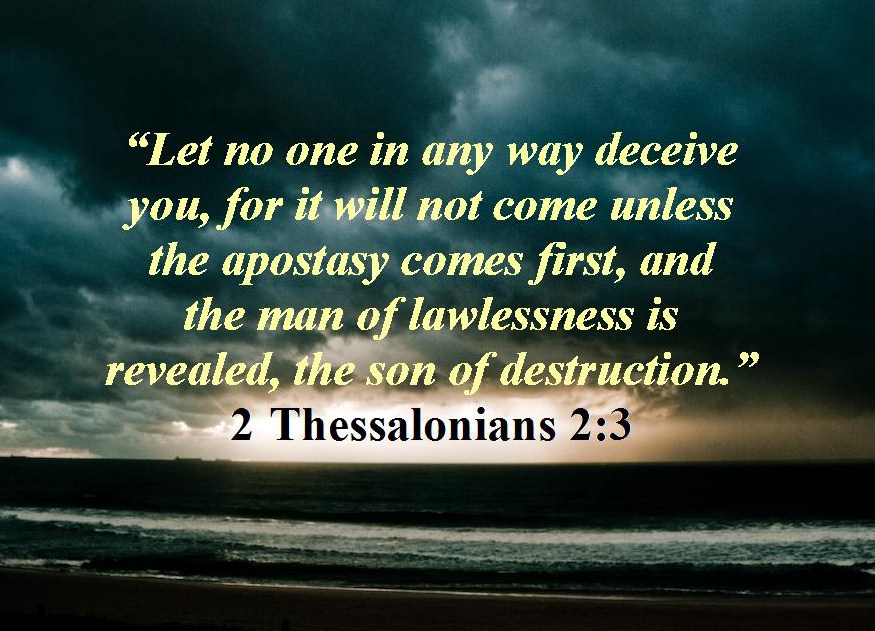
A POSTSCRIPT ON “THE LAWLESS ONE” – A majority of interpreters over the years has also equated the 666-beast with “the lawless one” of 2 Thessalonians 2:3-4:

“Let no one deceive you in any way; for that day will not come unless the rebellion comes first and the lawless one is revealed, the one destined for destruction.  4 He opposes and exalts himself above every so-called god or object of worship, so that he takes his seat in the temple of God, declaring himself to be God.”

The NAB notes are helpful in putting this “lawless one” in a historical context. (What a novel idea!) 2 Thessalonians 2:3-4 offers “a reflection of the language in Daniel 7:23-25; 8:9-12; 9:27; 11:36-37; 12:11 about the attempt of Antiochus IV Epiphanes to set up a statue of Zeus in the Jerusalem temple and possibly of the Roman emperor Caligula to do a similar thing (Mark 13:14). Here the imagery suggests an attempt to install someone in the place of God, claiming that he is a god (Ezekiel 28:2). Usually, it is the Jerusalem temple that is assumed to be meant; on the alternative view . . . . the temple refers to the Christian community.”

Both the Revelation’s 666-beast and 2 Thessalonians’ “lawless one” refer to pagan idolatry and emperor worship. It’s about those who used their power to play god. True, Domitian did that. So have many others. And so will many others. It was a danger to Christians then, and still is today, when a government dictates culture and religion.

Friday, January 23, 2009

The Lake of Fire Defined

Includes excerpts from Chapter 9 of “Heaven for Skeptics © 2009 by Bert Gary for FaithWalk Publishing


In John’s vision in the Book of Revelation he mentions six times a “lake of fire.” So what is it? Here are five of them.

Revelation 19:20b   These two (the beast and the false prophet) were thrown alive into the lake of fire that burns with sulfur.

Revelation 20:10 And the devil who had deceived them was thrown into the lake of fire and sulfur, where the beast and the false prophet were,and they will be tormented day and night forever and ever.

Revelation 20:14 Then Death and Hades were thrown into the lake of fire. This is the second death, the lake of fire;

Revelation 20:15  and anyone whose name was not found written in the book of life was thrown into the lake of fire.

Revelation 21:8 But as for the cowardly, the faithless, the polluted, the murderers, the fornicators, the sorcerers, the idolaters, and all liars, their place will be in the lake that burns with fire and sulfur, which is the second death."

I can’t interpret John’s entire revelation in one blog.That’s why I wrote a chapter doing that in an upcoming book, and that’s why I’ve begun a commentary on it that I hope to publish next. But I can try to give insight into John’s purpose while I try to define the lake.

If the lake of fire is a portrait of an afterlife hell (See my blogs Hell Defined 1 and Hell Defined 2) as some insist, then note that “hell” is in heaven. “Hell” is not separated from God underground somewhere, but is in the throne room in front of the Lamb, under his all-seeing seven eyes, subject to his all-powerful seven horns.

Revelation 14:10b   “. . . and they will be tormented with fire and sulfur in the presence of the holy angels and in the presence of the Lamb.” (emphasis mine)

I want to make sure you see this. In the five verses that mention the lake of fire above, they speak of torment in fire and sulfur. In 14:10b (immediately above), this torment with fire and sulfur is in the presence of the lamb and the holy angels. This is a clear reference to the lake of fire, and the lake is in the presence of the lamb and the angels. Where are the lamb and the angels in John's vision? They are in the throne room of God in heaven. This vision of the throne room of God is in Chapter 4, and before the throne is a "crystal sea."


               Revelation 4:6   and in front of the throne there is something like a sea of glass, like crystal.

The sea of glass like crystal can't be the lake of fire, can it? Oh yes it can.

               Revelation 15:2   And I saw what appeared to be a sea of glass mixed with fire, and those who had conquered the beast and its image and the number of its name, standing beside the sea of glass with harps of God in their hands. (emphasis mine)

The the sea of glass mixed with fire (or the lake that burns with fire and sulfur) in the heavenly temple is the mirror image of the earthly "molten sea" in the earthly temple (1 Kings 7:23). This holy fire represents God's glorious purifying love. Our God is a consuming fire (Deut 4:24; Heb 12:29). Jesus' eyes in John's first vision are as a flame of fire. His feet are like bronze hot from the furnace. The angels' feet are like pillars of fire. The seven spirits of God are described as torches. The Spirit of God falls on the disciples at Pentecost as tongues of fire.

[It may not be a coincidence that the Sea of Galilee is also called the Lake of Gennesaret, and the Dead Sea is also called Lake Asphaltites. In John's vision of heaven we apparently have a sea that is also called a lake; the sea of glass is also called the lake of fire.]

So, as I've shown, in John’s vision, the lake is surrounded by angels in heaven.“Hell” isn’t far away from Jesus the Lamb and his Father. It’s in their presence, at the feet of the throne of God and the Lamb:

Revelation 5:6 Then I saw between the throne and the four living creatures and among the elders a Lamb standing as if it had been slaughtered,having seven horns and seven eyes, which are the seven spirits of God sent out into all the earth.

There is no separation. There is no dualism. The kingdom is all in all, as Jesus is all in all (1 Cor 15:28; Eph 1:23). If we just look at the vision as John presents it, it creates lots of problems for literalists, but one of them is quite provocative:“Hell” is up. “Hell” is before the throne of God. “Hell” belongs to the Lamb and the Father. Imagine that!

But John tells us it’s a vision.

Revelation 1:1-2  The revelation of Jesus Christ, which God gave him to show his servants what mus soon take place; he made it known by sending his angel to his servant John,  2who testified to the word of God and to the testimony of Jesus Christ, even to all that he saw.

Revelation 1:10-11   10 I was in the spirit on the Lord's day, and I heard behind me aloud voice like a trumpet  11saying, "Write in a book what you see and send it to the seven churches,to Ephesus, to Smyrna, to Pergamum, to Thyatira, to Sardis, to Philadelphia, and to Laodicea."

John tells us his vision reveals (is a revelation of) Jesus Christ. His vision tells us about Jesus, who he is, what he’s accomplished, and what he purposes for his kingdom. It’s about Jesus, period. It reveals him,though not in gospel stories or doctrinal letters, but in apocalyptic pictures. It is successive, varying images of Jesus. So the reader should look for him.The reader should try to discern what John is telling us about Jesus in figures.

And John tells us not to take his vision literally. He tells us that each image stand for something else. And sometimes he specifically tells us what they mean. For example, the Son of Man stands among seven lampstands holding seven stars in his right hand.These are not literal lampstands and stars. How do I know? Because John says so. In the final verse of chapter one, John, for the first time but not the last, tells his readers what his visionary images represent.

Revelation 1:20   “As for the mystery of the seven stars that you saw in my right hand, and the seven golden lampstands: the seven stars are the angels of the seven churches, and the seven lampstands are the seven churches.”


A well known television evangelist said in a documentary interview, “I do not believe the Book of Revelation is metaphorical. I do not believe it is symbolic. I believe it is literal. For example, I believe there are coming four literal horsemen (He was referencing Revelation 6:1-8.) who represent. . . .” He went on to explain who and what future events he believes that the four horsemen represent. But did he not use the word “represent”? Wouldn’t literal horses and horsemen have to be real, actual horses and horsemen? Isn’t that what “literally” means? The evangelist contradicted himself. He is adamant that the horsemen are literal,yet in the same breath he interprets what they represent. He is interpreting Revelation symbolically while insisting that he’s taking it literally.

How can we possibly take anything in this apocalyptic vision literally when John didn’t? He writes that the seven lampstands and stars are figures. They represent something else. They are symbolic. It’s safe to assume that virtually everything in the Book of Revelation is symbolic unless otherwise noted by John.

This is so important. For example, in Revelation 5 there is a slain lamb standing. It doesn’t take a rocket scientist to figure out that this is not a literal dead lamb standing there with seven eyes and seven horns. That would look pretty ridiculous.


But John isn’t showing us livestock. He is showing us Jesus, the one who was crucified and resurrected,slain and yet standing, dead and yet alive forevermore, all seeing (seven eyes) and all powerful (seven horns).

So if the lamb is Jesus, the red dragon is Satan, the great whore is Rome, and the seven lampstands are John’s churches, then shouldn’t the lake of fire be a symbol of something else too? Yes. John shows us how to interpret his vision. It is,after all, his vision. He says to do it symbolically, not literally.

John’s vision gives us the gospel of Jesus Christ in pictures. Each image symbolizes something unless John tells you otherwise. So if the slaughtered yet living lamb represents Jesus, what does the lake of fire represent? Here’s the key verse (again) for me:

Revelation 20:14 Then Death and Hades were thrown into the lake of fire. This is the second death, the lake of fire;

John is trying to tell us something important. Death (Thanatos) and the Grave (Hades) are destroyed by Jesus’ death and resurrection. The symbol John chooses for Jesus’ destruction of Death and the Grave is a lake of fire. No wonder the fire is before the Lamb. It’s his fire! It’s the Lamb’s holy fire for finally, joyously destroying sin, death, and the grave. These are the holy things he accomplished on earth. Yet in his second coming he will mercifully wrap it up by allowing evil to burn in his eternal grace and love.

Everything in the holy of holies of heaven must, by definition and common sense, be holy. Therefore, the lake of fire (the crystal sea) must be not an evil thing or an evil place, but a holy thing and a holy place.

“The very fires of Hell are the love and joy of God experienced as wrath and torment by the soul that hates the light and its purifying fire.” Peter Kreeft, ". . . Heaven", p. 206

“Though the damned do not love God, God loves them, and this is their torture. The very fires of Hell are the love of God!” Kreeft, p. 234


“Thus Heaven and Hell are the very same objective reality, the only one there is, the only game in town: the fire of God’s love, which is his essential being.” Kreeft, p. 235

You may doubt this, and if so, I understand. Bear with me and look at this verse again.

Revelation 19:20  And the beast was captured, and with it the false prophet who had performed in its presence the signs by which he deceived those who had received the mark of the beast and those who worshiped its image. These two were thrown alive into the lake of fire that burns with sulfur.

John shows us in ever evolving images Jesus’ defeat of the enemy. He beats them with the gospel truth and the blood of his cross. The truth has a mixed response in Jesus’ world, in John’s world, and in the world today. It gladdens some hearts while it hardens others. The gladdened enter Life. The hardened enter death. Rome, with its emperors and emperor cults, will be defeated, John insists, and the blood of martyrs will be avenged by the Word of God who speaks the word of God (Life– John 12:47-50) in truth. With the blood of Jesus and the martyrs as an iron rod, God “beats” his opponents into submission.

Will a literal dragon, a literal beast, and a literal beastly-false-prophet be thrown alive into a literal blazing lake? Of course not. Specifically John was symbolizing the defeat of Satan, Rome/Emperor, and the idolatrous emperor cult. But John also is saying that the evil that Jesus already defeated will in The End be disposed of—period—because evil defeats itself. Evil inevitably self-destructs. But what is it that “tortures” evil in“the lake”? How about this:

The Lamb’s holy fire of love before his throne tortures evil. The Lamb’s mercy burns Satan like the sun burns Dracula! Mercy’s eternal truth is eternal agony for any score-keeping liar, especially religious ones! Don’t you love it?

John writes about a first and second death. Here’s a quick definition. The first death is when you die—meaning medically dead. The second death is for the “beast-worshipers” who reject Life—the Life that Jesus spoke and gave, the Life that he is. For those rejecting Life, it’s standing in the presence of the eternal Life that you won’t have. It’s torture in the lake before the Lamb. But remember, the lake is Jesus’ fire of Life. Don’t go assuming that Jesus (or any Person of the Trinity) is a merciless torturer.Jesus hasn’t changed in John’s vision. He’s still the flaming fire of Life. God is still love. And that love and Life brings great joy to those who desire it. But to Satan, his minions, and the beasts he employs to persecute and kill Christians, the flame of Jesus’ Life and the fire of the Father’s love feels like being burned alive.

The miraculous thing, according to John’s vision, is that the baddies remain in Jesus’ presence. (Everything is in Jesus’ presence.) That’s their punishment! They hang themselves on Jesus’ Life line. They drown themselves in Jesus’ baptism of forgiveness. They cut themselves on his sword of loving truth. Baddies aren’t tortured forever in a literal afterlife lake of fire. They are self-condemned Life-rejecters who writhe in the presence of the one who forgives them and offers them Life. “Hell” too is relational.

Also remember that the Book of Revelation is intensely concerned about the relentless pursuit of the church's Roman persecutors, not to torture them,but to win them over. How many delays did they get? How many warnings?


The invitation to Life is presented to them again and again by myriad means in John’s vision. God died for them. God forgave them. God would not give them up without a fight. If John is right, today, even still, he has not given up. His passion for his lost sheep is boundless.

Remember this too: Jesus nullified the first death for everyone. That battle was over a long time ago. John is telling us with his vision that the Life-embracers see neither the first nor the second death. But Life-rejecters see both. As the first and second resurrections are one, so the first and second deaths are one. There is a huge implication here.

Why are Christians today so preoccupied with the afterlife when Life is the point biblically? Life is a person who is alive forever, say the Scriptures. The Bible emphasizes not a place but a person who is Life. In this sense, evil-bent unbelievers are already participating in the second death, for it’s a spiritual death. In this way the second death,ironically, precedes the first. Here’s an example:

To a would-be disciple who wants to wait until his father’s death to follow Jesus, Jesus says, “Let the dead bury their own dead; but as for you, go and proclaim the kingdom of God.” (Luke 9:60 – For more on the context of this saying, see Jesus Unplugged, Chapter 2, pp. 27-35) You can be biologically alive and spiritually dead. You can live in Gehenna (See my blogs: Hell Defined 1 and Hell Defined 2) before the first death, if you so choose, as this man’s relatives did apparently. On the other hand, however, if you embrace the Life (his kingdom of God/heaven) that you (and all) have been given in him, you bypass both the first and the second death.

John 5:24   “Very truly, I tell you, anyone who hears my word and believes him who sent me has eternal life, and does not come under judgment, but has passed from death to life.”

John 8:51   “Very truly, I tell you, whoever keeps my word (His word is Life – John 12:47-50) will never see death.”

Revelation 2:11   Let anyone who has an ear listen to what the Spirit is saying to the churches. Whoever conquers will not be harmed by the second death.

Revelation 20:6   Blessed and holy are those who share in the first resurrection. Over these the second death has no power,

So what happens to Thanatos (Death) and Hades (the Grave)? John’s envisions them thrown into the Lamb’s holy lake of fire.

Revelation 20:14   Then Death and Hades were thrown into the lake of fire.

I know. It’s hard to stop literalizing and futurizing. We want to find in Revelation 20 the afterlife “hell” we all know and love. (Pardon my sarcasm.) But in 20:14, John envisions Death and Hades being thrown into the lake of fire. So Hades definitely doesn’t equal the lake of fire. It can’t. Why? Because Hades is thrown with Death into the lake. If Hades equals the lake, how can you throw something into itself? Likewise, if Hades and the lake of fire equal our modern concept of hell, how can hell be thrown into hell? Therefore Hades can mean nothing more here than the Grave, as elsewhere throughout the New Testament. (See Ch. 4, p. 143, 169-173; Ch. 5, p. 194, 214; Ch. 6, p. 243) That’s what John saw in his vision: Death and the Grave being annihilated by the lake of fire, the fire of the Lamb’s eternal Life, Jesus’ own fire of Life, his presence as the fire of love. The white-hot fire of Life and love consumes everything that is not Life and love. God is love, and his love is a fire.

NKJ Deuteronomy 4:24 "For the LORD your God is a consuming fire.

What was Peter feeling when he said this to Jesus:

Luke 5:8  “Go away from me, Lord, for I am a sinful man!”

God’s power is in his love, biblically speaking. That love is pure fire. It always and forever burns. Either we surrender to the purifying fire—as painful as its pure truth may be initially—and receive Life, or we cling to our hate and experience his love as something that it is not nor was it ever intended to be: torture. Jesus loves the world. But those who cling to their darkness experience the exposing light of love like Dracula in a tanning bed.

Given that the Lamb did all the work for us, it’s not surprising that some of us resent being bailed out. But the fire of universal love tortures scorekeepers. I suppose each of us has a tendency to want to stand on our own record. Each of us tends to keep a record of our moral achievements, too. We’d rather not be rescued. (I was rescued from drowning once. Believe me, it’s embarrassing.) We’d rather save ourselves. You can try to do that if you like, says John. You can lean on your own record rather than the Lamb’s. Go ahead. Knock yourself out. Count on the record of your “works” (Rev. 20:12-13) to make you righteous. But the Scriptures have a warning for you. The religious road to righteousness is wide and crowded with people striving to get there by their own merit. Jesus calls that “the road to destruction.” (Matthew 7:13) But—I might add by way of warning—the foundation of all religious fervor is arrogant denial. Your pride says you can make yourself good. Your pride keeps score and thinks you’re better than others. But there’s The Liar’s trap. You can’t make yourself good. Ever. But fear not. You are made righteous by the Lamb or not at all, says John (and the rest of the New Testament). That’s true of everybody else too, whether you approve or not. Letting go and leaning on the Lamb’s gift of righteousness is not merely a viable option, says John. It’s the only option, if you want Life real and free.

John warns and laments in Revelation 21:8, as he did over the tragic fall of Rome (14:8; 18:2), that those who continue in cowardice, faithlessness, pollution, murder,fornication, sorcery, idolatry, and lies, says the voice from the throne, will have rejected Life. They will experience the Lamb’s fire of mercy as judgment.They will choose for themselves the first and second deaths that those who lean entirely on the mercy of the Lamb will never see. Yet notice the tense that the voice uses: “their place will be in the lake.” Even to the end, even now, the door is open from heaven’s end to all of us. Because the warning still stands, then the possibility of entering Life still stands, even in the last portrait in the last gallery of John’s magnificent vision of Christ. The Lamb fights to The End for his sheep.

Matthew 18:14   So it is not the will of your Father in heaven that one of these little ones should be lost.

So what happens in The End? Death (Thanatos) is swallowed up in victory by the Lamb’s lake of fire. The Grave (Hades) is annihilated in his Life-flame. The sea of chaos from whence all evil comes is no more. And Satan and his buddies writhe together in the flames of the love-wrath of the Lamb.

The implications of God Emanuel are huge, aren’t they? Can you imagine not having to watch your back anymore? Can you imagine an end to spiritual warfare? “No evil” means no evil intentions remain. No grief, sorrow, or pain of any kind means no more tears (compare 7:17 to 21:4—The End) It’s all over, again and finally. But don’t try to relegate this victory to the future only. Jesus did all this already. The Lamb is victorious. His yoke is easy now. One can live unguarded now. Spiritual victory is won now. Eternal Life is present and given now. Living water is available now. Spirit and truth are at work now. New Birth is present now. The Apostle Paul agrees: Newness of life is available now (Romans 6:4), and the new creation is being born now (Romans 8:19-23). We died, rose, and ascended with him now (Romans 6:4; Ephesians 2:6; Colossians 3:1). Death’s sting is gone now (1 Corinthians 15:55). We are in the birth pangs of the new heaven and new earth now.


So the symbols John uses, like the river of Life and the tree of Life and the lake of fire, are not literal descriptions of places or things. They are images of Jesus the Lamb, Jesus the Resurrection, Jesus the Way, Jesus the Truth, Jesus the Life. He is the sun and moon, the bright and morning star, the lamp, the Faithful and True Rider, the radiant Son of Man, and together with God the Father he is the Temple in the New Jerusalem. And the New Jerusalem is the Lamb’s Bride representing his church. Jesus is our husband and our home. He is the ever-burning fire of love. He is the personal and present and coming kingdom of heaven.