Showing posts with label heaven. Show all posts

Saturday, September 12, 2009

Paul Didn't Go to Heaven

(painting by El Greco, 1606)

The Apostle Paul is believed by many to have made a round-trip visit to heaven—either bodily or via his soul leaving his body. But did he?
A quick look at Paul’s words in context says otherwise. The subject he is writing about is “visions and revelations.” Those are his words.

Paul complains that the Christians in Corinth are forcing him to boast again:

2 Corinthians 12:1-7 It is necessary to boast; nothing is to be gained by it, but I will go on to visions and revelations of the Lord. 2 I know a person in Christ who fourteen years ago was caught up to the third heaven -- whether in the body or out of the body I do not know; God knows. 3 And I know that such a person -- whether in the body or out of the body I do not know; God knows -- 4 was caught up into Paradise and heard things that are not to be told, that no mortal is permitted to repeat. 5 On behalf of such a one I will boast, but on my own behalf I will not boast, except of my weaknesses. 6 But if I wish to boast, I will not be a fool, for I will be speaking the truth. But I refrain from it, so that no one may think better of me than what is seen in me or heard from me, 7 even considering the exceptional character of the revelations. (emphasis added)

By “third heaven” Paul means God’s abode, which in the ancient world was believed to be above the air in which birds fly (first heaven) and beyond the level of the sun, moon, and stars (second heaven).

Eason’s Bible Dictionary: According to the Jewish notion there were three heavens: (a) The firmament, as "fowls of the heaven" Ge 2:19 7:3,23 Ps 8:8 etc., "the eagles of heaven" La 4:19 etc. (b) The starry heavens De 17:3 Jer 8:2 Mt 24:29 (c) "The heaven of heavens," or "the third heaven" De 10:14 1Ki 8:27 Ps 115:16 148:4 2Co 12:2

Though the Corinthians again put him in the uncomfortable position of having to use his own extraordinary visions and revelations to shame them for their constant crowing about theirs, he still refuses to give details. He says that he “heard things that are not to be told, that no mortal is permitted to repeat.” He says this not only out of humility, but also because he has no permission to share the details of his experience. Apparently it is his opinion that to repeat the revelations he received would be wrong.

[This mosaic is the oldest known image of the Apostle Paul (late 300s A.D.), found in the catacombs of Rome on June 19, 2009.]

Also out of humility, he speaks of himself humbly in third person as “a person.” (The Greek word anthropos can be translated as person, human being, or man.) He distances himself from his extraordinary vision/revelation in modesty by referring to himself as “a person.”

Moreover, Paul unassumingly claims to have been unable to tell whether what happened to him was in his mind’s eye or whether he was taken bodily to the third heaven or Paradise. In other words, the vision or revelation was so real that he couldn’t tell whether it was internal or external. That fact alone makes his experience superior to the Corinthians, he claims.

And further, if Paul had wanted to share knowledge of this “trip” in order to boost himself in their esteem, he could have. It’s as if Paul is saying, OK, if you want to play the boasting game, fine. I win! But he bests them not to subordinate them, but to shake them out of their arrogant self-sufficiency and delusional superiority.

I know that this is one of the New Testament passages quoted by the “disembodied-soul-going-to-heaven” crowd. But this verse doesn’t support a pagan Greek, Platonic, bodiless soul. (See The Soul Doesn't Leave the Body at Death)

Don’t read into these verses something that’s not there. Paul isn’t talking about the immortality of the soul. He’s not talking about his soul leaving his body. He didn’t mean to write, “I don’t know whether I went to heaven bodily or as a disembodied soul.” That’s just wrong, though that may be the way it’s usually read. Paul is a Christian. Christians believe in the resurrection of the body, not disembodied souls.

Paul is saying that he had an experience of heaven. He calls it a vision or a revelation. The experience was so vivid, so real, however, that if it was an inner vision (a mental panorama), he found it indistinguishable from an actual visit (a physical panorama).

So, if it was a vision, the vision was inside him, internal, in the body—that is, within himself, within his mind’s eye. But if he had an actual visit to heaven, the visit was a reality external to him, a reality outside of his body.

It is not Paul who was in or out of his body. It is what Paul saw that was either internal or external to his body. He’s saying that his inward vision looked externally real to him. It was so crystal-clear that it could have been an actual physical environment.

What’s his point? Paul is trying to show the Corinthians that it’s futile to compare revelations and visions, to rank people by how flashy their visions and revelations were. Paul is telling them they can’t win because they can’t top this:
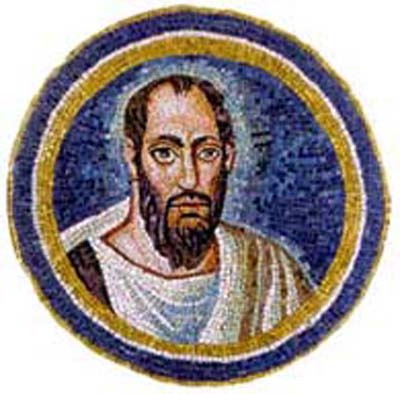
(Revenna mosaic, late 400s A.D.)

His vision of heaven was as real as his waking consciousness—so real, he says, that it seemed the same as being there bodily.

Let me say it once more. Paul’s experience was so convincingly realistic that he honestly couldn’t tell whether he envisioned heaven or actually went there. He emphasized twice:

I do not know; God knows. Whether in the body (an internal vision or revelation) or out of the body (an actual physical experience), I honestly don’t know. I couldn’t tell the difference. (paraphrase)

These are the only two possibilities he considers. And these have nothing whatsoever to do with what is called today “out of body experiences” (OBEs). His soul leaving his body was not an option given by Paul. That would not have even occurred to him.

Paul wanted the Corinthian Christians to see that while it was true that he’d had a spiritual experience (a vision or revelation) that outshined all of theirs, he was unwilling to use details of his experience to justify himself or his apostleship. He was uninterested in a vision contest. The very idea of a revelation competition repelled him. It would be using God’s gift for personal glory.

(Catacombs of Praetextatus, fresco, fourth-fifth century A.D.)

Paul may have had another concern, however. Surely he didn’t want his “boasting” to result in Christians getting the idea that extraordinary experiences like his were necessary (prerequisite) to becoming a “real Christian.” Paul knew that the only requirement was trust in the message of grace to the cosmos through Jesus’ crucifixion. He avoided even the appearance of saying that anything other than belief is required to become a believer. Faith in the crucified Christ is enough.

Paul is making it clear that no great vision or revelation makes you more Christian than the “ordinary believer” who has had no such experience. No experience, no gift, and no ability give you an advantage over other Christians. There are no grounds for comparison.


Scripturally, everyone is visited with the full measure of heaven’s grace.

For more on the Apostle Paul see my blogs The Apostle Paul Never Converted to ChristianityPorneia, and The Soul Doesn't Leave the Body at Death.


Sunday, June 21, 2009

He speaks of . . .

· Mustard seeds, flour, yeast, a vineyard, a vine, branches, fish, wine, bread, lilies, grass, pearls, grapes, thorns, figs, thistle, a reed, good trees, bad trees, good fruit, bad fruit, weeds, wheat, grain, mint, dill, cumin, rue, herbs, fig tree, leaves, a bramble bush, crops, grain, grass, pods, and a mulberry tree.


He speaks of:

· A camel, sheep, a lamb(s), a goat(s), a young goat (or kid), a bird building a nest, fatted calves, worms, snakes, a brood of vipers, sparrows, swine, pigs, dogs, a wolf, ravenous wolves, a fox, foxes, soaring birds, serpents, doves, ox, oxen, a gnat, vultures, a scorpion(s), a raven, a moth, a donkey, a colt, a hen, a hen’s brood, a hen’s wings, and an egg.


He speaks of:

· A shepherd, a woman who lost coin, a woman baking, a king going to war, a king settling accounts with slaves, a man building a tower, a man building a house, a man enlarging his barn, a man tilling, a sower sowing seeds, wedding guests, the bride, the bridegroom, bridesmaids, laborers, a landowner, thieves, robbers, bandits, merchants, neighbors, friends, reapers, a corpse, drunkards, a creditor, debtors, an innkeeper, a judge, a manager, a master, an officer, a gardener, a host, a guest, infants, a child, children, a wife, a father, a son(s), a mother, a daughter, brothers, relatives, daughters-in-law, mothers-in-law, a widow, the poor, the crippled, the lame, the blind, citizens, hired hands, prostitutes, rogues, adulterers, tax collectors, debtors, a nobleman, tenants, an accuser, a magistrate, a gatekeeper, a hired hand, and a vinegrower.


He speaks of:

· Weather, water, rain, floods, the sea, a river, soil, the earth, the world, a desert, fire, flames, scorching heat, sulfur, wind, sky, clouds, moon, stars, the sun, light, light rays, lightning, darkness, a mountain, a chasm, stones, a log, a splinter, foxes’ holes, and salt.


He speaks of:

· A sewing needle, a patch of unshrunk cloth, clothing, a robe(s), linen, an apron, cloaks, purses, a belt, sandals, wineskins, nets, a jar, property, a bed, a table, a lampstand, cups and plates, a door, closed doors, a key(s), a lamp(s), oil, a bushel, rooftops, housetops, a cellar, a garden, manure, a manure pile, tombs, a grave, unmarked graves, sackcloth and ashes, a field(s), a yoke, a sheepfold, a watchtower, a winepress, a millstone, a flute, a ring(s), bandages, an inn, marketplaces, royal palaces, a castle, a throne, a prison, armor, a sword, plunder, goods, a storehouse, possessions, alms, a case, the law, penny, pennies, treasure, money, wages, income, a cornerstone, a gate(s), streets, and a city.


He speaks of:

· Eyes, blindness, ears, the mouth, your neck, a hand, a finger, a foot, sores, a tongue, and hair.


He speaks of:

· A banquet, a wedding banquet, a luncheon, a dinner, a famine, music, and dancing.


And he speaks of:

· Birth pangs, thirst, and hunger.


I think it's kind of cool that so far as we know he never used the words theology, Christology, pneumatology, ecclesiology, soteriology, ontology, teleology, and eschatology!

Instead, we get more than 350 references to everyday things. He taught with common sights, sounds, smells, tastes, textures, and terms. Rather than boring us with bland theological speech, Jesus talks with people in a language spiked with Spirit.

Pictures work better than abstractions. Narrative works better than dogmatics. Everyday things became in Jesus' teaching symbols of the greatest truths. Everyday experience became the language of heaven.

[This article is published with a cool layout in Plain Truth Magazine: HE SPEAKS OF . . .]

For more on Jesus' parables see my blogs The Absurd Parable of the Unforgiving SlaveThe God Who GamblesParable of the Vine and BranchesThe Crooked ManagerThe Friend at MidnightHeaven Is Like a Crazy FarmerHe Speaks Of . . .Salted With FireTalking Sheep and GoatsIs Your Eye Evil?Two Prodigals and Their Strange FatherThe Lazarus Parable Is Not About the Afterlife,and Jesus Used Parables Like a Sieve.

MY NEWS: My kids and most of my best friends are in Mississippi, but I'm moving tomorrow to California. I'm not a poet, but these two lines express how I feel today:

I live in a place I've never seen;
Don't know the address, but it knows me.
---Bert

Friday, January 23, 2009

A Country Fried Parable

(Or a Lynyrd Synyrd Parable of the Kingdom of Heaven)

Appendix D from "Heaven for Skeptics"
© 2008 by Bert Gary for FaithWalk Publishing


Perhaps I should just do as Jesus did and tell a parable. And since I'm from the South, perhaps a country fried parable is called for.


ACT ONE


Entering the kingdom of heaven is like this: You are incarcerated for life in a dark and crowded Birmingham maximum security prison when out of the blue a letter arrives containing your pardon and an invitation to a party. In the neighboring cells, all of your fellow jailbirds received the same.


Just then you hear a band from somewhere outside the prison launch into "Free Bird" by Lynyrd Skynyrd. And just then every prison door unlocks with a clang. The doors fly open. All of them.

You look around at the other prisoners. They're standing there rereading their pardons. They look at you and back at the papers. You read your pardon and your personalized party invitation again. Is this some kind of sick joke? Is it a test? Is it a trap?

You hold your breath and inch toward the open door. The others are watching you. You see your hand reaching for the opening like it's hot, like it's wired. But your hand goes through unharmed. Others inch toward their doors, suspicious eyes darting left and right, uncertain hands reaching out and quickly drawing back.

By now the chorus of "Freebird" is roaring in your ears, and something hopeful is growing in your heart. Without thinking, you bolt from your cell and run for your Life. Right behind you another prisoner runs for his. Then many run, tearing through the cellblock, all the doors wide open. Running and screaming like warriors charging into battle, you emerge from the prison into a green sunlit park.

You and your cellmates rush the stage where you see none other than Ronnie Van Zant himself smiling as he looks right at you. Then he grabs the mic and directs the crowd, an enormous chorus, millions and millions of pardoned cons singing,

"So won't you fly high free bird, yeah!"

Guitars roar. Apple wine is flowing. Lamb is served. And Life is good.


COMMENT ON ACT ONE


Pardon the interruption, but a couple of Bible verses come to mind. Jesus quoted Isaiah saying,


"He has sent me to proclaim release to the captives . . ." (Luke 4:18)


I quoted it before, but Paul's words may make better sense here:


For God has imprisoned all in disobedience so that he may be merciful to all. (bold italics mine) (Romans 11:32)


Oh, yeah. I forgot about hell. Hell is easy to forget at a party! My parable continues:


ACT TWO


In the back of the prison, in the last cell at the end of a long ward, a prisoner sits in the corner fuming. "It's not fair," he says. Then he says it again. Louder. Again. And again. Like a chant. A chant that the other prisoners in nearby cells join in. "It's - not - fair," they chant. More join them. They begin banging and raking their tin cups across the cell bars. It is loud. Very loud. A multitude of freed prisoners refuse to leave their unlocked cells in protest of the general pardon of all. "It's - not - fair! It's - not - fair! It's - not - fair! It's - not - fair! It's - not - fair!"


It was loud as hell.Yet at the free-bird party in the park, Lynyrd Skynyrd was just warming up! The sound of "It's - not - fair!" coming from the unlocked prison was being drowned out by Ronnie and the boys, who were now singing,


"Won't you give me three steps, gimme three steps mister, gimme three steps towards the door?"


Ironical, isn't it?


COMMENT ON ACT TWO


While a Skynyrd concert might not sound like heaven to you, to a good old Southern boy, it's not bad at all. If you like, set the parable in a Detroit prison for women and let Janis Joplin sing "Bobby Magee."


"Freedom is just another word for nothing left to lose."


"The doors of Hell are locked on the inside." CS Lewis


If you like this parable, try my others: Pews Stink (A Black and White Satire)What Color Is a Green Apple?The Kingdom of Heaven is Like Gravity, and A Guitar Hero Parable (Or the Gospel According to Slash).


For Jesus' parables see The Absurd Parable of the Unforgiving SlaveThe God Who GamblesParable of the Vine and BranchesThe Crooked ManagerThe Friend at MidnightHeaven Is Like a Crazy FarmerHe Speaks Of . . .Salted With FireTalking Sheep and GoatsIs Your Eye Evil?Two Prodigals and Their Strange FatherThe Lazarus Parable Is Not About the Afterlife,and Jesus Used Parables Like a Sieve.