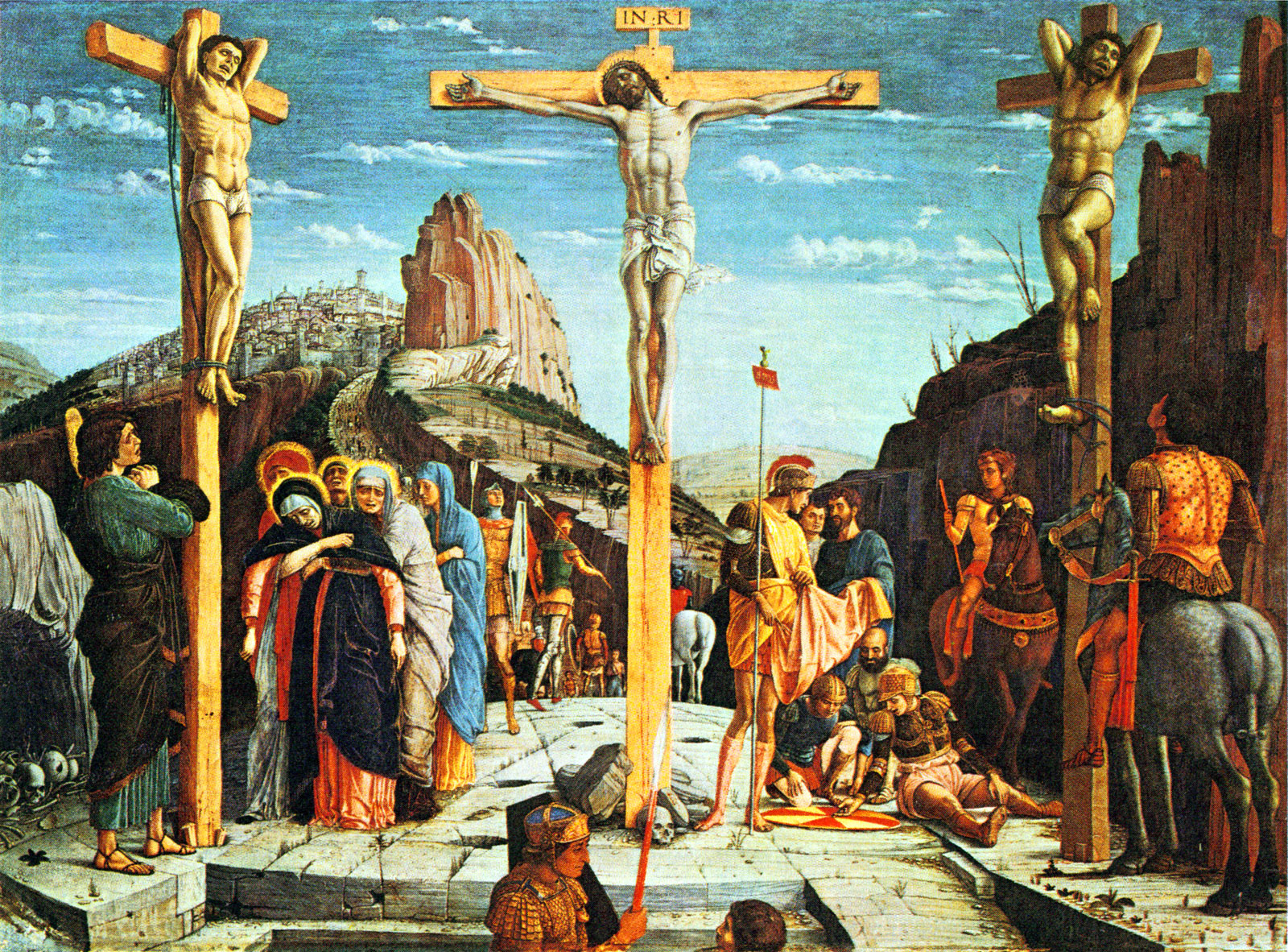
1. There are people who believe that there was no Jesus. He’s a fictional character around which a superstitious new religion called Christianity was created, they say. They hold that Jesus never existed. I don’t think this is an atheistic position necessarily, though some atheists I know (and whom I’ve read) do take this position.
So check out what physicist Albert Einstein—Jewish by birth, Catholic by upbringing, atheist as a young man, and deist as an adult!—had to say about the historical Jesus. His interviewer is German-American poet and writer George Viereck. The interview was published October 26, 1929 in the Saturday Evening Post:
Viereck: “You accept the historical existence of Jesus?”
Einstein: “Unquestionably. No one can read the Gospels without feeling the actual presence of Jesus. His personality pulsates in every word. No myth is filled with such life. How different, for instance, is the impression which we receive from an account of legendary heroes of antiquity like Theseus. Theseus and other heroes of his type lack the authentic vitality of Jesus.”
Viereck: “Ludwig Lewisohn, in one of his recent books, claims that many of the sayings of Jesus paraphrase the sayings of other prophets.”
Einstein: “No man,” Einstein replied, “can deny the fact that Jesus existed, nor that his sayings are beautiful. Even if some them have been said before, no one has expressed them so divinely as he.” (http://politicsandreligion.wordpress.com/2007/06/22/einstein-comments-on-jesus/)
Einstein’s argument is pretty subjective, though. It’s based on feel rather than fact. As he said, when you read the Gospels you get a feeling that Jesus was a real person. His personality comes through. He comes alive on the page in a way that mythical characters don’t. Therefore, Einstein argues that no one can deny—only from reading the Gospels—that Jesus existed, which is a valid argument.
Are there facts that corroborate the Scriptures concerning the existence of Jesus? For some, that “the Bible says so” is enough. But skeptics need more. So, is there extra-biblical historical evidence that Jesus was a real 1st Century human being? The answer is “Yes.” This “Yes” is the biggest hole in the Jesus-is-fiction argument. There are 1st and 2nd Century non-biblical sources that refer to Jesus, including the writings of Tacitus (an example coming up in the ten arguments for Jesus’ resurrection), Pliny the Younger, Josephus, the Jewish Talmud, and more. Not only does the Bible insist on Jesus’ historicity, but other ancient sources insist on the same.
I am aware that some mistrust the provenance of these ancient non-biblical sources, particularly the famous quote about Jesus from Josephus’ “The Antiquities of the Jews.” This quote is considered by some to be in part an interpolation (words interjected later) by a pro-Christian copyist.
- Antiquities of the Jews 18:63-64 Now there was about this time Jesus, a wise man, if it be lawful to call him a man; for he was a doer of wonderful works--a teacher of such men as receive the truth with pleasure. He drew over to him both many of the Jews and many of the Gentiles. He was [the] Christ. 64 And when Pilate, at the suggestion of the principal men among us, had condemned him to the cross, {b} those that loved him at the first did not forsake him, for he appeared to them alive again the third day, {c} because the divine prophets had foretold these and ten thousand other wonderful things concerning him; and the sect of Christians, so named from him, are not extinct at this day.
Yet some continue to hold that there are no trustworthy historical references to Jesus, period. For them, there is zero evidence for the existence of the historical Jesus. I consider this an extreme view. Tacitus’ quote (coming up) in particular is hard to dismiss.
2. The Bible is not a reliable source for historical information, some argue. Even if Jesus is a historical figure, the Gospel writers provide no more than a fictionalized account of his supposed life, teachings, and works. The Bible, they argue, is full of exaggeration and fabrication. Because it is a flawed human document, the Bible cannot be counted on for historical facts. Therefore, some conclude, no historical claim made by the Bible, perhaps especially the resurrection of Jesus, is trustworthy.
For historians and archaeologists, how accurate is the Bible in describing its settings—what the scholars call the “Sitz im Leben”? Well, books abound on the subject, so obviously I can’t unpack it all here. But my reading of the scholars is that they are generally impressed with the Bible’s accuracy. They will tell you that the Bible syncs pretty well with contemporaneous inscriptions, documents, and archaeological findings. Let me share a few. In a day when all archaeological findings and historical documents are suspected of forgery, however, I want to be as careful and fair as I can with the following descriptions:
 An 8th or 9th Century Aramaic inscription unearthed at Tel Dan (northern Galilee at the foot of Mt. Hermon) in 1993 refers to “the House of David.” [left] This is the only extra-biblical reference to King David ever found, and it has intensified a debate in the world of archaeology because a few scholars—sometimes called “Biblical Minimalists”—believe that David was ancient Israel’s version of King Arthur. They believe David was a myth. But the Tel Dan Inscription threw a big red monkey wrench into the working parts of their mythological conclusion. It appears that David may well have existed as a monarch of Israel, though a few minimalists are holding out that the inscription might be a fake. The find resides today in the Israel Museum, and there are few concerns about its authenticity.
[DIS AUGUSTI]S TIBERIEUM
[. . . . PO]NTIUS PILATUS
[. . .PRAEF]ECTUS IUDA[EA]E
[. .FECIT D]E[DICAVIT]
[. . . . PO]NTIUS PILATUS
[. . .PRAEF]ECTUS IUDA[EA]E
[. .FECIT D]E[DICAVIT]
It translates:
To the honorable gods (this) Tiberium
Pontius Pilate,
Prefect of Judea,
had dedicated
Pontius Pilate,
Prefect of Judea,
had dedicated
The so-called Pilate Inscription corroborates the historical existence of a biblical character and his title. Moreover, the Bible’s description of Pilate jibes pretty well with the 1st Century historian Flavius Josephus’ (and others’) descriptions of him. Also housed in the Israel Museum, the Pilate inscription from Caesarea has never been called a forgery.
Three Jewish burial boxes (for bones only) called ossuaries are significant for assessing the Bible’s historicity.

 Second, the ornate ossuary of a priest named Caiaphas was found in 1990 in Jerusalem’s Peace Forest. Some debate continues, but not about the ossuary’s authenticity. It is a 1st Century Jewish bone box—an exceptionally elaborate one. The inscription is authentic too. But there is some debate about whether the Caiaphas in the box is the same one in the Bible. Most scholarly authors I’ve read believe that they’re almost certainly one and the same. If so, this is another archaeological verification of a biblical character. At the very least it proves that there was a 1st Century Jerusalem priest named Caiaphas.

The Israeli Antiquities Authority to date, however, is calling the ossuary authentic, but part of the inscription (the “brother of Jesus” part) a modern forgery. The Biblical Archaeology Society is calling the whole thing authentic using its own group of experts. It is also calling for a new independent study. If authentic, this is the only 1st Century inscription bearing Jesus’ name ever found, and a confirmation of no less than three Biblical personalities. If a forgery, it’s a nice 1st Century artifact marred by a modern inscription.
There are more city ruins, stele, tablets, inscriptions, bulae, and documents that corroborate biblical texts. I encourage you to explore this fascinating subject on your own (since it’s too much material to cover here).
One more mention, however, just to give you a broader example pairing archaeology and the Bible: the ancient Canaanite cities of Jericho and Hazor. Ruins of 13th Century B.C. Jericho have never been found. There are ruins there from before and after the conquest of the Israelites under Joshua. Remember the spiritual? Joshua fit de battle of Jericho, and the walls came a tumblin' down. Well, no one can find those walls. Have the archaeologists just been looking in the wrong place for 13th Century Jericho, or did in never exist? No one knows. By contrast, the 13th Century destruction level of Canaanite Hazor dates exactly to biblical Joshua.
- Joshua 11:13 But Israel burned none of the towns that stood on mounds except Hazor, which Joshua did burn.

Do biblical minimalists still hold to their view of the Bible as an unreliable source of historical information? Yes. I’ve read several of their papers this year. My sense is that, like those who trust no evidence for the historical Jesus, their view is extreme.
3. Miracles have never occurred, some say. Miracles, by definition, must violate the laws of nature. Some claim that this has never been successfully proven to have ever happened. Therefore, the raising of Jesus never occurred, because by definition, the supernatural resurrection of a man from the dead is a miracle. And there is no such thing as miracles, they contend.
The group of liberal biblical scholars called the “Jesus Seminar” takes this stance. They jettison anything miraculous. Their historical critical methods seek to eliminate those elements from the gospels that they suspect do not go back to the historical Jesus, but are in their opinion the creation of the early church—like miracles. They vote one verse at a time using colored beads (color code pictured below) to indicate their level of certainty.
Colored beads were used by Jesus Seminar to vote on statements made by Jesus in the Gospels:
red: Jesus undoubtedly said this or something very like it.
pink: Jesus probably said something like this.
gray: Jesus did not say this, but the ideas contained in it are close to his own.
black: Jesus did not say this; it represents the perspective of a later writer
The most famous authors on the Seminar are John Dominick Crossan, Marcus Borg, and Robert Funk. To them the divine Jesus of Scripture is not tenable. Funk, the convener of the Seminar, said this:
- “We should give Jesus a demotion. It is no longer credible to think of Jesus as divine. Jesus' divinity goes together with the old theistic way of thinking about God. The plot early Christians invented for a divine redeemer figure is as archaic as the mythology in which it is framed. A Jesus who drops down out of heaven, performs some magical act that frees human beings from the power of sin, rises from the dead, and returns to heaven is simply no longer credible. The notion that he will return at the end of time and sit in cosmic judgment is equally incredible. We must find a new plot for a more credible Jesus.” (http://markdroberts.com/htmfiles/resources/unmaskingthejesus.htm)
This quote gives you a feel for the work of the “Jesus Seminar.” They’re using modern historical/literary critical methods in search of “the real Jesus” behind the church’s theology—or they might say mythology. To them, the Jesus of the Gospels “as is” won’t do. Their job is to find the true historical Jesus who was 100% human, 0% divine. They believe they are getting at the man Jesus by a sort of excavation of the ancient biblical texts. They remove and discard what they see as the church’s deification of the man. They believe they are producing a picture of the historical Jesus beneath the four Gospels’ theological propaganda.
 I disagree with them. I think the only Jesus we can see is the one that the gospels give us. The Jesus of Scripture is the only Jesus we can know, personal revelation aside. Scholars don’t have to buy the biblical picture, but to claim that they are producing a more accurate picture of Jesus than the New Testament Gospels is at best arrogant.
And by the way, the Gospels do not give us an “old theistic way of thinking about God,” as Funk insists. They give us a Trinitarian vision of God the Father, God the Son, and God the Holy Spirit—a vision that was offensive to the Jewish “theists” of the day.
As a pretty empirical guy, I understand those who are skeptical of miracles, including the resurrection of Jesus. If you didn’t have questions about it, I’d be suspicious that you weren’t being completely forthcoming. But are there people today who hold that there never has been and there never will be real miracles? Of course there are. For a time, I was one of them.
4. There are natural explanations for all so-called miracles, some claim. The miracle of Jesus’ resurrection is no exception. The following are five (a. – e.) proposed naturalistic explanations of his “rising” from the dead:
a. The women went to the wrong tomb that Sunday morning and jumped to the conclusion that Jesus had risen from the dead. They were mistaken, but their rumor was believed and spread.
Problems with this explanation are that, 1) nothing in the accounts suggests that the women went to the wrong tomb, and 2) surely other followers of Jesus, including the man who owned the tomb (Joseph of Aramathea), would have caught the women’s alleged mistake and checked on the correct tomb.
This “wrong tomb theory” doesn’t explain appearance accounts either. Even if they went to the wrong tomb, believers still claimed that they saw the risen Christ that day.
Furthermore, if Jesus wasn’t raised, and if they went to the wrong tomb, then logically Jesus’ body could have (and would have) been found in the correct tomb once they realized their mistake, right? And if under those circumstances the disciples hadn’t found his body, I assure you the Romans or the Jewish authorities would have “trotted it out real quick like” (pardon my Southernese) to dispel any resurrection rumors. But there is no record of that happening.
Finally, the theory that the women went to the wrong tomb must stand up against this:
- Mark 15:47 Mary Magdalene and Mary the mother of Joses saw where the body (soma in Greek means body or corpse) was laid. (italics mine)
And this:
- Matthew 27:58-61 [Joseph of Aramathea] went to Pilate and asked for the body (or the corpse) of Jesus; then Pilate ordered it to be given to him. 59 So Joseph took the body (or the corpse) and wrapped it in a clean linen cloth 60 and laid it in his own new tomb, which he had hewn in the rock. He then rolled a great stone to the door of the tomb and went away. 61 Mary Magdalene and the other Mary were there, sitting opposite the tomb. (italics mine)
And this:
- Luke 23:55 The women who had come with him from Galilee followed, and they saw the tomb and how his body (or his corpse) was laid. (italics mine)
The Gospels say that the women sat there and watched them put him in the tomb. Perhaps, you might argue, that in the early morning light (Easter Sunday) they could have made a mistake and gone to the wrong tomb. You might further argue that in their grief they got confused, and perhaps tears in their eyes did not allow them to see which tomb was which.
To me it’s still not a valid argument. In the Gospels, it’s not the women but the men who more often make the mistakes. The women “get it” sometimes even when the twelve don’t. The Scriptures say that they watched Joseph put Jesus in the tomb. And after everyone was gone, they sat and stayed for a while outside the tomb. No matter poor lighting or welling eyes, I don’t think these women could have gone to the wrong place by accident. And I don’t think they would have gone away spreading a false rumor of his resurrection without double-checking that they were at the right tomb. Even if they hadn’t double-checked, John and Peter and others would have, and did:


- Luke 24:12 But Peter got up and ran to the tomb; stooping and looking in, he saw the linen cloths by themselves; then he went home, amazed at what had happened.
- John 20:2-7 So she ran and went to Simon Peter and the other disciple, the one whom Jesus loved, and said to them, "They have taken the Lord out of the tomb, and we do not know where they have laid him." 3 Then Peter and the other disciple set out and went toward the tomb. 4 The two were running together, but the other disciple outran Peter and reached the tomb first. 5 He bent down to look in and saw the linen wrappings lying there, but he did not go in. 6 Then Simon Peter came, following him, and went into the tomb. He saw the linen wrappings lying there, 7 and the cloth that had been on Jesus' head, not lying with the linen wrappings but rolled up in a place by itself.
b. The disciples experienced a hallucination, some say. It’s argued that they saw what they wanted to see, and out of wishful thinking, they believed they saw something that they told others was the resurrected Jesus.
The biggest problem here is that mass hallucination just doesn’t happen. Two people having the exact same hallucination would be very strange. Besides, to make a mass hallucination work, you have to have everybody all having the same experience in the same time and place. But that’s not what happened according to Scripture.
The risen Jesus met with individuals, pairs, small groups, and a crowd of 500 in a wide variety of locations—like walking on the road from Jerusalem to Emmaus, on a mountain in Galilee, in a locked room in Jerusalem, and elsewhere. These appearances, by all accounts, are very different in content, witnesses, and location. There is no uniform experience, much less a uniform hallucination.
c. The “swoon theory” claims that Jesus survived the crucifixion; he was nearly dead and those who examined him only believed him to be dead. But he was merely in a swoon, proponents of this theory say, and he resuscitated later and left the tomb under his own power.
The swoon theory surfaced only in modern times. It’s reported to be the idea of Herrmann Reimarus in the early 19th Century. The theory, however, is full of holes (that I won’t elaborate here). A colleague of mine said, “The Romans were not always original, but they were very efficient [in their duties, including crucifixion detail]. I can’t believe anyone ever gave the swoon theory any credence.” Even David Strauss, arch opponent of the historicity of Jesus’ resurrection, argues that the swoon theory is utter nonsense. It contradicts Scripture more than any other attempt to explain away Jesus’ resurrection. Why? The Gospels are emphatic that Jesus was dead:
- Mark 15:37 Then Jesus gave a loud cry and breathed his last. (see also Matthew 27:50 and Luke 23:46) (bold and italics mine)
- Mark 15:43 Joseph of Arimathea, a respected member of the council, who was also himself waiting expectantly for the kingdom of God, went boldly to Pilate and asked for the body (or the corpse) of Jesus. (see also Matthew 27:57-58 and Luke 23:52) (bold and italics mine)
- Mark 15:44-46 Then Pilate wondered if he were already dead; and summoning the centurion, he asked him whether he had been dead for some time. 45 When he learned from the centurion that he was dead, he granted the body (or the corpse) to Joseph. 46 Then Joseph bought a linen cloth, and taking down the body (or the corpse), wrapped it in the linen cloth, and laid it in a tomb that had been hewn out of the rock. He then rolled a stone against the door of the tomb. (see also Matthew 27:59-60 and Luke 23:53) (bold and italics mine)
- John 19:30 When Jesus had received the wine, he said, "It is finished." Then he bowed his head and gave up his spirit. (bold and italics mine)
- John 19:31-33 Since it was the day of Preparation, the Jews did not want the bodies (or the corpses) left on the cross during the sabbath, especially because that sabbath was a day of great solemnity. So they asked Pilate to have the legs of the crucified men broken and the bodies removed. 32 Then the soldiers came and broke the legs of the first and of the other who had been crucified with him. 33 But when they came to Jesus and saw that he was already dead, they did not break his legs. (bold and italics mine)
- John 19:34-35 Instead, one of the soldiers pierced his side with a spear, and at once blood and water came out. 35 (He who saw this has testified so that you also may believe. His testimony is true, and he knows that he tells the truth.) (bold and italics mine)

With humor, Strauss asserted that if the swoon theory were true, the disciples would have called for a doctor rather than proclaim him the risen Lord. (The Historical Jesus, Habermas: http://www.garyhabermas.com/books/historicaljesus/historicaljesus.htm)
d. Jesus' resurrection was a fraud, a scheme cooked up by his disciples, some say. After his death and entombment, his followers came by night and stole the body and spread the lie that he'd been resurrected.
Matthew records that the chief priests and Pharisees requested that Pilate post guards at Jesus' tomb to prevent the disciples from stealing his corpse to fake a resurrection (27:62-66). Then Matthew records that once the body was gone, the soldiers were paid hush money. They were instructed to falsify their report saying, "His disciples came by night and stole him away while we were asleep." Matthew concludes this episode by writing that the soldiers took the money, spread the lie about the body being stolen, and their story "is still told . . . to this day." (28:11-15)
It is notable, however, that the Jews (the Judean authorities) went to great lengths to get rid of Jesus. It follows that if they would go to all the trouble to plot against him, arrest and charge him, try him themselves, try him again before Pilate, convict and crucify him, then certainly they would have kept up with his corpse to discredit the claims of resurrection. Imagine it. If the authorities could have produced Jesus' corpse, there would never have been what we call a church. Not one. Jesus' resurrection became the catalyst for Christian preaching and mission. Without it, Christianity would have never been born. The Apostle Paul wrote, ". . . if Christ has not been raised, then our proclamation has been in vain and your faith has been in vain." (1 Cor 15:13-14).
Scholars have long noted that Matthew, more than the other Gospels, makes an effort to defend the resurrection as a historical occurrence. Matthew does this by making sure that the story of a stolen body is acknowledged and addressed, but also by dismissing it as a fabrication. By doing this, however, for some scholars Matthew raises the possibility that the disciples may have, in fact, faked the resurrection by taking his body. Is that possible? Would the disciples have done such a thing? More to the point, in their state of mind, scattered and afraid, could they have quickly reformed and plotted together to steal the corpse, then hide it or dispose of it so that it was never found? Could they have spread a false rumor that he rose from the dead? Would they have risked their lives everyday thereafter in growing numbers to proclaim the lie publicly, even in the Jerusalem Temple itself where they were forbidden to do so? It seems most implausible, since the disciples’ actions can only be seen as extraordinarily courageous and dangerous stand-making or exceedingly stupid and pointless fakery.
e. Jesus did live and then die on a cross, some say, but his resurrection was merely a literary legend created by his early followers to express that his death was not the end. Jesus lived on in the memories of his followers, so they honored his eternal teachings by granting him an honorable resurrection in writing.
Could the resurrection story of Jesus have been a writer’s metaphor for the way in which the memory of Jesus "lived on" in his disciples? Resurrection was an accepted theological concept among the Pharisees and probably most of the Jewish people. (Zeitlin, p. 163-167) Therefore, some have suggested, the gospel writers honored Jesus' memory by granting him a resurrection ‑‑ a worthy, literary device creating a triumphant conclusion to his story. As such, these resurrection stories represent not an actual occurrence, but rather the reawakening of Jesus' life and teachings in the memories of his followers. Is this possible?
Zeitlin undercuts entirely a mythological/metaphorical interpretation by insisting that there appears to be no Jewish expectation in the 1st Century of a resurrection within history. They—the Pharisees in particular—thought of resurrection in the last days, at the end of history. That being the case, it is impossible that all four gospel writers might have honored Jesus' memory by granting him a literary resurrection. To honor him in this way, and thereby providing a triumphant ending to his story, presumes that 1st Century Judaism had some expectation that the messiah would rise from the dead within history. Such is not the case. If anything, a resurrection within history was a shock, unprecedented and completely unexpected, even to Jesus’ disciples in spite of Jesus’ predictions that it would be so, predictions that they did not understand. (Mark 9:9-10 & 31-32; Luke 18:33; Luke 24:44-46; John 20:8-9)
Furthermore, in Acts 5, the disciples take a dangerous stand in the temple before the Jewish authorities. They were thrown in prison. But they escaped and went back up to the temple proclaiming Jesus’ messiahship and death and resurrection again. They were arrested again, this time whipped, then ordered not to speak of Jesus ever again. The authorities wanted to kill the disciples, but a rabbi named Gamaliel talked them into releasing them. Still, the disciples went right back up to the temple and proclaimed Jesus’ again, not only that day, but every day thereafter.
- Acts 5:40-42 [W]hen they had called in the apostles, they had them flogged. Then they ordered them not to speak in the name of Jesus, and let them go. 41 As they left the council, they rejoiced that they were considered worthy to suffer dishonor for the sake of the name. 42 And every day in the temple and at home they did not cease to teach and proclaim Jesus as the Messiah. (italics mine)
According to early Christian records, of Jesus’ twelve apostles, ten were executed. James, the brother of Jesus? Also executed. The Apostle Paul? Executed. They wouldn’t back down, they wouldn’t recant, they wouldn’t shut up, and they wouldn’t stop. Were these men willing to die for a hoax, myth, legend, or lie?
There’s no doubt in my mind that people will continue to look for naturalistic explanations for the resurrection. Their search for resurrection proofs will parallel searches for the lost Ark of the Covenant, the Dead Sea Scrolls’ treasure, and the Holy Grail.
5. All written testimony in the Bible concerning Jesus' resurrection is hearsay, some argue (lawyers perhaps). The Gospels are probably not firsthand accounts, meaning not written by eyewitnesses. The scholarly argument that they were all written in the last third of the 1st Century A.D., some 35-65 years after the crucifixion of Jesus, is convincing to me. Remember how the author of the Third Gospel put it:
- Luke 1:1-4 Since many have undertaken to set down an orderly account of the events that have been fulfilled among us, 2 just as they were handed on to us by those who from the beginning were eyewitnesses and servants of the word, 3 I too decided, after investigating everything carefully from the very first, to write an orderly account for you, most excellent Theophilus, 4 so that you may know the truth concerning the things about which you have been instructed. (italics mine)
The author of Luke’s Gospel, for one, affirms he was no eyewitness: “. . . events . . . handed on to us by . . . eyewitnesses . . .” There were many gospels written by the time “Luke” wrote his, he claims, and he “investigated everything,” meaning he interviewed eyewitnesses and researched written sources intending to write an accurate and complete account. Yes, some scholarship still maintains that the authors assigned to the Gospels—Matthew, Mark, Luke, and John—are accurate. Yet no ancient copies of these Gospels name an author. All are written anonymously. The authors’ names were assigned in the late 2nd Century. I agree with scholars who say that the anonymous author of Luke’s Gospel, for example, wrote in the 80s A.D.—50 years after Jesus’ death. That opens the door for the “hearsay objection.” In a court of law, so to speak, Luke’s account (and all Gospel accounts for that matter) would be inadmissible.
We aren’t talking about a legal matter, however. We’re talking about history. Anyone who writes history does so with the aid of sources, especially if that writer is an eyewitness. An honest eyewitness knows he can be wrong. People in law enforcement will tell you that eyewitnesses often are wrong. That’s why history requires all available voices, because if only an eyewitness can write legitimate history, most histories must be discarded, not just the Gospels. Moreover, if hearsay is inadmissible in histories, then that means no one will be allowed to write a biography about someone that they didn’t know personally. And if a biographer knew a subject personally, he would not be allowed to write anything about that person that he did not witness directly. No hearsay means no hearsay. It would be the end of history-writing as we know it. It would be the end of anthropology and archaeology, period. What would be the point?
Do historians make mistakes? Certainly. Do I think that Luke got every historical detail right? Certainly not. A comparison of Matthew, Mark, Luke, and John shows variations in the story of Jesus. The question you may fairly ask, however, is, given that our four biblical Gospels are probably written by second generation Christians (not eyewitnesses) and given that they don’t agree in all the details, how reliable are they? Do they show us the life and teaching of a 1st Century Jewish rabbi from Nazareth named Jesus that lines up with non-biblical documents, ancient inscriptions, and archeological evidence? I say they do. The best way to fairly explore this question is to become a student of these Gospels. Agnostic scholar Bart Ehrman wrote of Jesus, “He certainly existed, as virtually every competent scholar of
antiquity, Christian or non-Christian, agrees, based on clear and
certain evidence.” (Ehrman, Bart D. Forged: Writing in the Name of God--why the Bible’s Authors Are Not Who We Think They Are. Reprint ed. Bravo Ltd, 2012: p. 285)
To some, I’m sure that the biblical accounts of Jesus’ resurrection from the dead remain objectionable. Hearsay. In the court of my own mind, that objection is overruled.
Read the companion blog to this one: Ten Arguments Supporting the Resurrection of Jesus.
For a discussion of Roman crucifixion, see my blog entry: Was Jesus Crucified in the Manner Shown in Paintings and Movies?
Read the companion blog to this one: Ten Arguments Supporting the Resurrection of Jesus.
For a discussion of Roman crucifixion, see my blog entry: Was Jesus Crucified in the Manner Shown in Paintings and Movies?