Saturday, September 12, 2009

Paul Didn't Go to Heaven

(painting by El Greco, 1606)

The Apostle Paul is believed by many to have made a round-trip visit to heaven—either bodily or via his soul leaving his body. But did he?
A quick look at Paul’s words in context says otherwise. The subject he is writing about is “visions and revelations.” Those are his words.

Paul complains that the Christians in Corinth are forcing him to boast again:

2 Corinthians 12:1-7 It is necessary to boast; nothing is to be gained by it, but I will go on to visions and revelations of the Lord. 2 I know a person in Christ who fourteen years ago was caught up to the third heaven -- whether in the body or out of the body I do not know; God knows. 3 And I know that such a person -- whether in the body or out of the body I do not know; God knows -- 4 was caught up into Paradise and heard things that are not to be told, that no mortal is permitted to repeat. 5 On behalf of such a one I will boast, but on my own behalf I will not boast, except of my weaknesses. 6 But if I wish to boast, I will not be a fool, for I will be speaking the truth. But I refrain from it, so that no one may think better of me than what is seen in me or heard from me, 7 even considering the exceptional character of the revelations. (emphasis added)

By “third heaven” Paul means God’s abode, which in the ancient world was believed to be above the air in which birds fly (first heaven) and beyond the level of the sun, moon, and stars (second heaven).

Eason’s Bible Dictionary: According to the Jewish notion there were three heavens: (a) The firmament, as "fowls of the heaven" Ge 2:19 7:3,23 Ps 8:8 etc., "the eagles of heaven" La 4:19 etc. (b) The starry heavens De 17:3 Jer 8:2 Mt 24:29 (c) "The heaven of heavens," or "the third heaven" De 10:14 1Ki 8:27 Ps 115:16 148:4 2Co 12:2

Though the Corinthians again put him in the uncomfortable position of having to use his own extraordinary visions and revelations to shame them for their constant crowing about theirs, he still refuses to give details. He says that he “heard things that are not to be told, that no mortal is permitted to repeat.” He says this not only out of humility, but also because he has no permission to share the details of his experience. Apparently it is his opinion that to repeat the revelations he received would be wrong.

[This mosaic is the oldest known image of the Apostle Paul (late 300s A.D.), found in the catacombs of Rome on June 19, 2009.]

Also out of humility, he speaks of himself humbly in third person as “a person.” (The Greek word anthropos can be translated as person, human being, or man.) He distances himself from his extraordinary vision/revelation in modesty by referring to himself as “a person.”

Moreover, Paul unassumingly claims to have been unable to tell whether what happened to him was in his mind’s eye or whether he was taken bodily to the third heaven or Paradise. In other words, the vision or revelation was so real that he couldn’t tell whether it was internal or external. That fact alone makes his experience superior to the Corinthians, he claims.

And further, if Paul had wanted to share knowledge of this “trip” in order to boost himself in their esteem, he could have. It’s as if Paul is saying, OK, if you want to play the boasting game, fine. I win! But he bests them not to subordinate them, but to shake them out of their arrogant self-sufficiency and delusional superiority.

I know that this is one of the New Testament passages quoted by the “disembodied-soul-going-to-heaven” crowd. But this verse doesn’t support a pagan Greek, Platonic, bodiless soul. (See The Soul Doesn't Leave the Body at Death)

Don’t read into these verses something that’s not there. Paul isn’t talking about the immortality of the soul. He’s not talking about his soul leaving his body. He didn’t mean to write, “I don’t know whether I went to heaven bodily or as a disembodied soul.” That’s just wrong, though that may be the way it’s usually read. Paul is a Christian. Christians believe in the resurrection of the body, not disembodied souls.

Paul is saying that he had an experience of heaven. He calls it a vision or a revelation. The experience was so vivid, so real, however, that if it was an inner vision (a mental panorama), he found it indistinguishable from an actual visit (a physical panorama).

So, if it was a vision, the vision was inside him, internal, in the body—that is, within himself, within his mind’s eye. But if he had an actual visit to heaven, the visit was a reality external to him, a reality outside of his body.

It is not Paul who was in or out of his body. It is what Paul saw that was either internal or external to his body. He’s saying that his inward vision looked externally real to him. It was so crystal-clear that it could have been an actual physical environment.

What’s his point? Paul is trying to show the Corinthians that it’s futile to compare revelations and visions, to rank people by how flashy their visions and revelations were. Paul is telling them they can’t win because they can’t top this:
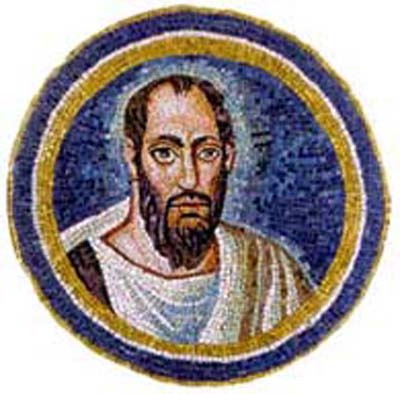
(Revenna mosaic, late 400s A.D.)

His vision of heaven was as real as his waking consciousness—so real, he says, that it seemed the same as being there bodily.

Let me say it once more. Paul’s experience was so convincingly realistic that he honestly couldn’t tell whether he envisioned heaven or actually went there. He emphasized twice:

I do not know; God knows. Whether in the body (an internal vision or revelation) or out of the body (an actual physical experience), I honestly don’t know. I couldn’t tell the difference. (paraphrase)

These are the only two possibilities he considers. And these have nothing whatsoever to do with what is called today “out of body experiences” (OBEs). His soul leaving his body was not an option given by Paul. That would not have even occurred to him.

Paul wanted the Corinthian Christians to see that while it was true that he’d had a spiritual experience (a vision or revelation) that outshined all of theirs, he was unwilling to use details of his experience to justify himself or his apostleship. He was uninterested in a vision contest. The very idea of a revelation competition repelled him. It would be using God’s gift for personal glory.

(Catacombs of Praetextatus, fresco, fourth-fifth century A.D.)

Paul may have had another concern, however. Surely he didn’t want his “boasting” to result in Christians getting the idea that extraordinary experiences like his were necessary (prerequisite) to becoming a “real Christian.” Paul knew that the only requirement was trust in the message of grace to the cosmos through Jesus’ crucifixion. He avoided even the appearance of saying that anything other than belief is required to become a believer. Faith in the crucified Christ is enough.

Paul is making it clear that no great vision or revelation makes you more Christian than the “ordinary believer” who has had no such experience. No experience, no gift, and no ability give you an advantage over other Christians. There are no grounds for comparison.


Scripturally, everyone is visited with the full measure of heaven’s grace.

For more on the Apostle Paul see my blogs The Apostle Paul Never Converted to ChristianityPorneia, and The Soul Doesn't Leave the Body at Death.


Sunday, September 6, 2009

I called 911 today (a true story)


I start to punch 9-1-1 but then in the urgency of the moment I realize I’ve forgotten the name of the park. I unzip my backpack and pull out the brochure I got from the Ranger at the gate.

Gaviota State Park, California. It’s a sunny seventy-eight degrees. I’m sitting on a cliff ledge almost a hundred feet above the Pacific. The waves are only two feet high, but inland winds, accelerated to thirty miles per hour by the narrow park canyon walls, sweep across the waves, whipping up white tops and mist. To my left, a rusting train trestle, still in use, spans the small beach. Emerging from the right end of the beach is an even older looking wooden pier reaching out into the waves about five hundred feet. The happy fishermen on the pier seem unaware of what is happening less than a half mile from them.

I use my binoculars again to make sure she is still there. It takes a few seconds to find her because she has now drifted farther out, but she’s there. Treading water. No life vest. I know she is a young woman because I saw her paddling a small white boat earlier. She passed the pier heading up the coast. But then I saw her go in. She just lost her balance and rolled out. I watched her try to climb back in. I rooted for her, and believed at first that she was in no imminent danger, but she must have gotten tired. She lost her grip on the boat, and the wind took it away from her. That’s when I got concerned, because she swam so weakly trying to catch it, which was a futile effort in that wind. A wave helped the wind flip it, and it was capsized and on its way to Indonesia.

She watched the boat for a few helpless seconds. Then she turned toward the shore, toward me. I was too far away to see her expression, even in the binoculars, but something about the way she didn’t even try to swim ashore---the way she bobbed in the water looking at a distant beach she could never reach---made my heart sink.

I punch 9-1-1and put the cell phone to my ear. The operator's voice breaks up, but I’m pretty sure she’s asking me what the emergency is.

“There’s a girl in the water at Gaviota State Park. She’s about a half mile out and drifting out to sea. I don’t think she has a life vest on.”

She says I’m breaking up. I stand and repeat. I notice a heavy man on the pier sprinting toward the beach. Good, I think. Someone else has spotted her.

The operator connects me to the Coast Guard. I repeat everything. She wants details. While I’m talking a man on an orange surfboard is paddling toward the capsized boat.

“OK, there’s a guy heading out on a surfboard now.”

“Is it a lifeguard?” she asks.

“I hope so. But he’s going the wrong way. He’s going for the boat. He can’t see her. She’s drifted out and up the beach.” She asks me for my name and cell number and we hang up.

Another guy hits the water on a shorter blue surfboard. Both boarders are headed for the boat, not the girl. I whistle as loud as I can and point up the beach, but they can’t hear me. I whistle and yell and point but it’s no use. All I can do is watch now. I sit down and raise the binoculars.

She’s bobbing and drifting away. The boarders are paddling for the boat. But the orange boarder stops and raises himself up to look for her. Good! He paddles and rises up and paddles and rises up. He spots her and puts the nose down and paddles hard in her direction. I cheer and give thanks thinking that maybe this thing is over. Maybe my emergency call was for nothing.

He reaches her. They’re pretty far out now, and it’s hard to see exactly what is happening, but it looks like she’s having a hard time getting on the board. She makes it on about the time the blue board reaches them. Then both boards turn and start paddling for the pier. I decide to time them.

After ten minutes, the orange board, now with two passengers, is making zero progress, and the guy on the blue board is losing ground. They’re separated. But a third boarder, this one also orange, is going out to assist. In maybe ten minutes he’s speaking with the other orange boarder, but then paddles out toward the blue boarder. He ties a chord to the blue board and starts to try to tow him in. Five minutes later they’ve made no progress. The wind and currents are too strong. It’s easy to get out there, apparently, but not so easy to get back.

"They’re not going to make it without help,” I say aloud. I look left and right for the Coast Guard. Nothing. Ten more minutes pass and I hear a helicopter back inland. I stand up and turn as the chopper blasts past me and heads straight for the boarders. But it’s not the kind of helicopter that can land on water, so I’m wondering what he will do. I lift the binoculars and see a frogman standing on the runner, ready to go in. But he doesn’t jump. They just hover.

As if by magic, the presence of the helicopter makes the guys paddle harder. “Guys really hate being rescued,” I say with a smile. I watch them make slow progress as the helicopter hovers right behind them. Then I hear sirens. And more sirens. And more still. Then a jet ski cranks up all of a sudden and heads out from the beach. He hitches up the orange board with two passengers and begins towing them. When they approach the pier, I pack up, climb up the rocks, cross the tracks, and follow a trail down to the beach. Is she OK?

Two fire trucks are parked at the beach. Three utility trucks, one with a trailer for the jet ski. And an ambulance. As I reach the beach, I gasp when I see the young lady strapped to a stretcher. She’s so pale. Her trembling hands clutch the blanket to her cheeks. Then as they load her into the ambulance, she pulls the blanket over her face and presses it tight. I didn’t expect that. She’s hypothermic and exhausted. And fortunate.

I identify the first orange boarder. He’s the beach lifeguard. I hear someone call him George. We exchange stories, mine from a cliff top and his from the beach. The pier obscured his view, he said, and he didn’t know she was in the water until the heavy man ran down the pier yelling. The guy on the blue board was her boyfriend, and his inexperience with paddling on the shorter board got him in trouble. They had to send the jet ski back out to tow him in too.

Every fireman and frogman on the beach is smiling and slapping George on the back. The frogman in the helicopter gives George the thumbs up as they head back inland from wherever they came. George earned his paycheck today.

I stand there pondering the irony. I had been feeling down about not finding a job. I’d been out here in California since June, and despite hundreds of applications and calls, still nothing. A friend said I should go somewhere, maybe the beach, and pray and listen and take a moment for myself to just be. So, wanting to go to the Santa Barbara area, a beautiful area on the coast but not too far from Arcadia, I looked online and found Gaviota State Park. The cliffs, the rocks, the trails, the beach, the old trestle and pier looked just right. So I headed out.

I had checked out the beach, then a reedy area full of birds on the east end, then bought some water and decided the best place to be alone and pray might be up on the cliff. I walked the road and a trail, crossed the tracks, and found my way over the lip and sat on a ledge. Kelp danced in the waves. Pelicans dive-bombed silver fish from above while seals picked them off from below. I had been sitting there for thirty minutes when I began to pray.

I don’t usually close my eyes to pray. I just talk. I was sitting there talking when I saw her boat. To my naked eye, something appeared to be wrong. I raised the binoculars. You know the rest.

While I am still standing on the beach watching the firemen and frogmen and one frogwoman laughing and loading up, an older couple comes up to me.

“Are you all right?” she asks.

“Yes, ma’am. Why do you ask?”

“I overheard you talking to the lifeguard. Were you alone up there?”

“Yes, ma’am.” And suddenly I’m wondering whether I am all right. I choke up a bit, feeling grateful to have had my binoculars and cell phone with me up there, grateful that George was on the job, and grateful for all the men and women on duty round the clock ready to risk their lives to save someone else.

I assure the woman I’m fine, and as she walks away I look around at the sunbathers and picnickers and wonder if there is a message in this for me. Is God talking to me? And if so, what is he saying?

Then it hits me. As I had watched her from the cliff, I had put myself in her place. She went out on an adventure alone and got in over her head. Perhaps she was me. I had gone on an adventure to California alone and was certainly feeling in over my head this weekend.

I walk back up the cliff to my Jeep and get in. At the park entrance I meet the truck with the jet ski on its trailer. They wave me to go first. I do. I’m pulling onto the coastal highway and I realize that what I just witnessed was exactly how I feel.

Does anyone on the pier see me bobbing in freezing water? Is there a guy on the cliff with binoculars and a cell phone watching over me? Will the lifeguard or the Coast Guard come for me?

At moments like this, what else can you do but wait and trust and hope?

I’m back in my one-room efficiency in Arcadia now, typing the events of today. I’ve told no one about this, and I thought about keeping it that way. But then again, I thought, this is a story that needs writing, and writing it has been good.


Thursday, September 3, 2009

What Color is a Green Apple?


a parable of perception

Things aren’t always as they seem.

Take your favorite coffee cup and put it on the table in front of you. Now look at it. Let’s say for the sake of the argument that you have “normal,” non-corrected, 20/20, human eyesight. Your eyes are giving you information about the cup. Your image of it is sharp and clear. You assume that what you are seeing is the cup. But is it?

An enormous number of living creatures on earth have eyes. Elephants, eagles, dogs, hammerhead sharks, and houseflies all have eyes. But are their eyes identical? When other creatures look at your cup, do they see exactly what you see? Do they see shapes and colors the same way your eyes do? If not, then which image of your cup—the elephant’s, eagle’s, dog’s, shark’s, housefly’s, or yours—is “correct”? Which one is really the cup?

When you examine the problem this way, you begin to see that all of these images belong to the cup, but none of the images are the cup. The cup is a reality that is more than merely what your eyes can see. Your eyes only see a narrow band of the full spectrum of light. For example, your eyes can see no light from the ultraviolet or the infrared spectrums. Your eyes “see” the cup, for sure, but only in the spectrum of light that your eyes are designed with which to see.

What you see, your visual image of the cup, is limited by your eyes’ design. In fact, your eyes are sieves that filter out the chaotic light frequencies that interfere with your survival—so you can hunt a deer, spot a crouching lion, and avoid walking off a cliff. Therefore your image of the cup is incomplete. The cup’s cup-ness is more than what your eyes in their limitations can perceive.

When an apple appears green to you, it is not because the apple is actually green. The surface of the apple happens to absorb blue and red wavelengths of light while it reflects green. The apple then appears to your eyes to be green. But if you were significantly colorblind, you probably would not be able to tell a red from a green apple!

One in every 100 males has some “red-weakness” (Protanomaly), meaning shades of red are difficult to distinguish. Five in every 100 males has a “green-weakness” (Deuteranomaly). (Colorblindness in women is very rare. Tritanope is even rarer.) A colorblind person who looks at a colorful map of the world will see “the world” differently than you. The following four maps of the world demonstrate this.

When your eye sees the green apple, the really weird thing is that a green apple is actually absorbing every other color but green. Green is the only light wave that it rejects! Your eye sees the apple as green because green is the only light color it can’t keep (absorb).

To state this even more accurately and boldly, when you look at your cup, you’re not really seeing your cup at all. Your eyes are “reading” the light reflected off of the cup’s surface. If you put your cup in total darkness, the cup is still there even though you can’t see it. Does the cup exist in the dark? Yes, obviously. So your cup is more than its mere appearance. Cup-ness is a reality in and of itself apart from your visual perception of the light bouncing off of it. The fact that a blind person can drink from your cup should have told you that! The cup is more than meets the eye.

We are “seeing things” because of light. Eyes are organs that process light. Light enters the eye, shining on what are called cones and rods, and the light triggers a chemical reaction in the rods and cones, and the chemicals turn into electrical impulses that are sent to a certain part of the brain where these impulses are received, organized, and transmitted to other parts of the brain for analysis and communication.

So when you look at your cup, are you seeing your cup? Yes and no. “Yes” because the image your eyes provide is an actual image of your cup. “No” because the image is not your actual physical cup. Like a camera, your eye catches light and provides a “photograph” of that light bouncing off of stuff like your cup. Light bounces off of the cup and goes into your eyes, and you “see the light” bouncing off the cup. You do not see the cup itself. For everyday purposes everyone seems to assume that the cup they “see” is the actual cup. In a very real sense it’s not.

Why?

Because light is the only thing eyes can see. Eyes receive and process light, not cups. Your eyes are light processors, not cup processors. The “photograph” of the cup is not the cup.

Let’s make things worse! Think about light. If light bounces off of things (like your cup) and then goes into your eyes, then light has speed, right? What is that speed? Light travels at 186,282 miles per second (or about 670 million mph). It travels fast enough to circle the earth more than seven times a second. To put that speed in perspective, light coming all the way from the moon’s surface only takes 1.28 seconds to reach the Earth. That’s really fast. The moon is 238,857 miles away. A quarter-million miles in a-second-and-a-half. The implication of this is just wild.

What this means is that when you look at the moon, you are not seeing the moon as it appears right now. You are seeing the moon as it was one second ago. Merely by gazing at the moon tonight you are actually looking back in time one second.

The moon, however, doesn’t give off its own light. It merely reflects the light of the sun. So how long does it take sunlight to travel from the sun all the way to the Earth and its moon? Eight minutes. We’re talking about 93 million miles at 186,282 miles per second in about 500 seconds (or a little over eight minutes). So when you look at the sun—hopefully you don’t stare at it!—you aren’t seeing the sun as it is, but as it was eight minutes ago. You’re looking eight minutes back in time.

When you look at the planet Saturn with your naked eye—easily done if you know where and what to look for—you aren’t seeing Saturn as it is, but as it was . . . one whole hour ago.

The nearest star to our sun (our sun is a star)—Proxima Centauri (Alpha Centauri C)—is 4.3 “light years” away. A light year is the distance light travels in one year. It takes light from Proxima Centauri four years to reach us. So when you look up and see Proxima Centauri, you are not seeing Proxima Centauri as it is, but as it was four years ago.

On a clear, cold, moonless night, drive out away from the lights of “civilization” and look up using only your naked eye. The sky is a virtual canopy of stars—thousands of them. Some of the dim stars you are looking at are 2000 light years from Earth. But you are not seeing those distant stars as they are today. You are seeing them as they were 2000 years ago when Jesus of Nazareth walked the Earth. Moreover, when Jesus gazed at these distant stars, he saw them as they were 2000 years before his time, or near the time when Abraham walked the Earth.

Now there are 200 to 400 billion such stars in our Milky Way Galaxy. But, as the Hubble Space Telescope has so dramatically shown us, there are at least 100 billion galaxies out there too, each with on average 200 to 300 billion stars of their own. That brings an even more bizarre fact.

When the Hubble “looks” at a galaxy at the far edge of the known universe and provides us with an image of it, that image is not one of what the galaxy looks like now. It is an image of how it looked billions of years ago! To look at such distant galaxies is to look back in time well before the creation of telescopes, before the presence of humans on earth, before even the formation of our own solar system. How strange! The telescope orbiting Earth is viewing a time prior to the existence of Earth.

Again, things aren’t always as they seem. We can’t see anything in the heavens as it “is” right now. To stand in your backyard and look up at the stars is to leave “the now.” To stargaze is to travel backward in time. But this raises yet another oddity.

Look at your favorite coffee cup again. Not only is the cup in its cup-ness more than what your eyes can perceive, but the light traveling from your cup to your eye takes time to get there. It’s a very, very short amount of time, granted. But it takes time. Therefore, you can’t even look at your own coffee cup and see its image in “the now.” It’s nearly instantaneous, yes. And you can’t perceive it as anything other than instantaneous. But it’s not instantaneous.

When you look at your cup, you are seeing an image of it as it was a fraction of a second ago. In fact, because the speed of light is finite, there is no image that you can ever perceive visually in the actual present. Everything you perceive with your eyes is in the past due to a finite speed of light. How far in the past the object is seen depends on its distance from your eye.

Because light has a speed, you see the cup in front of you as it was fractions of a second ago. You see the moon as it was one second ago. You see the sun as it was eight minutes ago. You see Saturn as it was an hour ago. You see Proxima Centauri as it was four years ago. You see distant stars in the night sky as they were 2000 years ago.

My point? This blog is a parable of perception. When it comes to seeing, perception is not reality. But what about God? Is perception reality when it comes to God?

After much study and thought, I’m convinced that at the core of Jesus’ mission was his intent to provide for us corrective lenses. He came to reveal his heavenly Father as he really is. He came to correct our perception of God.

We tend to see the Son and the Father as different, do we not? The Father is seen as distant and judging while Jesus is seen as accessible and forgiving, even though the Jesus of the Bible insists that “when you’ve seen me, you’ve seen the Father.” (For more on this, see The Un-Religion.)


This creates a rather bizarre dilemma, doesn’t it? If you are a follower of Jesus or want to be, and if you take what he says in the Scriptures seriously, then you can trust your own perception of God, or you can trust what Jesus is telling you when it comes to seeing his Father. Is Jesus’ image of his Father direct, clear, and correct, or is yours?