By David Foreman and Bert Gary

Do you want to claim all the blessings of the Bible? I’ve heard pastors telling their congregants to claim this very thing. But I have reservations. And I raise my reservations in order to question common assumptions about what the Bible is and how to interpret it.
Now I like this blessing:
Blessed is he who has regard for the weak; the LORD delivers him in times of trouble. (Psalm 41:1)
But look at this one:
Blessed shall he be who takes your little ones and dashes them against the rock! (Psalm 137:9 - ESV)
Do I really want to claim all the blessings in the Bible? I realize the Bible assures us, "For every one of God’s promises are “Yes” in him; therefore also through him the “Amen” is spoken, to the glory we give to God." (2 Cor 1:20 - NET) But obviously I can’t claim the right to be a blessed baby smasher, can I? Houston, we have a problem.
As I have grown to love and trust the Bible, I’ve come to understand that the Scriptures “plainly” say a lot of things. But, where I see us frequently getting off track is when we fail to realize that, if not reverently cautious to read Scriptures in context, we can read the Bible saying a lot of things that the Bible “plainly” doesn't say.
Here are two ten-dollar words that all students of the Bible should learn:

- Exegesis [pronounced ek-si-JEE-sis]
- Eisegesis [pronounced ahy-si-JEE-sis]
Exegesis means “a reading out.” It’s the faithful attempt to interpret the message of Scriptures in context. Eisegesis means “a reading into.” It’s the frequent and unfortunate practice of imposing external assumptions on Scriptures to the neglect of a serious attempt to search for meaning in context.
Eisegesis has an unfortunate result in the church. I've seen too many dear saints look down on themselves because they've "claimed" some biblical promise plucked from its context, only to have God "fail to deliver on his 'word.'" Since the fault can't be with God, they conclude that it must be a lack of faith on their part. So how can we address this, maybe even fix this?
I now look at it like this. Just because God seems to promise a blessing, like the promise of blessings on baby smashers, does not mean we can "claim" that biblical promise for ourselves willy-nilly. Context matters to faithful interpretation. And most Christians would quickly agree, I think, that something is just wrong in randomly claiming promises that may mean something vastly different in context, and promises that may not even apply to them.
Look, brothers and sisters. What if it’s not that God has failed on his promises or that you lacked faith? What if sound exegesis reveals that he never made those promises to you in the first place?
Jesus blessed a variety of people in what is called The Beatitudes recorded in his Sermon on the Mount. Here’s one:
"Blessed are the poor in spirit, for theirs is the kingdom of heaven." (Matthew 5:3)
This blessing is widely interpreted as: I have to be poor in spirit to get the kingdom of heaven. But who wants to be poor in spirit? I don’t! I’ve been there, and I wanted out. No one in their right mind, it seems to me, wants “the dark night of the soul.” We are doing eisegesis, a reading into the Scripture our own false assumption. We are reading into Jesus’ words something that’s not there.
It takes nothing away from me and you that Jesus blesses those who at that moment (or any moment) may be walking through the valley of the shadow of death. This misreading is so human. We turn Jesus’ beautiful blessing on those who are in deep despair into a “how to” formula for earning his blessing! Why can’t we just celebrate that Jesus blesses people in spiritual meltdown, knowing that the time may come, sooner that we might wish, when one of those unfortunates may be one of us?
I believe, as Scripture says, all of God's promises are Yes and Amen. When God really makes you a promise, he will really keep it. But just because you make a quick reading (or misreading) of a verse, doesn't mean you can presume a personal promise from God. Sometimes you can, admittedly. Good exegesis bears it out. Here’s an example, again from the Sermon on the Mount.
"Blessed are you when people insult you, persecute you and falsely say all kinds of evil against you because of me.” (Matthew 5:11)
Context and content both promise something straightforward and simple. It doesn’t mean that you should go out trying to make people hate you and lie about you so you can earn the blessing! It means that when your love and loyalty to Jesus results in the deep hurt that comes from people hating you and lying about you, know deep in your heart that you are blessed personally by that same Lord. That’s a biblical promise you can bank on when such a situation arises.
We can avoid misusing the Scriptures by the very way we approach them in the first place. Yes, Scripture is good for training, doctrine, etc. But (and I'm sure some "fundies" will crucify me for this) Scripture is not the “end all” in knowing God. This is not my opinion. Jesus said it.
“You diligently study the Scriptures because you think that by them you possess eternal life. These are the Scriptures that testify about me, 40 yet you refuse to come to me to have life.” (John 5:39-40)
He has life, not the paper and ink. The purpose of the Scriptures is to point us to life in him. Scriptures invite us to draw near to him, and let him reveal himself to us personally. Let him reveal truth to us personally. Scriptures are for our aid and guidance in getting to him. To make Scriptures more than that, biblically speaking, is idolatry. The Bible isn’t God. It points us to him and leads us to life abundant in a close personal relationship with him.
 I have come to trust that the Bible is divinely inspired by God. But there is a difference between divine inspiration and divine "dictation." It was, after all, God who completely trusted the imperfect human beings who wrote and collected the documents in our Bible. He created these people, endowed them with intelligence and talent and skill, and employed them by the power of his Holy Spirit to write those things which lead us to knowledge of God.
This is why I cannot label the Bible, as it is often labeled, as an “owner’s manual,” a “playbook,” a “rulebook,” or a “how to guide.” These smack to me of marketing gimmicks. I see the Bible as the inspired story of God’s love for his people, and his determination to have a relationship of utter union with them. We are invited by Scripture to abide in him, even as he abides in us.
So what about the baby smashing blessing?
There are a few Scriptures about it (2 Kgs 8:12; Isa 13:16; Hos 13:16; Nah 3:10). Amazingly, thanks to eisegesis, hardcore doctrines have been established on less! We've seen great misuses with New Age fads, for example, like "prosperity teaching." We then judge the faith of others by how nice of a car they drive. And if we drive a clunker, we judge ourselves as faith-deficient. Let’s not let these abuses slide. Yes, the Bible is "good for doctrine," but this doesn't mean that we can skim, pluck something out, and twist it to fit our whims.
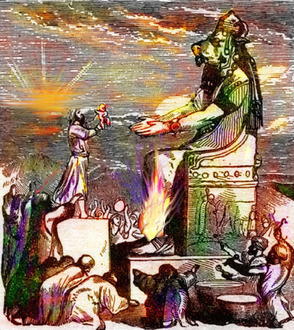 “Passing children through the fire” was the Ammonite’s practice of pagan child sacrifice to the calf-headed man-god named Molech (2 Kings 16:3; 2 Chronicles 28:3, 33:6; Jeremiah 7:31; 19:2-6), and this practice was prohibited by the Old Testament as idolatrous (not to mention abhorrent). Paralleling this pagan worship barbarism was the gruesome military practice employed by some of Israel’s enemies of dashing captured children on rocks, even opening up the wombs of captured pregnant women to accomplish this.
These practices were despised by the biblical writers. Yet in Psalm 137, baby smashing is given a painful twist. The psalmist bemoans Israel’s captivity in Babylon. There is weeping and unimaginable hardship. He calls his captors tormentors. He calls Babylon a devastator. With very honest, human frustration, the writer dreams of payback. He can’t help it. He expresses his desire in verse 9 that the tables might one day be turned on his captors. While Israelites usually avoided the barbarism of foreign powers, like baby smashing, he cries out a blessing on someone, anyone, who might one day smash Babylon’s babies on rocks. Let them one day feel our pain.
Context is everything in biblical exegesis, and in the Old Testament there is an intentional contrast between the atrocities of war and idolatrous child sacrifices of her neighbors, and the practices of Israel, the people chosen of God.
Idolatry, of course, is when we worship something other than God. Today, too many Christians treat the Bible as an object of worship, almost as if it’s a fourth member of the Holy Trinity. But his Word (Jesus is the Word of God—John 1:1-4, 14; Rev 19:13) is a person who is alive, active, more powerful that a double-edged sword, and not confined to a book, not even the Holy Bible.
*This article was published in Plain Truth Magazine by the title, "Does the Bible Really Say That?" (That should be a hot link to the article. The layout is cool.)


