
Let me show you that the medium from Endor didn’t really raise the Prophet Samuel’s ghost from her “conjuring pit.” Bodiless spirits were the belief of pagan cults, not the faith of Israel. Look at this prohibition in Jewish law:
NIV Deuteronomy 18:10-11 Let no one be found among you who sacrifices his son or daughter in {Or who makes his son or daughter pass through} the fire, who practices divination or sorcery, interprets omens, engages in witchcraft, 11 or casts spells, or who is a medium or spiritist or who consults the dead.
The Hebrew word translated by the NIV as medium is bAa 'owb {pronounced obe}. ‘Owb can refer to the medium or to the pit used by the medium to conjure up underworld spirits. For example, look at this verse about the sacrilege of King Manasseh:
NET 2 Chronicles 33:6 He passed his sons through the fire in the Valley of Ben-Hinnom* and practiced divination, omen reading, and sorcery. He set up a pit** to conjure up underworld spirits and appointed magicians to supervise it. He did a great amount of evil before the LORD and angered him.
*Ben-Hinnom is a valley just to the south of Jerusalem. Idolatry and child sacrifice were committed there. The Valley of Hinnom, or Gehenna in the New Testament, was where the city’s sewage and garbage were burned day and night. Gehenna is one of three biblical terms sometimes translated as hell. The others are Sheol, Hades, and Tartarus. For definitions of hell, Sheol, Hades, Gehenna, and Tartarus see my blogs Hell Defined 1 and Hell Defined 2.
**Pit: It’s not known what these “conjuring pits” looked like, but you would do well, should you be interested, to explore the “sacred springs” at Delphi in Greece and at Didyma in Turkey, where prophetesses (oracles), intoxicated on the fumes from the springs, would “tell the future.” I suspect that the pagan Greek rituals were as elaborate as the huge temples that housed them. The rituals of mediums at local conjuring pits in the tiny kingdom of Israel were undoubtedly more humble affairs.
So ‘owb refers to both the magic pit and the medium who conjures with it. The so-called “Witch of Endor” is such a medium:
NET 1 Samuel 28:7 So Saul instructed his servants, "Find for me a woman who is a medium (‘owb – or one who divines with a ritual pit), so that I may go to her and inquire of her." His servants replied to him, "There is a woman who is a medium in Endor."
The Endor medium story is a bit long to include in its entirety, but select verses will help you see that while the woman seems (at first reading) to raise the dead prophet Samuel’s soul or shade or ghost from the underworld or Hades,* she’s a fraud.
[*For definitions of hell, Sheol, Hades, Gehenna, and Tartarus see my two-part blog entitled Hell Defined]
The disguised King Saul says to the woman, "Use your ritual pit to conjure up for me the one I tell you." (v. 8) But the woman expresses suspicion:
NET 1 Samuel 28:9 "Look, you are aware of what Saul has done; he has removed the mediums and magicians from the land. Why are you trapping me so you can put me to death?" (italics mine)
Could she be pretending not to know that the man before her is King Saul? Why couldn’t the king’s aid—who knew exactly where the illegal medium was—have tipped her off? You get brownie points for pleasing the king. If you supply a medium for the king, wouldn’t you want her to perform well, for your own sake? Besides, mediums weren’t fools. They made their livings fooling others. She could have seen through Saul’s disguise without any tips from an aid. By whatever means she identified her customer, I’m certain that she knows up front that the man is Saul. But—and this is important—she pretends not to know, for reasons I’ll explain in a sec.
A medium, one who uses a ritual pit to call up dead souls or shades, is an ‘owb in Hebrew. They were known tricksters and illusionists. So much so that when the Septuagint was first written—the Hebrew Bible translated into Greek in the 3rd Century B.C.—, what Greek word did they use for ‘owb? You’re not going to believe this. The Septuagint renders the Hebrew ‘owb (a medium who uses a conjuring pit) as engastrimuthos, which means ventriloquist! Why? Because that’s what an ‘owb did. The medium with the conjuring pit had to convince her customer that his dead relative or friend was present and speaking. Ventriloquism was part of the act. Mediums counted on being able to produce the illusion of a disembodied voice.
Isaiah discredits these mediums or necromancers as ventriloquists:
NKJ Isaiah 8:19 And when they say to you, "Seek those who are mediums and wizards, who whisper* and mutter**," should not a people seek their God? Should they seek the dead on behalf of the living?
* tsaphaph {tsaw-faf'} means to chirp, peep, chatter, or whisper
** hagah {haw-gaw'} means to moan, growl, make a sound, or mutter

Back to Endor: Could the Medium of Endor be pretending not to know that the man before her is King Saul? If she knows, she certainly doesn’t let on that she knows. Not yet. In just a moment she can use what she’s deduced to her advantage, so she holds the card close to her vest. She hides that she’s seen through his disguise so that she can impress him with her “powers.” She is about to “divine” that the disguised man is really Saul. But how? That’s where “the ghost of Samuel” comes in.
The medium asks the man (Saul in disguise) why he’s trying to get her killed. But the man reassures her by swearing an oath to the Lord. "As surely as the LORD lives, you will not incur guilt in this matter." (v. 10) Now she’s ready to do business. Now she can play her card.
The medium asks the man, "Who is it that I should bring up for you?" He said, "Bring up for me Samuel." (v. 11) The show begins right here, folks. Watch closely or she may fool you too.
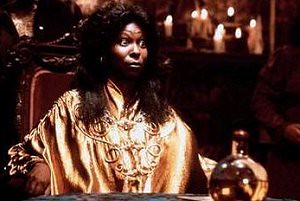
There it is. Give her an Oscar. She makes it seem like Samuel’s ghost had appeared to her and told her that the man in disguise was King Saul, though she knew it from the start. Bravo! Well played.
Saul was very impressed. He was probably thinking, Wow, she’s the real thing. How else could she have known who I am beneath this really cool disguise unless she really conjured Samuel and he revealed to her my true identity?
He was taken in by her first illusion—hook, line, and sinker. What happened next? The king said to her, "Don't be afraid. What have you seen?" (v. 12) The woman replied to Saul, "I have seen one like a god (or a spirit) coming up from the ground!" Don’t miss it, folks. Saul sees and hears nothing. She, the powerful medium, is the only one who supposedly hears and sees the dead prophet Samuel’s ghost. Saul doesn’t see or hear a blessed thing.
But the king’s hooked. Saul believes Samuel is there. He believes she sees and hears the prophet. Why? From Saul’s perspective, he was convinced that Samuel was there because he believed that Samuel revealed the disguised king’s true identity to the woman. (As I said before, likely someone told her the king was coming in a disguise, or maybe it was not such a great disguise. Something or someone tipped her off.) Her knowing his identity persuaded Saul that Samuel was present, and he believed that the medium could really hear and see the dead prophet’s ghost.
Saul asked the medium, "What about his appearance?" (v. 14) Do you see that this question confirms again that Saul can’t see Samuel? He asks her what Samuel looks like. Saul, seeing absolutely nothing, blindly trusts the medium to describe the dead prophet’s disembodied soul. She answered Saul: "An old man is coming up! He is wrapped in a robe!" Wow, what detail! (Pardon my sarcasm.) Don’t you think everybody knew that Samuel was an old man who wore a robe?
This “vision,” nevertheless, impresses Saul. Saul (portrayed as not too bright and easily fooled) feels that she has described Samuel perfectly, and that only someone who could really see him could have described him with such accuracy. Hebrew scholar James Orr agrees that the spirit of Samuel wasn’t really conjured:
“It is not to be credited that the saintly Samuel was actually summoned from his rest by the spells of a professional diviner. . . . [The] whole transaction was a piece of feigning on the part of the woman.” (citation)
Yet Saul throws himself on the ground prostrate before the medium and the supposed, invisible, silent ghost of the dead prophet Samuel. Saul is overcome. Worse, the king of Israel is bowing before a pagan “witch” rather than the Lord God.
In verse fifteen it says that “Samuel” asked Saul, "Why have you disturbed me by bringing me up?" Well, what do you think? Did Samuel really speak this time? Was the spirit or disembodied soul or shade or ghost of the real dead prophet really there and was he really speaking? Of course not. Not before and not now. The medium is supplying the sights and sounds at this séance from the beginning. Only she sees him (or claims to). Only through her does “Samuel” speak (if at all). She’s providing Samuel’s voice, which leads us back to the Greek Bible’s name for her: ventriloquist.
“Why have you disturbed me by bringing me up?” This is “Samuel’s” question to Saul provided by the ventriloquist. And it’s a great question because it places the blame for the illegal séance on Saul’s shoulders, not hers. She’s making sure that Saul takes one hundred percent responsibility by putting words of blame on the lips of Samuel’s specter: Saul, you disturbed me. Saul, you brought me up. Why did you do it? asks the ventriloquist on “Samuel’s” behalf. Thus she protects herself from blame.
Now the duped king spills all the beans. He blurts out all the information that the medium requires to continue the ruse: "I am very concerned. The Philistines are fighting against me and God has turned away from me. He does not answer me--not by the prophets nor by dreams. So I have called on you to tell me what I should do." (v. 15)
Now the medium is set. She almost certainly has news of the current events of her nation (Geographically, the battle is in her back yard. Check a Bible map.), its history, its enemies, the kings, the prophets, Saul’s previous relationship with Samuel, Samuel’s previous prophesies, and even how the prophet spoke. Add to that the specifics of what Saul wants to know, and she’s ready to drop the bomb. Again she speaks for “Samuel”:
16 . . . "Why are you asking me, now that the LORD has turned away from you and has become your enemy? 17 The LORD has done exactly as I prophesied. The LORD has torn the kingdom from your hand and has given it to your neighbor David. 18 Since you did not obey the LORD and did not carry out his fierce anger against the Amalekites, the LORD has done this thing to you today. 19 The LORD will hand you and Israel over to the Philistines. Tomorrow both you and your sons will be with me. The LORD will also hand the army of Israel over to the Philistines."
She says nothing that she couldn’t have surmised for herself given foreknowledge of the late Samuel’s public prophesies against Saul. All she does is repeat what Samuel himself said repeatedly while he was alive:
NIV 1 Samuel 15:17-23 Samuel said, . . . “The LORD anointed you (Saul) king over Israel. 18 And he sent you on a mission, saying, 'Go and completely destroy those wicked people, the Amalekites; make war on them until you have wiped them out.' 19 Why did you not obey the LORD? Why did you pounce on the plunder and do evil in the eyes of the LORD?” . . . Because you have rejected the word of the LORD, he has rejected you as king." (See also 1 Samuel 13:13-14)
NIV 1 Samuel 15:26-28 But Samuel said to him, ". . . You have rejected the word of the LORD, and the LORD has rejected you as king over Israel!" 27 As Samuel turned to leave, Saul caught hold of the hem of his robe, and it tore. 28 Samuel said to him, "The LORD has torn the kingdom of Israel from you today and has given it to one of your neighbors-- to one better than you.”
Is it really surprising that the medium says almost word for word what Samuel had said to Saul repeatedly before? Either she’s familiar with Samuel’s public prophesies or, again, she’s used informants in preparation for the séance (knowing the king was coming) by getting information on what Saul wanted to know and what Samuel had prophesied.
All conniving and “sorcery” aside, it follows logically that if what Samuel prophesied is true, then there is no way Saul will defeat the Philistines in coming battle. And if Samuel said that David would be king, then it also follows that Saul must soon die. The Israelites are outnumbered by the Philistines, the war is going badly by his own admission, the disobedient King Saul is ripe for payback, and David stands ready in the wings. It doesn’t take ghosts and mediumship to predict this outcome. The writing was, as they say, on the wall.
Again, Hebrew scholar James Orr agrees:
“It required no great skill in a practiced diviner to forecast the general issue of the battle about to take place, and the disaster that would overtake Saul and his sons; while if the forecast had proved untrue, the narrative of the witch of En-dor would never have been written. Saul, in fact, was not slain, but killed himself. The incident, therefore, may best be ranked in the same category as the feats of modern mediumship.” (citation)
After the medium’s ventriloquism, Saul collapses, drained and terrified. So she shows him great hospitality, even killing her fatted calf and baking fresh bread. She pulled off the séance for the king, she secured her safety by passing full blame for the illegal séance to the king, and she entertained and rejuvenated the exhausted, fearful king. She covered all the bases; she’s one smart cookie.
And King Saul is both duped and doomed.


