Showing posts with label Bible. Show all posts

Monday, August 19, 2013

Luke 11:5-8 – The Friend at Midnight

Jesus Treated the Subject of Prayer with Humor
A Badly Mistranslated Parable
Anaideia: The Avoidance of Shame

The God-character is sleepy and annoyed by a prayerful request? Exactly!

While The Parable of the Prodigal Son and The Parable of the Good Samaritan—Jesus’ most familiar parables—have multiple scenes within a longer drama, The Friend at Midnight is one scant scene, a mere four verses.

Luke 11:5-8   5 Then he said to them, "Suppose one of you has a friend, and he goes to him at midnight and says, 'Friend, lend me three loaves of bread,  6 because a friend of mine on a journey has come to me, and I have nothing to set before him.'  7 "Then the one inside answers, 'Don't bother me. The door is already locked, and my children are with me in bed. I can't get up and give you anything.'  8 I tell you, though he will not get up and give him the bread because he is his friend, yet because of the man's boldness {8 Or persistence} he will get up and give him as much as he needs.


Characters and plot

The two main characters:
  1. a suddenly-awakened father
  2. his neighbor outside the door requesting bread for his unexpected midnight guests

The supporting cast with no speaking parts includes:
  1. the father’s sleeping family
  2. the hungry travelers at the neighbor’s house
  3. and we can presume the presence of sleeping villagers

Plot:
Jesus’ analogy about prayer takes place at a house in a Jewish village in the middle of the night. A father (representing God) and his family are asleep in their home when a neighbor (representing one who prays) comes to call asking for bread for travelers who have shown up unexpectedly. The shock introduced by Jesus is that the drowsy father says in reply, “Don’t bother me,” and he makes weak excuses for why he can’t help. It’s inexcusably bad behavior on the part of “the God-character.” Jesus knows how to grab your attention.


Jesus used two ancient literary techniques in one parable

Technique #1: “Who among you . . .” – Jesus employs an ancient Middle Eastern teaching technique by asking a question that can only be answered with an emphatic No. The technique uses the phrase “who among you.” Can anyone of you imagine a friend refusing you bread at midnight when you have unexpected guests from out of town? No, this is unimaginable, both in Jesus’ day and today in the Middle East. Such a refusal would be shameful, especially in light of the rude words and ridiculous excuses that the friend made. This refusal, these rude words, and these flimsy excuses are so unthinkable that it is humorous.

Here, as is often the case, we see Jesus’ sense of humor in high gear. We’ve often heard this parable somberly intoned from lofty pulpits, but it is impossible to tell this tale—given a first century Jewish perspective—without a twinkle in the eye and a tongue planted firmly in the cheek. If Jesus were asking for a show of hands (when he asked, Who among you can imagine this?), he would have gotten zero hands and a room full of chuckles.

Do you have a hard time imagining Jesus laughing? Kidding around? Poking fun? Using sarcasm and irony? Using funny voices when he dramatizes his characters’ lines? Making faces when he dramatizes a scene? Our near inability to see and hear Jesus telling a good story well, with humor and drama and maybe even sound effects, is tragic. I think it’s due to at least two factors.

  • One, 2,000 years have gone by and Jesus was from another culture that used a different language. We can often recapture Jesus’ humor, however, by putting on first century ears, to the extent that that is possible.
  • Two, religion tends to take itself super seriously. Could we be victims of generations of teachers and preachers who have de-humor-ized (and therefore dehumanized) Jesus and his teachings? I think so. In an attempt to stress the urgency of belief and the gravity of our “all-important afterlife choice,” they have ignored or suppressed any creative playfulness they may have accidentally found in Jesus’ teaching. Moreover, as in the case in our featured parable, if Jesus can tell a humorous parable about prayer, then maybe our approach to prayer could be a little less grim than we tend to make it.
Jesus employs the technique of “who among you” often; the only possible response is a negative one; to respond in the positive is ludicrous and laughable. And this is Jesus’ humorous intent:

NAB Luke 11:11-12  “What father among you would hand his son a snake when he asks for a fish?  12 Or hand him a scorpion when he asks for an egg?”

(See also Luke 14:5, 15:4, 17:7)

In our featured parable Jesus asks his listeners to “suppose.” This is another way of saying, “Who among you can imagine this?”

Luke 11:5-7  “Suppose one of you has a friend, and he goes to him at midnight and says, 'Friend, lend me three loaves of bread,  6 because a friend of mine on a journey has come to me, and I have nothing to set before him.'  7 "Then the one inside answers, 'Don't bother me. The door is already locked, and my children are with me in bed. I can't get up and give you anything.'”

The answer to the implied question—who among you can suppose this?—is “No one can suppose this. Such a response to this request is un-supposable.”

Technique #2: “How much more . . .” – Jesus employs another ancient Middle Eastern teaching technique in this parable, an argument “from light to heavy.” If THIS is true, how much more then is THIS true. If something is true in a lighter everyday situation, then how much more true it must be in application to a much weightier matter. Sometimes Jesus identifies this technique with the very words “how much more.”

Matthew 7:11   11 If you, then, though you are evil, know how to give good gifts to your children, how much more will your Father in heaven give good gifts to those who ask him!

Matthew 10:25   25 It is enough for the student to be like his teacher, and the servant like his master. If the head of the house has been called Beelzebub, {25 Greek Beezeboul or Beelzeboul} how much more the members of his household!

Matthew 12:12   12How much more valuable is a man than a sheep! Therefore it is lawful to do good on the Sabbath."

(See also Luke 11:13, 12:24, 12:27-28)

Sometimes, however, Jesus employs the technique of “how much more” without using those words, as in the Parable of the Unjust Judge, for example.

Luke 18:2-8   2 He said: "In a certain town there was a judge who neither feared God nor cared about men.  3 And there was a widow in that town who kept coming to him with the plea, 'Grant me justice against my adversary.'  4 "For some time he refused. But finally he said to himself, 'Even though I don't fear God or care about men,  5 yet because this widow keeps bothering me, I will see that she gets justice, so that she won't eventually wear me out with her coming!'"  6 And the Lord said, "Listen to what the unjust judge says.  7 And will not God bring about justice for his chosen ones, who cry out to him day and night? Will he keep putting them off?  8 I tell you, he will see that they get justice, and quickly.

While in the telling of this parable Jesus did not use the phrase “how much more,” he nevertheless employed the technique. One could insert the phrase in verse seven by changing his question into a sentence. “How much more then will God bring about justice for his chosen ones, who cry out to him day and night!” I consider The Unjust Judge a sister parable to The Friend at Midnight. They both are designed with the technique of “how much more,” and they are both about prayer.

The Apostle Paul also used this technique, including four times in Romans 5.

Romans 5:17   17 For if, by the trespass of the one man, death reigned through that one man, how much more will those who receive God's abundant provision of grace and of the gift of righteousness reign in life through the one man, Jesus Christ.

(See also Roman 5:9, 10, and 15)

The writer of Hebrews was fond of this technique as well.

Hebrews 12:9   9 Moreover, we have all had human fathers who disciplined us and we respected them for it. How much more should we submit to the Father of our spirits and live!

(See also Hebrews 9:13-14 and 10:28-29)


Jesus employs three metaphors to support the parable

Luke records Jesus telling his disciples our featured parable (Luke 11:5-8) and then following that parable with three helpful metaphors:

1) asking, seeking, and knocking
2) fish or snake
3) egg or scorpion

Luke 11:9-13   9 "So I say to you: Ask and it will be given to you; seek and you will find; knock and the door will be opened to you.  10 For everyone who asks receives; he who seeks finds; and to him who knocks, the door will be opened.  11 "Which of you fathers, if your son asks for {11 Some manuscripts for bread, will give him a stone; or if he asks for} a fish, will give him a snake instead?  12 Or if he asks for an egg, will give him a scorpion?  13 If you then, though you are evil, know how to give good gifts to your children, how much more will your Father in heaven give the Holy Spirit to those who ask him!"

The closing verse (13) interprets the fish-or-snake and egg-or-scorpion metaphors, and it gives us a strong hint of how to interpret our featured parable. We are to interpret it as a “how much more” saying. This is where the translation and application of the word anaideia comes into play as the key to understanding The Parable of the Friend at Midnight. It’s a “how much more” parable, best interpreted by verse 13.

Luke 11:13   If you then, though you are evil, know how to give good gifts to your children, how much more will your Father in heaven give the Holy Spirit to those who ask him!"

Note also that Jesus concludes not with asking for a new car, but asking for the Holy Spirit. Prayer begins with this because the Spirit is God’s personal presence and power. By asking for the Spirit, you are not asking for specific needs, thus you are trusting the Spirit to know what you need, what you really need, rather than what you think you need. It’s a way of exercising faith. You prayerfully trust God to know what you need and what he already desires deeply to give you. It’s opening yourself to God’s agenda by putting your agenda aside. It would be like a child sitting on Santa’s knee and saying, “You know what I need and I trust you to give it to me. Thanks in advance.”


Three ways archaeology and history help with this scene

  1. Nighttime travel – Contemporary literature to the New Testament in the Middle East refers to people traveling at night on purpose because of the desert heat during the day. Traveling by the relative cool of the evening on moonlit roads was logical and common. So travelers arriving in the middle of the night in need of bread would have likely surprised no one among Jesus’ listeners. This probably happened all the time.
  1. Bread – There are three things about bread in first century Palestine that you should know.
a.       It may be that village bread-baking was put on a rotation schedule by the women. They may have coordinated the chore so that they all didn’t have to bake every day, and they didn’t have to bake just one or two loaves at a time. One woman (or a few designated women) would bake a lot of bread for the day’s consumption by the whole village. You took your turn. You worked in shifts. This being the case, it explains why a neighbor would have to go to another house for bread. The bread was baked by a certain woman that day, and she had the daily stash of leftover loaves from that day. If you had an unexpected need for bread in the middle of the night, you could discover who baked that day simply by asking your wife. Then you would go to that house and ask for some.
b.      This is not just a matter of the travelers being hungry. As we might offer an unexpected visitor to come in, have a seat, have something to eat, or have something to drink, even more so in Middle Eastern culture, you offer (among other things) bread. It’s a matter of hospitality. It would be shameful not to offer bread.
c.       Also remember that in the Middle East, then as sometimes today, the bread is more than a meal. It is your eating utensil. You use it as a fork or spoon to eat other dishes provided. You pick up meats or vegetables from a common plate or bowl with a piece of bread. You dip bread in dishes of sauce or cups of wine. Bread dipped into something is called “sop.” It’s like dunking your donut in coffee. The most famous biblical sop is this:

NIV Matthew 26:23 Jesus replied, “The one who has dipped his hand into the bowl with me will betray me.”

ASV John 13:26 Jesus therefore answereth, He it is, for whom I shall dip the sop, and give it him. So when he had dipped the sop, he taketh and giveth it to Judas, the son of Simon Iscariot. 27 And after the sop, then entered Satan into him. Jesus therefore saith unto him, What thou doest, do quickly. 28 Now no man at the table knew for what intent he spake this unto him.

To sop is to use bread to soak up a liquid for eating. Today this is most frequently done (perhaps more so in the southern US) by using biscuits to sop up gravy. In this case, no fork or spoon is required. The bread is your “utensil.” Today in Palestine this is everywhere an everyday occurrence. Go to almost any restaurant. Plates of various salads and hummus are brought to the table with pita bread as an appetizer. No silverware required. Just dip and eat.

  1. Kataluma – Imagine a small living space with mats spread on the floor for the entire family to sleep on. At the back of the room is the brick oven where coals warm the bread and the room. At the other end is the door to the modest first century home. The father and mother sleep next to the oven so that they can reach and provide food or water for the children should they need them in the night. Therefore there are sleeping children between the father and the door. This being the case, then, it is true that the father would have to disturb his children by climbing over them to make his way to the door to hand the neighbor some bread. Yes, it’s a flimsy excuse, but it is nonetheless true. This fact fits both the parable and the layout of excavated first century homes in typical Jewish villages like Nazareth and Bethlehem.
That main living room where people gathered, ate, and slept is called in the Bible the kataluma. Now perhaps it is clearer what Luke meant in the verse describing Jesus’ birth.

NJB Luke 2:7 and she gave birth to a son, her first-born. She wrapped him in swaddling clothes and laid him in a manger because there was no room (topos – spot, space, or place, not a hotel room) for them in the living-space (kataluma – not pandochieon which means inn).

The manger (phante – animal feed trough) would have likely been in a room or cave beneath or behind the house—a stable or sheepfold of sorts for the family animals. Such a place would have given the privacy and isolation needed for childbirth. People would be sleeping in the main room, and childbirth renders the mother and others involved ritually impure. Childbirth would defile the living room and its occupants. Therefore, since the occupied living quarters (kataluma) was no place (topos) for labor and delivery, Mary went to a private place, the stable or sheepfold beneath or in the back of the house, as probably did any mother in that day giving birth at home, and she used a manger there for Jesus’ crib as is logical for any mother of the day.

While in The Parable of the Friend at Midnight, neither childbirth nor defilement was the issue, there are still the issues of privacy and inconvenience. The friend in need is causing a midnight disturbance.


Key translation problem: the Greek word anaideia

avnai,deia anaideia {an-ah'-ee-die-ah'} – it means shamelessness

Most English translations of the Bible translate anaideia as boldness or persistence.

NIV Luke 11:8   “I tell you, though he will not get up and give him the bread because he is his friend, yet because of the man's boldness {8 Or persistence} he will get up and give him as much as he needs.” (emphasis mine)

But there are two major problems with translating anaideia as boldness or persistence:

  1. Anaideia does not and cannot mean boldness or persistence. It means shamelessness.
  1. It is the sleeping man, not the man at the door asking for bread, who possesses the trait of anaideia – shamelessness.
Darby’s Translation comes closer to the original Greek meaning:

DBY Luke 11:8   I say to you, Although he will not get up and give them to him because he is his friend, because of his shamelessness (anaideia), at any rate, he will rise and give him as many as he wants. (emphasis mine)

The man at the door is not identified by Jesus as shameless. The man in bed is.

Why is this word consistently mistranslated and then incorrectly applied to the man at the door? Simple. The sleeping man is the “God character,” and Jesus can’t possibly be calling him shameless, it is assumed. So to make this “make sense,” translators have consistently changed shamelessness to persistence or boldness—making the message parallel to another parable where a bold woman annoyed an unjust judge with persistent pleading to hear her case (Luke 18:1-8 – another “how much more” parable)—and apply the trait of bold persistence to the man at the door. By doing this, almost all English translations have missed Jesus’ point completely.

What persistence or boldness did the man needing bread demonstrate in Jesus’ parable? None. As Jesus describes it, the neighbor came and asked for bread. That’s it. He asked once. What’s bold about that? What’s persistent about that? Only if we imagine him asking again and again, louder and louder, creating a ruckus and waking the house, can we call him bold or persistent. But he did none of those things.

Look carefully at verse 8. It’s all about the sleeping man. Because of his (the sleeping man’s) shamelessness, he (the sleeping man) will get up, and he (the sleeping man) will provide bread. It’s all about the sleeping man.

But this raises the key question about the key word anaideia: What is this shamelessness that motivates the sleeping man?


Anaideia = avoidance of shame

The reason that the unjust judge finally hears the case of the pestering woman is not because he cares about her or even about justice. He finally hears her case because she’s wearing him out. She’s a pain in the neck. She won’t shut up or go away. He hears her case just to get rid of her! Jesus’ point then, in that parable, is that if this unjust judge who cares nothing for her, who “fears neither God nor man,” and who cares little for justice, will in the end hear her case, how much more then will God who cares both for you and justice hear your prayers.

In our featured parable, however, the sleeping fellow doesn’t change his mind and provide the bread because of the persistence/boldness of the man at the door. And he doesn’t give bread to him just to shut him up and get rid of him. There is another reason: anaideia.

If the sleeper refuses to provide the bread, it will create a chain reaction of negative results. The man at the door will go back to his family and his out-of-town guests empty handed, complaining that the guy with the bread said, “Go away!” His lame excuses about the door being locked and the children asleep will be met with incredulity. By morning the whole village will be abuzz.

What we may fail to realize because of our western mindset is that this bread issue is a village hospitality issue. How a family treats visitors reflects directly on the village. If one family mistreats a visitor, the whole village has mistreated a visitor. Such inhospitality is the height of shame for the village.

And here’s what’s important. The sleeping guy knows this! If it were merely a personal matter between him and the guy asking for bread, he wouldn’t have gotten up because, clearly, he just didn’t want to be bothered. But more was at stake. The hospitality of the village was at stake, and if he didn’t get up, the village would have come down on his head. He would have brought shame not just on himself (which he didn’t care about at all), but his refusal would have brought shame on the village. Now maybe he didn’t care about that either, but what he did care about was the long-term anger and ostracization his negligence would bring on him.

So the closest word in English for anaideia is shamelessness, but what is intended is the avoidance of the shame to the village that would result from his refusal to provide bread for visitors, and, of course the avoidance of the resulting probable sustained ire of the village toward him. “Shame on you!” would be the cry on the streets for years to come. Anaideia in this context means a desired shame-less state, a state minus (less) the shame, a state where shame has been avoided, thus anaideia in the context of this parable means the avoidance of shame.

“I tell you though he will not give him anything having arisen because of being his friend but because of his avoidance of shame he will get up and give him whatever he wants.” (Translation of Luke 11:8 by Kenneth E. Bailey, “Poet and Peasant”)

The unjust judge might have had no integrity, and the sleeping guy might have had no integrity, but God does. That’s Jesus’ point, and he makes it with a heaping helping of humor. God has integrity because he loves you. God acts because he cares about you. He doesn’t act just to shut you up and get rid of you, as the judge did to the widow. And he doesn’t act because everybody will call him shameful if he doesn’t, as the sleeping man did to the neighbor at the door at midnight. Unlike Jesus’ “God-characters” without integrity, you can trust God who acts out of the integrity of love and care. Unjust and shameful are not attributes of God, says Jesus.


Example: Eating on the Mount of Olives with a Palestinian family

I was in for a shock the first time I was invited to a Palestinian friend’s home for dinner. His son picked me up at my hotel and drove me to their three-story home on the Mount of Olives. The son, his third, was about to be married, and the top floor had just been completed in preparation. My friend and his wife had moved to the top floor, his two oldest sons had moved up to the second floor with their families, leaving the bottom floor available for the youngest (third) son and his new wife-to-be the bottom floor. He drove like a madman. But that wasn’t the shock. Everyone drives like a madman in Jerusalem.

When I reached the top floor, the bedroom was not yet furnished. It was a large room with windows overlooking the Judean Wilderness, Jericho, the Jordan River and Dead Sea, and the mountains of Trans-Jordan on the horizon. A full moon was rising above the red jagged peaks.

Carpets covered with a plastic table cloth were on the floor surrounded by cushions and pillows. I was directed to sit or recline with my friend. The two of us were treated to hot tea, pita bread, hummus, and a variety of salads, all served by his wife and daughters. We dipped sop from common dishes while the sons and grandsons stood against the wall talking and observing. Then, to my surprise, people from the village began to arrive, and they also stood around against the walls talking and observing. Soon there were thirty or more people watching me eat!

Yes, the villagers were welcome, and they would eventually share in the feast of lamb, chicken, and beef, all served on large platters with attention to presentation. But not before they watched me eat till I was sick. They put enough food for an army in front of little ol’ me. It was an impressive spread, as was intended. I was to be impressed, even overwhelmed, by their generous hospitality. And I pigged out. In the southern US there is a saying about “putting on the whole hog.” No pork was actually served, but my friend went all out just for me.

The village came for another purpose, however. They were witnesses. When a special guest is invited to the home of a Palestinian, it is not just a family invitation. It is a village invitation. They were there to insure that the village was represented properly. For if my friend had failed to duly impress and overwhelm me with hospitality, it would not have merely reflected on him and his family; it would have reflected on the village. They were there to make sure that the village avoided shame—anaideia.


Meaning in light of the immediate context

It’s about trust.

Luke 11:1-4 is the Lord’s Prayer, a prayer of trust in God.

Luke 11:5-8 is a parable (The Friend at Midnight) about trusting God in prayer.

Luke 11:9-12 offers three metaphors about trusting God in prayer.

Luke 11:13 sums up these teachings about prayer by saying that God is trustworthy to give the Holy Spirit to those who ask for him in prayer.

Jesus follows his own personal prayer with instructions on how to pray, with a humorous parable, and with three humorous analogies about God’s trustworthiness when we pray. Can he be saying that the depth and sincerity of prayer is in no way canceled out by lightening up when we approach him? What’s all the seriousness about, all the crying, and all the groveling? Do we really believe that posturing, posing, and pleading will make God care and love more? We act as though we do, even today. Maybe Jesus is saying simply this:

When you pray, you need not worry that God is asleep

Monday, May 28, 2012

The Da Vinci Code: FACT?

I am not worried that Dan Brown's The Da Vince Code harms anyone's faith. If a so-so novel brimming with falsehoods can destroy one's faith, then one's faith was not very strong to begin with.

I am, however, concerned about one thing, and it stems from Brown's statement of "fact" at the beginning of The Da Vinci Code. His novel begins with a page entitled FACT, and this quote: 


"All descriptions of artwork, architecture, documents, and secret rituals in this novel are accurate." Dan Brown 

Brown's quote on his FACT page is displayed prominently at the beginning of the book. Historians and biblical scholars alike have debunked this claim over and over since the book's publication, they have done so in dozens of articles and books (I recommend Ben Witherington's book, The Gospel Code.), yet the public seems to have, by and large, bought this fabrication to this day.

Whenever this comes up in conversation, someone often says to me, "Yeah, Bert, but it's just a novel." And that is unquestionably true. But how many bestselling novels have you read that begin with a page entitled FACT, and how many of them have a FACT page with false claims about the Bible?

There are three inaccuracies in this single sentence about ancient documents we call gospels:

"More than eighty gospels were considered for the New Testament and yet only a relatively few were chosen for inclusion - Matthew, Mark, Luke and John among them." Dan Brown, The Da Vinci Code, p. 231

Brown says this statement is factual, since the gospels are among the documents that he claims on his FACT page to describe accurately in his novel. But he is wrong:

  1. We know of 32 gospels--34 if you include the hypothetical gospels of "Q" and "Signs". Thirty-two is far from "over eighty."
  2. No one knows how many gospels were considered by the early church for inclusion in the biblical canon. So far as we know, the four gospels in the Bible are the only gospels that were considered.
  3. When Brown wrote that relatively few gospels were chosen for inclusion in the Bible--"Mathew, Mark, Luke and John among them" (emphasis mine), he's wrong again. Matthew, Mark, Luke, and John are not four among others included in the Bible. They are the only gospels included in the Bible.

By these three inaccuracies alone, it must be concluded that Brown's universal claim of FACT concerning his descriptions of documents in The Da Vinci Code is patently false, but there is more.

The most absurd claim to me in Brown's novel is the claim that the four gospels in the Bible suppress Jesus' humanity and emphasize his divinity--a repeated claim in The Da Vinci Code. Brown paints this “fact” as the biggest conspiracy and cover-up in history. He further claims that the gospels not included in the Bible have been suppressed, and that they emphasize Jesus' humanity, and are therefore truer than the four biblical gospels. Dan Brown has this exactly backwards. Our four New Testament gospels - Matthew, Mark, Luke, and John - emphasize Jesus' humanity, and the bulk of the other gospels not found in the Bible (most of them considered to be Gnostic gospels) emphasize Jesus' divinity. Brown, claiming the opposite, could not be more wrong.


Is Brown intentionally lying about the Bible? I don't know. Either he is a shoddy researcher or he's misleading the public on purpose for profit. If the former, why not just apologize for his misstatements? If the latter, shame on him and buyer beware.


Saturday, April 24, 2010

Bless the Baby Smashers?

By David Foreman and Bert Gary

Do you want to claim all the blessings of the Bible? I’ve heard pastors telling their congregants to claim this very thing. But I have reservations. And I raise my reservations in order to question common assumptions about what the Bible is and how to interpret it.


Now I like this blessing:

Blessed is he who has regard for the weak; the LORD delivers him in times of trouble. (Psalm 41:1)

But look at this one:

Blessed shall he be who takes your little ones and dashes them against the rock! (Psalm 137:9 - ESV)   

Do I really want to claim all the blessings in the Bible? I realize the Bible assures us, "For every one of God’s promises are “Yes” in him; therefore also through him the “Amen” is spoken, to the glory we give to God." (2 Cor 1:20 - NET) But obviously I can’t claim the right to be a blessed baby smasher, can I? Houston, we have a problem.

As I have grown to love and trust the Bible, I’ve come to understand that the Scriptures “plainly” say a lot of things. But, where I see us frequently getting off track is when we fail to realize that, if not reverently cautious to read Scriptures in context, we can read the Bible saying a lot of things that the Bible “plainly” doesn't say.

Here are two ten-dollar words that all students of the Bible should learn:


  • Exegesis [pronounced ek-si-JEE-sis]
  • Eisegesis [pronounced ahy-si-JEE-sis]


Exegesis means “a reading out.” It’s the faithful attempt to interpret the message of Scriptures in context. Eisegesis means “a reading into.” It’s the frequent and unfortunate practice of imposing external assumptions on Scriptures to the neglect of a serious attempt to search for meaning in context.

Eisegesis has an unfortunate result in the church. I've seen too many dear saints look down on themselves because they've "claimed" some biblical promise plucked from its context, only to have God "fail to deliver on his 'word.'" Since the fault can't be with God, they conclude that it must be a lack of faith on their part. So how can we address this, maybe even fix this?

I now look at it like this. Just because God seems to promise a blessing, like the promise of blessings on baby smashers, does not mean we can "claim" that biblical promise for ourselves willy-nilly. Context matters to faithful interpretation. And most Christians would quickly agree, I think, that something is just wrong in randomly claiming promises that may mean something vastly different in context, and promises that may not even apply to them.

Look, brothers and sisters. What if it’s not that God has failed on his promises or that you lacked faith? What if sound exegesis reveals that he never made those promises to you in the first place?

Jesus blessed a variety of people in what is called The Beatitudes recorded in his Sermon on the Mount. Here’s one:

"Blessed are the poor in spirit, for theirs is the kingdom of heaven." (Matthew 5:3)

This blessing is widely interpreted as: I have to be poor in spirit to get the kingdom of heaven. But who wants to be poor in spirit? I don’t! I’ve been there, and I wanted out. No one in their right mind, it seems to me, wants “the dark night of the soul.” We are doing eisegesis, a reading into the Scripture our own false assumption. We are reading into Jesus’ words something that’s not there.

It takes nothing away from me and you that Jesus blesses those who at that moment (or any moment) may be walking through the valley of the shadow of death. This misreading is so human. We turn Jesus’ beautiful blessing on those who are in deep despair into a “how to” formula for earning his blessing! Why can’t we just celebrate that Jesus blesses people in spiritual meltdown, knowing that the time may come, sooner that we might wish, when one of those unfortunates may be one of us?

I believe, as Scripture says, all of God's promises are Yes and Amen. When God really makes you a promise, he will really keep it. But just because you make a quick reading (or misreading) of a verse, doesn't mean you can presume a personal promise from God. Sometimes you can, admittedly. Good exegesis bears it out. Here’s an example, again from the Sermon on the Mount.

"Blessed are you when people insult you, persecute you and falsely say all kinds of evil against you because of me.” (Matthew 5:11)

Context and content both promise something straightforward and simple. It doesn’t mean that you should go out trying to make people hate you and lie about you so you can earn the blessing! It means that when your love and loyalty to Jesus results in the deep hurt that comes from people hating you and lying about you, know deep in your heart that you are blessed personally by that same Lord. That’s a biblical promise you can bank on when such a situation arises.

We can avoid misusing the Scriptures by the very way we approach them in the first place. Yes, Scripture is good for training, doctrine, etc. But (and I'm sure some "fundies" will crucify me for this) Scripture is not the “end all” in knowing God. This is not my opinion. Jesus said it.

“You diligently study the Scriptures because you think that by them you possess eternal life. These are the Scriptures that testify about me, 40 yet you refuse to come to me to have life.” (John 5:39-40)

He has life, not the paper and ink. The purpose of the Scriptures is to point us to life in him. Scriptures invite us to draw near to him, and let him reveal himself to us personally. Let him reveal truth to us personally. Scriptures are for our aid and guidance in getting to him. To make Scriptures more than that, biblically speaking, is idolatry. The Bible isn’t God. It points us to him and leads us to life abundant in a close personal relationship with him.


I have come to trust that the Bible is divinely inspired by God. But there is a difference between divine inspiration and divine "dictation." It was, after all, God who completely trusted the imperfect human beings who wrote and collected the documents in our Bible. He created these people, endowed them with intelligence and talent and skill, and employed them by the power of his Holy Spirit to write those things which lead us to knowledge of God.

This is why I cannot label the Bible, as it is often labeled, as an “owner’s manual,” a “playbook,” a “rulebook,” or a “how to guide.” These smack to me of marketing gimmicks. I see the Bible as the inspired story of God’s love for his people, and his determination to have a relationship of utter union with them. We are invited by Scripture to abide in him, even as he abides in us.

So what about the baby smashing blessing?

There are a few Scriptures about it (2 Kgs 8:12; Isa 13:16; Hos 13:16; Nah 3:10). Amazingly, thanks to eisegesis, hardcore doctrines have been established on less! We've seen great misuses with New Age fads, for example, like "prosperity teaching." We then judge the faith of others by how nice of a car they drive. And if we drive a clunker, we judge ourselves as faith-deficient. Let’s not let these abuses slide. Yes, the Bible is "good for doctrine," but this doesn't mean that we can skim, pluck something out, and twist it to fit our whims.

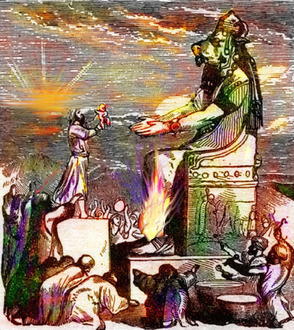
“Passing children through the fire” was the Ammonite’s practice of pagan child sacrifice to the calf-headed man-god named Molech (2 Kings 16:3; 2 Chronicles 28:3, 33:6; Jeremiah 7:31; 19:2-6), and this practice was prohibited by the Old Testament as idolatrous (not to mention abhorrent). Paralleling this pagan worship barbarism was the gruesome military practice employed by some of Israel’s enemies of dashing captured children on rocks, even opening up the wombs of captured pregnant women to accomplish this.

These practices were despised by the biblical writers. Yet in Psalm 137, baby smashing is given a painful twist. The psalmist bemoans Israel’s captivity in Babylon. There is weeping and unimaginable hardship. He calls his captors tormentors. He calls Babylon a devastator. With very honest, human frustration, the writer dreams of payback. He can’t help it. He expresses his desire in verse 9 that the tables might one day be turned on his captors. While Israelites usually avoided the barbarism of foreign powers, like baby smashing, he cries out a blessing on someone, anyone, who might one day smash Babylon’s babies on rocks. Let them one day feel our pain.

Context is everything in biblical exegesis, and in the Old Testament there is an intentional contrast between the atrocities of war and idolatrous child sacrifices of her neighbors, and the practices of Israel, the people chosen of God.

Idolatry, of course, is when we worship something other than God. Today, too many Christians treat the Bible as an object of worship, almost as if it’s a fourth member of the Holy Trinity. But his Word (Jesus is the Word of God—John 1:1-4, 14; Rev 19:13) is a person who is alive, active, more powerful that a double-edged sword, and not confined to a book, not even the Holy Bible.

*This article was published in Plain Truth Magazine by the title, "Does the Bible Really Say That?" (That should be a hot link to the article. The layout is cool.)

Saturday, August 29, 2009

Every head bowed and every eye closed


A priest, a minister, and a guru sat discussing the best position for prayer, while a telephone repairman worked nearby.

“Kneeling is definitely the best way to pray,” said the priest.

“No,” said the minister. “I get the best results standing with my hands outstretched to heaven.”

“You’re both wrong,” said the guru. “The most effective prayer position is lying down on the floor.”

The repairman, unable to contain himself any longer, said, “Hey, fellas. The best praying I ever did was when I was hanging upside down from a telephone pole.”
(author unknown)

When Jesus prays prior to a miracle, something he rarely does, he looks up to heaven (once in Matthew, twice in Mark, once in Luke, and once in John). For example,

Mark 6:41 Taking the five loaves and the two fish, he looked up to heaven (ouranos = heaven or sky), and blessed and broke the loaves, and gave them to his disciples to set before the people; and he divided the two fish among them all.

Mark 7:34 Then looking up to heaven, he sighed and said to him, "Ephphatha," that is, "Be opened."

John 17:1 After Jesus had spoken these words, he looked up to heaven and said, "Father, the hour has come; glorify your Son so that the Son may glorify you . . .”


Why did Jesus look up to pray sometimes? Is the heavenly Father really “up there” somewhere—implying that he is somehow absent “down here”? Did Jesus believe like other ancient peoples that God’s heaven is beyond the sky’s dome of blue waters? Or was Jesus’ sense of God’s Spirit that, like the wind, it comes from everywhere in the air around and above us? The Bible neither emphasizes nor clarifies why Jesus on occasion looked upward when he prayed.

What’s strange to me is that while Jesus prayed with his eyes opened looking up, we Christians pray with our eyes closed and our heads bowed down! The next time someone says, “Let us pray,” sneak a peak. Watch the heads bow and the eyes close automatically. Some pastors go so far as to specifically instruct worshipers with the words, “Every head bowed and every eye closed.” Why is that?

Heads bowed and eyes closed may be the customary posture for prayer among Christians today, but it’s certainly not biblical. Jesus never gave instructions to bow your head and close your eyes when you pray. Neither did anyone else in the Bible. So why do we do it?

I have a theory.

In Jesus’ parable of the Praying Pharisee and Tax Collector, the Pharisee stands where he can be seen as he thanks God that he’s better than other people because he fasts a lot and gives a lot of money. But . . .

. . . the tax collector, standing far off, would not even look up to heaven, but was beating his breast and saying, 'God, be merciful to me, a sinner!' (italics mine) (Luke 18:13)

Maybe this is why we Christians face downward and close our eyes when we pray, so as to imitate this tax collector’s humility. We avoid looking up to heaven by bowing our heads.

Is there any other place in scripture where someone bows his head to pray? Sort of. Though prayer is not specified, it could be implied in four verses in the Old Testament (Gen 24:26, 48; Ex 34:8; Ps 35:13) where someone bows his head to worship.

What about the New Testament? Matthew says that Jesus once prayed with his face to the ground (Matthew 26:39), which is sort of like bowing your head. A man healed of leprosy bowed with his face to the ground and begged Jesus to heal him (Luke 5:12), which sounds like a prayer. A healed Samaritan fell with this face to the ground at Jesus’ feet (Luke 17:16) expressing thanksgiving, which could be seen as a prayer. And the disciples once took hold of Jesus’ feet and worshiped him (Matthew 28:9), perhaps including prayer.

Paul also wrote:

NET 1 Corinthians 14:25 The secrets of his heart are disclosed, and in this way he will fall down with his face to the ground and worship God, declaring, "God is really among you."

So there is evidence in the Bible, though weak, that sometimes people bowed their heads when they prayed. But are there biblical references to closing one’s eyes to pray? No. While there is some precedence for falling on your face for worship, perhaps meaning to include prayer, I can find no biblical instructions specifically to bow your head and to close your eyes when you pray.

Frankly, I don’t think Jesus intended to regulate praying postures with his parable of the Praying Pharisee and Tax Collector. It was the man’s heart—not his posture—that was “justified.” Should you press your palms together or fold them? Should you stand or kneel? Should you raise your hands or hold hands with others? Do you want to know what I think? I think you could pray standing on your head wearing a pink tutu if you wanted to, but it wouldn’t help. Prayer’s effectiveness has little to do with body position, though the creator of this imaginative chart obviously disagrees.


Nevertheless, on several occasions our New Testament says that Jesus looked up to ouranos (sky or heaven) when he prayed. Is that why his prayers always “worked”? Is there magic in looking heavenward? Was he showing us how to properly posture ourselves for prayer? If so, why do so few Christians today do it that way?

I often open my eyes when I pray. I like looking outward or upward because it reminds me that I have come to believe that the kingdom of heaven is near us, around us, among us, and within us, as Jesus insisted. I don’t have to close my eyes to imagine the kingdom. I can see it all around me with the eyes of faith.

On the other hand, many whom I’ve spoken with about this topic have told me that closing their eyes to pray helps them to block out distractions.

So, do we avoid looking toward heaven as the tax collector did in Jesus’ parable? Or should we pray with eyes heavenward as Jesus did on occasion?

Again, I don’t think it matters. I’ve never had the sense that the position of my eyelids makes God any more attentive. If it did, I’d pray upwards every time, rub my rabbit’s foot, avoid stepping on any cracks, and contort myself into the Lotus position—whatever worked.

Standing? Kneeling? Prostrate on the floor? Eyes closed? Eyes opened? Head raised? Head bowed? It doesn’t really matter, it seems to me. I doubt that posturing manipulates God. And I doubt that anyone but a religionist would monitor your prayer posture.

Friday, August 7, 2009

The Giant Flying Cube (No, not the Borg. The Bride.)


It’s strange, isn’t it, that John mixes his metaphors for the church side by side? The church, he says in the Book of Revelation, is both the Bride of Christ and a giant cube-shaped city called the New Jerusalem

Revelation 21:2 And I saw the holy city, the new Jerusalem, coming down out of heaven from God, prepared as a bride adorned for her husband.

Why both a woman given in marriage and a city? It’s really quite simple. 

John is contrasting fornication with a whore (Rome – the unholy city) and marital union with a virgin Bride (the church – the holy city).

Compare Revelation 21:2 (above) with selected verses from Revelation 17:1-9:

Revelation 17:1-9 "Come, I will show you the judgment of the great whore who is seated on many waters, 2 with whom the kings of the earth have committed fornication, and with the wine of whose fornication the inhabitants of the earth have become drunk." 3 So he carried me away in the spirit into a wilderness, and I saw a woman sitting on a scarlet beast that was full of blasphemous names, and it had seven heads and ten horns. . . . 7 But the angel said to me, "Why are you so amazed? I will tell you the mystery of the woman, and of the beast with seven heads and ten horns that carries her. . . . 9 . . . the seven heads are seven mountains on which the woman is seated . . .”

(This is referring symbolically to Rome’s seven surrounding hills for which it is famous.)

Fornication with the whore in the unholy city of Babylon (Rome and her idolatrous abominations), or union with the lamb-husband in the holy city called the New Jerusalem (the Lamb-husband’s kingdom and marital union with him)? Which will it be? John asks.

In John’s vision: Jesus is a Lamb, a groom, and a husband. The church is a bride, a wife, and a city. Rome is evil Old Testament Babylon, the unholy city, and the great whore.

Mixed metaphors? Yes. Strong language? You betcha!

So should we literalize John’s vision? Look to these mixed metaphors for your answer. Are Christ’s company of believers literally a bride? Obviously not. The bride is an image in a vision. Then is his New Jerusalem literally a massive cube flying down from the sky? Of course not. But see for yourself:


Revelation 21:16 The city lies foursquare, its length the same as its width; and he measured the city with his rod, fifteen hundred miles; its length and width and height are equal.*

*This New Jerusalem is in the form of a cube. Fifteen hundred miles cubed has a volume of eleven thousand million cubic kilometers, which is about half the volume of earth’s moon.

The New Jerusalem is a giant flying cube? If you take John’s image literally, yes! It’s a cube that’s about half the size of the moon with walls 1,500 miles tall (John’s highly symbolic 12,000 stadia or furlongs). 

A mile is 5,280 feet. Commercial jets fly at an altitude of about six miles (31,680 feet). So a wall that is 1,500 miles tall is about 8,000,000 feet high. That’s over 250 times higher than a commercial jet. That’s outer space, people! Earth’s atmosphere is only about 100 miles thick.

A cube that huge stuck to the side of our planet would destroy earth’s atmosphere, disrupt earth’s orbital spin, and catastrophically distort earth’s solar orbit and the moon’s earth orbit. In a nutshell, a cube that big landing on our planet would result in the extinction of all life, if not the tearing apart of the earth.

This is clearly not what John has in mind by marriage

John is trying “by means of the reported measurements to give the impression of a city which in magnitude, symmetry, solidity, and splendour transcends the power of man to envisage.” He’s bursting “the bonds of language in an attempt to hint at what is essentially beyond imagination.” (Caird, The Revelation of Saint John, p. 272) 

John is sharing the inexpressible Good News of God’s eternal, earth-heaven uniting presence in the Lamb-Groom and his New-Jerusalem-Bride. John is telling his churches that we are his Bride and we are his City, and that he is our husband and he is our home. What we will become is beyond words.

1 John 3:2 . . . what we will be has not yet been revealed. What we do know is this: when he is revealed, we will be like him, for we will see him as he is.

So let’s not take it literally. If the New Jerusalem is not a giant cube coming in for a landing, then what is it? 

It’s clear to me that The End in John’s apocalypse is not a distant time or a massive place. The End-time Place John is describing is an eternal union with the person who is the Alpha and the Omega, the Great I AM. He is the Eternal Emmanuel, God with us, forever. All that is required of us is to open ourselves to trusting our “husband,” says John. Prepare to be his Bride and his City as he always meant for you to be. Be his bride and his home.

I call your attention to John 14:2 where Jesus says, “I go to prepare a place for you.” (italics mine) He goes (via death, resurrection, and ascension) to prepare a “room” (mone = abode) for you in his Father’s “house.” He goes to prepare a place, yet he is the place, he promises to bring you to himself (John 14:3) and he is in the Father:

John ..1:18.. No one has ever seen God. It is God the only Son, who is close to the Father’s heart (literally “in the bosom of the Father”) who has made him known. (italics mine)

The closeness of the relationship between God the Father and God the Son is expressed biblically by speaking of close proximity in space. They are in a place together, yet they are the place.

When Jesus spoke of an afterlife place he painted it symbolically by picturing a house with guest rooms. By preparing a place for you in the house of God, Jesus is preparing a place for you in the heart of the Father.

He’s speaking of something much more heavy duty than lodging. Jesus is talking about being “moved in” to the persons of the Father, the Son, and the Holy Spirit and their relationship of mutual love, admiration, and respect. He’s talking about utter union, not unlike a marriage.

In the archaeological excavations of Capernaum, Bethsaida, and other New Testament Jewish villages, we have learned that rooms were often added onto houses. It’s believed that when a son married, his father added a room on the house for the son and his bride. The new wife thus joined the household of her father-in-law. 

Among Palestinians in the West Bank there is a similar practice. The Quran prohibits borrowing money even to build a home, and Palestinians, even if they aren’t particularly religious, might nevertheless avoid borrowing. So they only build the first floor when they have the money saved. But, they put very tall rebar in place to support another floor that they plan to build later when funds again are available. The purpose of such an addition is often a marriage. 

Not long ago, a friend of mine who lives on the Mount of Olives in Jerusalem completed the third floor of his home on the occasion of his second son’s marriage. But rather than give the new third floor to his son and new daughter-in-law, my friend moved up to the third floor with his wife (with a great view of the Dead Sea and Jericho up there). The oldest son (already married with children) moved up from the first to the second floor. The newlyweds got the first floor.

So when Jesus said that he goes to his Father to prepare a room for you in his Father’s house, he’s exactly referring to what would happen in his culture when a son expects his father to help him prepare a room for him and his new bride

Jesus calls his followers “brides.” The bride lives in a new room readied by the Son in the Father’s house. The relationship the believer has with Jesus is likened to a marriage relationship, arguably the most intimate human union possible. The two become one flesh. (Genesis 2:21; Matthew 19:5-6; Mark 10:8; 1 Corinthians 6:16; Ephesians 5:31) 

This bride and groom analogy matches the verses in the Bible that refer to the church as Jesus’ Bride.

Ephesians 5:25 Husbands, love your wives, just as Christ loved the church and gave himself up for her,

Revelation 19:7 Let us rejoice and exult and give him the glory, for the marriage of the Lamb has come, and his bride has made herself ready;

Revelation 21:2 And I saw the holy city, the new Jerusalem, coming down out of heaven from God, prepared as a bride adorned for her husband.

Revelation 21:9 "Come, I will show you the bride, the wife of the Lamb."

These are John’s powerful portraits of Jesus’ followers, members of John’s congregations, those Christians who endure faithfully to their wedding day, their New Jerusalem day. And John’s key portrait of Jesus is that of a lamb, the one who is your lamb-groom and your lamb-husband. No need to remind you to avoid taking that literally!

I’m confounded by those today who insist on a literal cubed city coming down from a doomsday sky. If Jesus is not a literal lamb, if the lamb is not a literal groom and husband, and if the church is not the lamb’s literal bride and wife, then the church is not a literal flying cube-shaped city either!

John isn’t showing us future catastrophe. He’s showing us marital bliss in the newlywed’s abode—symbols of our eternal union and mutual indwelling with Christ.


For more on the Book of Revelation see my blogs 666Rapture InterruptedThe MillenniumPearly Gates and Streets of GoldNames In the Book of Life, and The Lake of Fire Defined.

Wednesday, July 15, 2009

The Millennium

It’s mentioned nowhere else in the New Testament, only these six times in these six verses: Revelation 20:2-7. Yet your position concerning the millennium is used to define you theologically. (Millennium is a word meaning a thousand years--- mille "thousand" + annus "year.")


Do you believe Jesus will come before the millennium begins? Then you are a “premillennialist.” Premillennialists are typically viewed as pessimistic about humanity. They believe that Jesus will have to break in at the beginning of the millennium because humans are incapable of ushering in the kingdom. This is viewed by most as a conservative position.


Do you believe Jesus will come after the millennium? Then you are a “postmillennialist”. Postmillennialists are typically viewed as optimistic about humanity. Only when the church has transformed and ruled society for a thousand years will it be prepared for Jesus to come. This is viewed by most as a liberal position.


But what if you don’t believe there will be a future earthly millennium? You’re an “amillennialist.” Amillennialists usually see the millennium as a heavenly thing, not earthly.
So, what am I? I’m none of the above. Like amillennialists, however, I have two fundamental problems with viewing this passage as referring to a literal one-thousand-year future event.

  1. Obsession with the “when” of Jesus’ second coming and the accompanying end time events—including speculation about this one thousand years in Revelation 20—is futile. No one knows when. The point of Jesus’ “little apocalypse” speech in Mark 13 is to insist that you forget about “when,” and instead live fully alive and awake and alert. Don’t you think John the Revelator knew Jesus’ concern about dating The End? Don’t you think that’s why his vision is non-specific about “when”—using vague terms like “soon,” “in those days,” and rounded off symbolic numbers like “a thousand years”? To try to turn the Book of Revelation into a psychic medium’s crystal ball is to violate Jesus’ prohibition against eschatological guesswork, and is to contradict John’s anti-dating references to time spans, like his repeated use of Daniel’s “a time, and times, and half a time” (1,260 days or 3 ½ years).
  1. John’s one thousand years, this millennium, like all other elements in John’s vision, is symbolic. Again, John underlines that the thousand years is symbolic by picking a large rounded off number. Remember that everything is symbolic in this book, unless John tells you otherwise. Why would John write such a symbolic book only to shift to a literal date-the-end-of-the-world effort in Revelation 20? He wouldn’t, and he didn’t. But it’s hard to remember that when you’ve been programmed to view the Book of Revelation chronologically, literally, and futuristically, as almost all of us have been.
Then what does the millennium represent? Let’s put John’s vision and the Gospels together a bit. Why not? They’re both in the Bible, and they’re both about Jesus.

John says that in his vision Satan was chained for the duration of Jesus’ millennium. Did you know that some scholars have rightly called the duration of Jesus’ earthly ministry as a “Satan-less Time”?

Luke 4:13 When the devil had finished every test, he departed from him (Jesus) until an opportune time.

Jesus’ ministry begins with his baptism and temptations in the wilderness. After enduring Satan’s tests, throughout the length of Jesus’ ministry Satan had no power over him. Of course when Jesus saw demonic possession, he had the power to cast it out. But up front, at the completion of forty days of fasting and testing, Jesus bound “the strong man” and proceeded to “plunder his house” at will.

Matthew 12:29 “How else can someone enter a strong man's house and steal his property, unless he first ties up the strong man? Then he can thoroughly plunder the house.”

Jesus is talking about Satan, the ruler of this world, being bound by him. John’s vision shows us the same thing—Satan being bound by Jesus. In the Gospels, Satan being bound in Satan’s own house (earth) lasts only a few years. In John’s vision, it is represented as a thousand years—the millennium.

Yes, I said that the few years in which Jesus “bound Satan” during his earthly ministry is the millennium in John’s vision. I can back that up if you’ll bear with me.

Could the millennium be John’s symbolic length for Jesus’ magnificent but brief ministry—John’s point being that though tragically brief, Jesus’ ministry was as a thousand years worth of good? Let’s take a look.

When was Satan’s “opportune time” mentioned by Luke?

Luke 22:3-4 Then Satan entered into Judas called Iscariot, who was one of the twelve; 4 he went away and conferred with the chief priests and officers of the temple police about how he might betray him (Jesus) to them.

This moment at the end of Luke’s Gospel (and the others as well) signals the end of Jesus’ earthly ministry. For me, Satan’s return in Judas confirms the millennial reign as being the duration of Jesus and his kingdom’s first century presence on earth. During his ministry, from his temptations by Satan in the wilderness until the time Satan returns to enter Judas, Satan (the ruler of this world) could not rule the kingdoms of this earth because Jesus (the true King and ruler of the kingdom of heaven) stopped him.

Then pointing beyond his ministry, Jesus makes a remarkable claim. During Jesus’ ministry Satan is bound, says Revelation and Luke. But on the cross, says Jesus in John’s Gospel, Satan is driven out. The cross, Jesus claims, is the end of Satan:

John 12:31-32 Now is the judgment of this world; now the ruler of this world (Satan) will be driven out. 32 And I (Jesus), when I am lifted up from the earth, will draw all people to myself." (italics mine)

There’s an obvious problem with this claim, however. John’s late first century churches in Asia Minor were going through hell! If Satan was bound by Jesus’ presence and ministry in the early first century, and if Satan was driven out (exorcised) from the earth when Jesus was crucified in 31 or 33 AD, then how can the Asia Minor churches of 95 AD be suffering so under Roman persecution?

John’s vision explains this problem by showing that Satan is loosed for “a little while.” That “little while” is the time between Jesus’ earthly ministry (the millennium) and his return (the eschaton).

PAST:..............=►..PRESENT: ......=►..FUTURE:
His first coming......Now is the................His second coming
is Revelation’s.........in between...............is Revelation’s
Millennium with.....time with Satan....... last day when
Satan bound............loosed for.................Satan is finally
.................................a little while.............disposed of

You want more evidence? OK.

The wait for Jesus’ return may seem a long time, John conveys to his churches, even a hundred years (or more, as it turns out), but in John’s vision it is only “a little while” (Rev. 20:3). Look at what John’s vision does with time:

John reverses the language of time concerning Jesus’ ministry (a few brief years). Obviously the return of Jesus began to be hard to wait for in Ephesus and the other cities (already more than sixty years and counting at the time of John’s writing). So John’s vision addresses this by flipping the time spans. The short span of Jesus’ ministry is written large—“a thousand years,” and the long span of Jesus’ delay is written small—“a little while.” This is to produce patience in the hearts of his church members.

Today, we still wait in John’s “a little while” for the return of Christ. Yes, Satan is present today, “loosed for a little while,” but because of Jesus’ victory over him on the cross, his doom is sure.

Does John do this time-language reversal elsewhere? Absolutely!

Revelation 18:10 they will stand far off, in fear of her torment, and say, "Alas, alas, the great city, Babylon, the mighty city! For in one hour your judgment has come."

Revelation 18:17a For in one hour all this wealth has been laid waste!"

Revelation 18:19 And they threw dust on their heads, as they wept and mourned, crying out, "Alas, alas, the great city, where all who had ships at sea grew rich by her wealth! For in one hour she has been laid waste."

It will take centuries by human reckoning for Rome to fall, but in John’s vision it is “in one hour.” Rome is fleeting from John’s viewpoint. I’m reminded of a verse that insists that earth-time (kronos) and God-time (kairos) are vastly different.

2 Peter 3:8 But do not ignore this one fact, beloved, that with the Lord one day is like a thousand years, and a thousand years are like one day.

This “little while” John writes about, this “one hour,” is the time frame in which John’s churches find themselves under siege, suffering, and even martyred awaiting Christ’s return. So what is the church supposed to do in this meantime of suffering? That’s where St. John the Revelator comes in.

John proclaims that the years between Jesus’ first and second coming are a “grace period” for the church to proclaim the Good News of God’s grace to all in Jesus Christ, even to its persecutors, a task for which they will suffer, but only for “a little while.”

KJV Psalm 30:5 . . . weeping may endure for a night, but joy cometh in the morning.

John says that the Lord wants all of his prodigals to come home. It’s not his will that anyone should perish. He wants the whole flock. So Satan’s final destruction is only delayed to give John’s churches (and us) time to proclaim forgiveness and grace to the world, even to the enemy.

In a nutshell, John’s vision holds up Jesus’ earthly ministry, brief though it was, as a glorious, Satan-less, one-thousand-year Kingly Reign. And the release of Satan and his Roman beasts to reign on earth, though hundreds of years by human reckoning, is the time for the church to witness with it’s life and death (if necessary), and is viewed in John’s vision as but a mere hour, as but a waning little while.

The brief reign of Jesus’ ministry trumps the hundreds of years of Roman rule in the prophet’s vision. The evil and tragic things of this earth, though they appear triumphant year after year, decade after decade, century after century, have not and cannot and will never win. John’s vision calls for the endurance of the saints, reminding them of Jesus’ monumental reign and Rome’s fleeting day in the sun.

From the perspective of God’s eternity, Jesus’ few years among us are a millennium and Rome’s centuries of rule but a scant sixty minutes. Rome’s generations of geo-political dominance in the Mediterranean basin are dwarfed by the brief mission of one solitary life.


For more on the Book of Revelation see my blogs 666Rapture InterruptedThe Giant Flying CubePearly Gates and Streets of GoldNames In the Book of Life, and The Lake of Fire Defined.