My Five-year Eyewitness Retrospective
 The fire chief stopped me in the parking lot of Marvin United Methodist Church in Florence, Mississippi. I was walking from my office to the sanctuary for morning worship. It was Sunday, August 28, 2005, the day before Hurricane Katrina made landfall near the Louisiana / Mississippi State line. The chief walked up to me, shook my hand, and made a simple request. He asked me to prepare my congregation for “a Camille-like event.”
I was not a resident of Mississippi in 1969 for Hurricane Camille, but locals talked of 100-mph winds. Trees down. No power. No water. And fatalities. What could equal Camille? The suggestion was unthinkable.
I gave the chief a hard stare. “Camille-like,” I said.
“Yes, sir,” he said, his voice flat, his eyes already tired. I was looking at a man who knew he was not going to sleep much for a few weeks. I was not sure I believed him, but I agreed to make the announcement.
“What else should I tell them?” I asked him.
I listened to Hurricane Katrina Preparations 101. Anything outside that could become a projectile should be brought inside. Lots of water and non-perishable food items. Lots of batteries for radios and flashlights. Once she hits, stay home. Do not drive. Prepare for weeks without water and electricity.
Projectiles? Weeks?
“Do we need to get the gym ready?” I asked. I knew the church gym had been used as a shelter during previous hurricane evacuations. I knew that the church could organize quickly to make that happen, if needed.
“No,” he said. “Send anyone who stops here up to Richland High School. Don’t let anybody stay here. Your gym roof is not designed to handle 90 mile-per-hour sustained winds.” How he knew that, I do not know. But the prospect of 90 mile-per-hour sustained winds peeling the roof off of the gym left me dumbfounded. That it might happen tomorrow, within twenty-four hours, was inconceivable.
The sun was already radiating off the asphalt as I thanked the chief and shook his hand again. He drove away, and I entered the sanctuary to make the announcement. When I shared with them that the fire chief had just come by the church to ask me to tell them to expect “a Camille-like event,” they gasped and fell silent. My blood ran cold. I did not experience Camille firsthand, but these people did. They knew what those words meant. That is when I realized that something terrifying was out there, and that she might be coming for us, for real.
After worship, while my son and I secured our lawn chairs and such in the garage, my wife and my daughters moved everything in the refrigerator to the deep freezer. Then we filled gallon milk jugs with water and packed the deep freezer to the top. We had already stocked up on batteries and candles. The propane tanks were ready for cooking. We did everything we knew to do. All that was left was to hurry up and wait.
Katrina Arrives
We awoke to wind and rain. It could have been any summer rainstorm, I told myself. I went on the front porch and thought about the coast and New Orleans. Katrina had just made landfall, the TV said. People are fighting for their lives, I thought. God, please help them.
The winds picked up throughout the morning. Looking back, things went in slow motion, but happened so fast. The sky opened and the yard became a lake. A vicious gust scooted a long black snake like a surfer across our flooded front lawn. Limbs cracked and thudded with such frequency that it reminded me of fireworks. More than anything, I was awed by the sustained hiss of the leaves in the trees combined with the sustained howl of the wind. Hours. That is what stunned me. Hours of howl and hiss unrelenting. Add explosions of thunder. And inside the house, add the low drone from the sound of the horizontal deluge driving against the roof. Hour after hour, it made you yearn for just a few seconds of sweet silence.
When the power failed, we huddled in the darkened den, candles were lit in windowless bathrooms, lightning strobed, and we almost yelled at times to hear one another over the roar against the roof and windows.
Then we napped. I am not kidding. I do not understand it even now. We could not keep our eyes open. It must have been Katrina’s low barometric pressure. We all drifted off, like Jesus asleep in the stern of a sinking boat. Then Katrina woke us up.
The large hardwood trees on the far side of the front lawn moved in ways I have never seen trees move. I stepped out onto the front porch with my family at the height of the storm. Because our front porch faced south, and because Katrina’s wrap-around winds were out of the north, the house blocked the storm enough that we could venture out to meet a killer face to face. That moment, for me, is frozen in time. Those treetops resembled blades of grass beneath a weed eater, the way they whipped, trembled and lay down and shattered. Pines snapped at the taproot and fell across the driveway. White siding ripped off the side of the church across the street and flew away. We went back inside.
By the time the sun set, the wind had eased but the rain still poured. We were able to open windows and get some air circulating. We lay awake pondering the fate of people we could not reach by phone, and praying for anyone south and east of us. Hattiesburg. Laurel. Meridian. And God help the people on the coast. The darkness was complete even with my eyes open. We tossed and dozed and wondered.
A New Day Dawns
Sunrise greeted us with new sounds, the combination of which I had never heard before. Chainsaws, sirens, helicopters and planes. I did not know it yet, but those four sounds would be constant for nearly a week. It may not be so in most areas of Los Angeles, but in Florence, Mississippi, guys have chainsaws. And we needed every one of them. There was not a single second during days following Katrina when you could walk outside and not hear chainsaws, sirens, helicopters and planes. It reminded me, though by stark contrast, of the week following the events of September 11, 2001, when the skies were eerily empty and silent.
The gym roof survived, but no street in our town was passable the day after Katrina. Yes, 150 miles from the coast, lucky because we were on the “weak” western side of the storm, and still there was not a passable street in Florence. Trees, utility poles and downed power lines blocked every road. No power. No water. No way out. And thankfully, we found out later, no fatalities in our community. 
We were fortunate. Our house, being downtown, got water and power back in four days. It seemed a long time. But friends did not have water and power for over two sweaty, stressful weeks. My best friend was one of those. He and his wife rode out the storm and its long aftermath with a newborn. You did what you had to do.

Why Did It Happen?
A few weeks after Katrina, my first book came out. I went to the Florence, Mississippi, Post Office to mail a copy to a friend. I got a mailer and waited in line. A man came in behind me and took notice of the title of my book, Jesus Unplugged. He commented to me about it and introduced himself as a pastor. He was a 140-pound, elderly African American.
“The Lord sent Katrina to New Orleans as a punishment,” he said, “for the sins going on in that sinful place.”
“I don’t believe that,” I said, aware that people were starting to listen.
“No doubt about it,” he said, not seeming to realize that I had just disagreed with him. “The Lord got those sinners.” I turned to face him.
“You don’t really believe Jesus sent Katrina to punish New Orleans, do you?” I asked.
“Yes, sir, I do! Don’t you?”

Because he had no reply, some in the line laughed nervously. I felt bad. I did not want a public theological debate, and I did not mean to embarrass the man or myself, though I may have succeeded in accomplishing both. But it bothers me when people say things like that. That theology (bad things happen to people because of the bad things they did) is not Christian. My fellow pastor in the post office was describing how karma works, not the kingdom of God.
What Did Jesus Say?
  
Putting aside some unsightly “Christian” interpretations of Katrina as God’s punishment for sin, I want to affirm the compassion and generosity of Christians following the storm. For that matter, the whole world chipped in on the recovery. Our disaster was that huge. It is encouraging to know that in the face of tragedy, people really do come together and try to help. A lot of people worked very hard, not just in the days following the storm, but month after month, year after year, really, to help the coast recover. The recovery goes on even now, five years later.
“I never thought I’d see anything worse than… Oh, what was the name of that awful 1969 storm?” he asked.
“Camille,” someone reminded him.

Though I was an eleven-year-old boy some 500 miles away in Georgia when Camille hit Mississippi in 1969, just five years ago I personally witnessed a measure of Hurricane Katrina’s power. But in these last five years, I also personally witnessed Katrina’s continuing power—the power to do the impossible for anyone who survived the viciousness of “that awful 1969 storm.” Katrina was making Mississippians forget the name “Camille.”
 NOTE: August 29, 2010 is the fifth anniversary of Hurricane Katrina’s landfall on the U.S. Gulf Coast. Nearly 2,000 people lost their lives. Nearly 100 were listed as John or Jane Doe. Katrina was the fifth deadliest Atlantic storm. At her peak, she was the sixth most powerful Atlantic hurricane. And Katrina was the most costly natural disaster in U.S. history. NOTE: August 29, 2010 is the fifth anniversary of Hurricane Katrina’s landfall on the U.S. Gulf Coast. Nearly 2,000 people lost their lives. Nearly 100 were listed as John or Jane Doe. Katrina was the fifth deadliest Atlantic storm. At her peak, she was the sixth most powerful Atlantic hurricane. And Katrina was the most costly natural disaster in U.S. history.For more evangelical bad behavior: Hell House The Prosperity Gospel: God In a Box The Christian Ambush: A True Story Don't You Hate Christian Tracts? |
Friday, June 4, 2010
Katrina - The Wrath of God?


Saturday, April 24, 2010
Bless the Baby Smashers?
By David Foreman and Bert Gary

Do you want to claim all the blessings of the Bible? I’ve heard pastors telling their congregants to claim this very thing. But I have reservations. And I raise my reservations in order to question common assumptions about what the Bible is and how to interpret it.
Now I like this blessing:
Blessed is he who has regard for the weak; the LORD delivers him in times of trouble. (Psalm 41:1)
But look at this one:
Blessed shall he be who takes your little ones and dashes them against the rock! (Psalm 137:9 - ESV)
Do I really want to claim all the blessings in the Bible? I realize the Bible assures us, "For every one of God’s promises are “Yes” in him; therefore also through him the “Amen” is spoken, to the glory we give to God." (2 Cor 1:20 - NET) But obviously I can’t claim the right to be a blessed baby smasher, can I? Houston, we have a problem.
As I have grown to love and trust the Bible, I’ve come to understand that the Scriptures “plainly” say a lot of things. But, where I see us frequently getting off track is when we fail to realize that, if not reverently cautious to read Scriptures in context, we can read the Bible saying a lot of things that the Bible “plainly” doesn't say.
Here are two ten-dollar words that all students of the Bible should learn:

- Exegesis [pronounced ek-si-JEE-sis]
- Eisegesis [pronounced ahy-si-JEE-sis]
Exegesis means “a reading out.” It’s the faithful attempt to interpret the message of Scriptures in context. Eisegesis means “a reading into.” It’s the frequent and unfortunate practice of imposing external assumptions on Scriptures to the neglect of a serious attempt to search for meaning in context.
Eisegesis has an unfortunate result in the church. I've seen too many dear saints look down on themselves because they've "claimed" some biblical promise plucked from its context, only to have God "fail to deliver on his 'word.'" Since the fault can't be with God, they conclude that it must be a lack of faith on their part. So how can we address this, maybe even fix this?
I now look at it like this. Just because God seems to promise a blessing, like the promise of blessings on baby smashers, does not mean we can "claim" that biblical promise for ourselves willy-nilly. Context matters to faithful interpretation. And most Christians would quickly agree, I think, that something is just wrong in randomly claiming promises that may mean something vastly different in context, and promises that may not even apply to them.
Look, brothers and sisters. What if it’s not that God has failed on his promises or that you lacked faith? What if sound exegesis reveals that he never made those promises to you in the first place?
Jesus blessed a variety of people in what is called The Beatitudes recorded in his Sermon on the Mount. Here’s one:
"Blessed are the poor in spirit, for theirs is the kingdom of heaven." (Matthew 5:3)
This blessing is widely interpreted as: I have to be poor in spirit to get the kingdom of heaven. But who wants to be poor in spirit? I don’t! I’ve been there, and I wanted out. No one in their right mind, it seems to me, wants “the dark night of the soul.” We are doing eisegesis, a reading into the Scripture our own false assumption. We are reading into Jesus’ words something that’s not there.
It takes nothing away from me and you that Jesus blesses those who at that moment (or any moment) may be walking through the valley of the shadow of death. This misreading is so human. We turn Jesus’ beautiful blessing on those who are in deep despair into a “how to” formula for earning his blessing! Why can’t we just celebrate that Jesus blesses people in spiritual meltdown, knowing that the time may come, sooner that we might wish, when one of those unfortunates may be one of us?
I believe, as Scripture says, all of God's promises are Yes and Amen. When God really makes you a promise, he will really keep it. But just because you make a quick reading (or misreading) of a verse, doesn't mean you can presume a personal promise from God. Sometimes you can, admittedly. Good exegesis bears it out. Here’s an example, again from the Sermon on the Mount.
"Blessed are you when people insult you, persecute you and falsely say all kinds of evil against you because of me.” (Matthew 5:11)
Context and content both promise something straightforward and simple. It doesn’t mean that you should go out trying to make people hate you and lie about you so you can earn the blessing! It means that when your love and loyalty to Jesus results in the deep hurt that comes from people hating you and lying about you, know deep in your heart that you are blessed personally by that same Lord. That’s a biblical promise you can bank on when such a situation arises.
We can avoid misusing the Scriptures by the very way we approach them in the first place. Yes, Scripture is good for training, doctrine, etc. But (and I'm sure some "fundies" will crucify me for this) Scripture is not the “end all” in knowing God. This is not my opinion. Jesus said it.
“You diligently study the Scriptures because you think that by them you possess eternal life. These are the Scriptures that testify about me, 40 yet you refuse to come to me to have life.” (John 5:39-40)
He has life, not the paper and ink. The purpose of the Scriptures is to point us to life in him. Scriptures invite us to draw near to him, and let him reveal himself to us personally. Let him reveal truth to us personally. Scriptures are for our aid and guidance in getting to him. To make Scriptures more than that, biblically speaking, is idolatry. The Bible isn’t God. It points us to him and leads us to life abundant in a close personal relationship with him.
 I have come to trust that the Bible is divinely inspired by God. But there is a difference between divine inspiration and divine "dictation." It was, after all, God who completely trusted the imperfect human beings who wrote and collected the documents in our Bible. He created these people, endowed them with intelligence and talent and skill, and employed them by the power of his Holy Spirit to write those things which lead us to knowledge of God.
This is why I cannot label the Bible, as it is often labeled, as an “owner’s manual,” a “playbook,” a “rulebook,” or a “how to guide.” These smack to me of marketing gimmicks. I see the Bible as the inspired story of God’s love for his people, and his determination to have a relationship of utter union with them. We are invited by Scripture to abide in him, even as he abides in us.
So what about the baby smashing blessing?
There are a few Scriptures about it (2 Kgs 8:12; Isa 13:16; Hos 13:16; Nah 3:10). Amazingly, thanks to eisegesis, hardcore doctrines have been established on less! We've seen great misuses with New Age fads, for example, like "prosperity teaching." We then judge the faith of others by how nice of a car they drive. And if we drive a clunker, we judge ourselves as faith-deficient. Let’s not let these abuses slide. Yes, the Bible is "good for doctrine," but this doesn't mean that we can skim, pluck something out, and twist it to fit our whims.
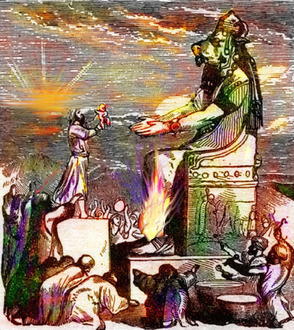 “Passing children through the fire” was the Ammonite’s practice of pagan child sacrifice to the calf-headed man-god named Molech (2 Kings 16:3; 2 Chronicles 28:3, 33:6; Jeremiah 7:31; 19:2-6), and this practice was prohibited by the Old Testament as idolatrous (not to mention abhorrent). Paralleling this pagan worship barbarism was the gruesome military practice employed by some of Israel’s enemies of dashing captured children on rocks, even opening up the wombs of captured pregnant women to accomplish this.
These practices were despised by the biblical writers. Yet in Psalm 137, baby smashing is given a painful twist. The psalmist bemoans Israel’s captivity in Babylon. There is weeping and unimaginable hardship. He calls his captors tormentors. He calls Babylon a devastator. With very honest, human frustration, the writer dreams of payback. He can’t help it. He expresses his desire in verse 9 that the tables might one day be turned on his captors. While Israelites usually avoided the barbarism of foreign powers, like baby smashing, he cries out a blessing on someone, anyone, who might one day smash Babylon’s babies on rocks. Let them one day feel our pain.
Context is everything in biblical exegesis, and in the Old Testament there is an intentional contrast between the atrocities of war and idolatrous child sacrifices of her neighbors, and the practices of Israel, the people chosen of God.
Idolatry, of course, is when we worship something other than God. Today, too many Christians treat the Bible as an object of worship, almost as if it’s a fourth member of the Holy Trinity. But his Word (Jesus is the Word of God—John 1:1-4, 14; Rev 19:13) is a person who is alive, active, more powerful that a double-edged sword, and not confined to a book, not even the Holy Bible.
*This article was published in Plain Truth Magazine by the title, "Does the Bible Really Say That?" (That should be a hot link to the article. The layout is cool.)
Sunday, February 14, 2010
Rapture Interrupted
 Almost two thirds of Christian leaders who call themselves "evangelical" believe in the rapture of the church, and over half believe it will occur in their lifetimes. Concerning the broader subject of Jesus' "second coming," nearly half of all Christians (evangelicals included) believe that Jesus "definitely" or "probably" will return before the year 2050. (Pew Forum, Article 1; Pew Forum, Article 2) I could not find a survey showing the percentage of all Christians who believe in the rapture; it is a minority, no doubt, but a very vocal one. If I had found credible evidence for the rapture of the church in the Bible, I would have considered joining their ranks.
The scriptural case for rapture is a three-legged table, meaning it is founded on three scriptural "legs" (though its proponents try to amass many more). A serious look at these three legs causes the table to fall. But first, enjoy some preliminary rapture facts.
Rapture Preliminaries

The rapture, or more precisely, the rapture of the church, is an event that a few Christian writers popularized in the 19th century, and it is still popular and strongly held by some Christians today, thanks in no small part to LaHaye’s recent books. Actually, one of those books is entitled “The Rapture.” It is a prequel to “Left Behind,” and was released on June 6, 2006 to suggest a connection to 666, a number assigned to a beast in Revelation 13. Pretty slick marketing!
This event that LaHaye and others call “the rapture” is a U-turn return of Jesus Christ; that is, Jesus is expected soon to come partway from “heaven” to earth to remove Christians from the planet, then he makes a U-turn and takes them all back with him to heaven. He kind of “beams them up” like Scotty did to Kirk and Spock on Star Trek, if you will. Then he holds them in a tractor beam—to stick with the Star Trek metaphor—and tows them to heaven.

Believers in the coming rapture have confidence it will happen soon. Yet many of their leaders have predicted dates that have come and gone. You may remember the book by Edgar C. Whisenant, “88 Reasons Why the Rapture is in 1988.” He followed up that book with another: “The Final Shout: Rapture Report 1989!
 As you can see here on a flier, a Korean group called “Mission for the Coming Days” predicted that the rapture would occur October 28, 1992. I guess they were trying to count back seven years (and 65 or 66 days?) from the year 2000 to account for the alleged seven-year tribulation period believed to have been prophesied by Daniel, which I will show you below.
In spite of repeated prediction failures, believers in the rapture abound today, not so much in mainline denominations, though acquaintances of mine knew of it growing up in a Southern Baptist congregations. But I, a United Methodist all my life, learned about rapture from Baptist friends and religious radio and television. I have never heard it espoused in Methodist circles except for the few individuals here and there who had transferred into Methodism having come to believe in rapture elsewhere previously.

 How far back does the doctrine of rapture go? Not far. Anglo-Irish Anglican clergyman John Nelson Darby is credited with originating the doctrine and popularizing the term rapture in the 19th century during the rise of Pentecostalism's doctrines of premillennialism and dispensationlism. (See my blog, THE MILLENNIUM.) But the idea was not his. The idea originated with
the prophetic visions/revelations of a woman named Margaret Macdonald.
How far back does the doctrine of rapture go? Not far. Anglo-Irish Anglican clergyman John Nelson Darby is credited with originating the doctrine and popularizing the term rapture in the 19th century during the rise of Pentecostalism's doctrines of premillennialism and dispensationlism. (See my blog, THE MILLENNIUM.) But the idea was not his. The idea originated with
the prophetic visions/revelations of a woman named Margaret Macdonald. In the 1820s a Presbyterian minister in London named Edward Irving began calling for the need of a renewal of speaking in tongues and other prophetic experiences, it began happening, and this outpouring is identified as the beginning of modern Pentecostalism. The movement reached the lowlands of Scotland in 1830, influencing Ms. Macdonald who was ill in bed at the time of her experiences. Her account of seeing a double return of Christ--one for believers and then another later for judgment--impressed Darby who believed it, and then went in search of scriptures that he believed supported it. Then in 1908 the Johnny-come-lately doctrine of rapture, having crossed the Atlantic, was further advanced by an American evangelist, William Eugene Blackstone (apparently unrelated to the contemporaneous magicians Harry Blackstone Sr. and Jr.), in his book, “Jesus is Coming.” It sold more than a million copies. Then his book was included within the pages of the Scofield Reference Bible in 1909. Millions read it there. Many books followed Blackstone’s, but it was Hal Linsey’s “The Late Great Planet Earth” in 1970 that set the stage for LaHaye and the popularity of rapture in church and culture today.
Do all believers in the rapture agree on the timing of the event? Not in the least. This is the point at which you will hear proponents arguing about whether there will be a pre-tribulation rapture or a post-tribulation rapture. The people in these two camps disagree on whether the rapture will occur before or after the seven years of tribulation that they believe are predicted by one badly misused verse in the Book of Daniel.
Daniel 9:27 He shall make a strong covenant with many for one week, and for half of the week he shall make sacrifice and offering cease; and in their place shall be an abomination that desolates, until the decreed end is poured out upon the desolator.
The abomination that desolates is mentioned in Daniel 8, 9, and 12. Daniel is widely interpreted to be referring to the 2nd century B.C. Jewish War of Independence from the Seleucids, one of four kingdoms to come after Alexander the Great. Is the “he” in Daniel a future antichrist as rapture supporters say? Is the one week in Daniel equivalent to seven future years of tribulation? Or did Daniel have an historical event in mind that has already occurred?
In his campaign of Hellenization, the Seleucid ruler Antiochus Epiphanes caused an altar to be erected on the altar of burnt-offering of the Second Temple on which sacrifices were offered to the god Jupiter. (If you research this yourself, see also Chanukah and Maccabees.) This is the abomination that desolates. Never mind that most scholars disagree with them, the rapture proponents insist that Daniel is referring to a seven year future period of tribulation that will be initiated or completed by the rapture of the church. Most rapture supporters believe in a pre-tribulation rapture. Others believe in a post-tribulation rapture. But pre-trib and post-trib, as they are called, are not the only options, though they are the most popular.
 You may hear of a possible mid-tribulation rapture, or a partial rapture, or conditional rapture. I will not try to define these. What you can take from this attempt at defining the rapture of the church is that a significant number of Christians today believe in it in one variety or another, and they are very vocal. Rapture believers tend to dominate Christian television and radio broadcasting. And you know about LaHaye’s best-selling books of fiction (and subsequent movies) based on this doctrine. Rapture talk is everywhere today, and to have missed it means you probably have not been paying very much attention to the media. Or maybe you just block “Christian channels” or just surf on by. Still, who among us has not read this bumper sticker?
This common sticker led to others. I saw one that read, “Come the rapture can I have your car?” Then this one: “Warning: In case of rapture this car will swerve violently as my mother-in-law takes the wheel.” And the latest rapture sticker reads, “Get right or get left.”
No Legs On Which to Stand
Let us turn as I promised to the three scriptures on which rapture stands, or I should say attempts to stand. Here is the first and most important of the three:
1 Thessalonians ..4:17.. Then we who are alive, who are left, will be caught up in the clouds together with them to meet the Lord in the air; and so we will be with the Lord forever. (emphasis mine)
The italicized words “caught up” are the key. It is the translation of the Greek word harpazo (pronounced har-pad'-zo). Here is what you need to know about harpazo and rapture:
- The word “rapture” is not in your Bible. Not in English. Not in the original Greek. Harpazo does not translate into English as rapture. I can find no translation of the New Testament into English including the KJV that translates harpazo as “raptured.”
- The term “raptured” is derived from the Latin Vulgate. Harpazo is translated into Latin as rapiemur. The Latin verb is rapere. The adjective is raeptius. From this we get the English term rapture. In Latin it literally means “carried away,” but in English it means being carried away emotionally or sensually. In English we mean by rapture being taken away in ecstasy or intense pleasure, like in the bathtub crystals TV commercial: “Calgon, take me away!”
- In English translations of the Bible, harpazo is most often translated “taken up” or “caught up.” But literally it means “to sieze,” “to snatch away,” “to suddenly grab or take by force,” “to steal away.” Harpazo is the action of thieves or wild animals! I checked a half-a-dozen Greek lexicons. It is true.

Matthew 13:19 When anyone hears the word of the kingdom and does not understand it, the evil one comes and snatches away (harpazo) what is sown in the heart; this is what was sown on the path.
John ..6:15.. When Jesus realized that they were about to come and take (harpazo) him by force to make him king, he withdrew again to the mountain by himself.
John 10:12 The hired hand, who is not the shepherd and does not own the sheep, sees the wolf coming and leaves the sheep and runs away -- and the wolf snatches (harpazo) them and scatters them.
John 10:28-29 I give them eternal life, and they will never perish. No one will snatch (harpazo) them out of my hand. 29 What my Father has given me is greater than all else, and no one can snatch (harpazo) it out of the Father's hand.
Acts ..23:10.. When the dissension became violent, the tribune, fearing that they would tear Paul to pieces, ordered the soldiers to go down, take (harpazo) him by force, and bring him into the barracks.
As you can see, the New Revised Standard Version, in agreement with all other major English translations of the Bible, renders harpazo as “snatch” or “take.” It is used for attack, thievery, or arrest.
Harpazo occurs only thirteen times in Scripture. Here are the exact verses, should you like to read them all: Matt. 11:12; 13:19; John 6:15; 10:12, 28f; Acts 8:39; 23:10; 2 Cor. 12:2, 4; 1 Thess. 4:17; Jude 1:23; and Rev. 12:5.
Five of these thirteen are quoted in full above. I am skipping here a discussion of the 2 Corinthians 12:2 and 12:4 uses of harpazo because I already wrote about it in my blog, PAUL DIDN'T GO TO HEAVEN. These verses involve Paul’s claim that he was “snatched” up to a third heaven.
Now that you know about the word at issue here, let us return to 1 Thessalonians 4:17. But this time let us put it in context too. (What a novel idea!)
13 But we do not want you to be uninformed, brothers and sisters, about those who have died, so that you may not grieve as others do who have no hope. 14 For since we believe that Jesus died and rose again, even so, through Jesus, God will bring with him those who have died. 15 For this we declare to you by the word of the Lord, that we who are alive, who are left until the coming of the Lord, will by no means precede those who have died. 16 For the Lord himself, with a cry of command, with the archangel's call and with the sound of God's trumpet, will descend from heaven, and the dead in Christ will rise first. 17 Then we who are alive, who are left, will be caught up (harpazo) in the clouds together with them to meet the Lord in the air; and so we will be with the Lord forever. 18 Therefore encourage one another with these words. (emphasis mine) (1 Thessalonians 4:13-18)
So let us straighten this out. First, some church members in Thessalonica (a lovely town on the northern Aegean coast of Greece) asked the Apostle Paul (in person or by letter) a question about something that was bothering them. They wanted to know whether Grandma (and other deceased loved ones), who did not get the chance to hear about Jesus, will be OK when Jesus returns to raise the dead. Grandma served her family faithfully. She loved her grandchildren. They loved Grandma deeply and her absence in death had left a hole in their family and in their hearts. They are afraid for her because she died before having the chance to hear the gospel Paul preached. So they asked Paul about their dearly departed loved ones’ fates.
Their question is a resurrection question. And the New Testament affirms a “general resurrection” when all people are raised bodily at the same time. This resurrection is a central belief of the church. Basic scriptural beliefs of the church were very early on condensed into affirmations of faith. The two most recognized and popular are the so-called Apostles’ Creed and the Nicene Creed. Here is the final line of each:
“I believe in the resurrection of the body, and the life everlasting. Amen.” Apostles’ Creed (Roman Catholic, Anglican, and United Methodist versions are identical at this point.)
“We look for the resurrection of the dead, and the life of the world to come. Amen.” Nicene Creed (Amended with this and other phrases at the First Council of Constantinople in 381. The Orthodox, Anglican, and Lutheran versions use “I” instead of “We.” Ecumenical versions retain the “We.”)
First, clearly in 1 Thessalonians 4:13-18 Paul is referring to the day of resurrection. It is not about rapture as popularized beginning in the late 19th century.
Second, have I dinged my head, or does not Paul say very clearly that he is giving the Thessalonians an answer to their resurrection question about Grandma in order for them to encourage one another? Once more:
Therefore encourage one another with these words. (emphasis mine) (1 Thessalonians 4:18)
That word “encourage” is most often translated into English as comfort. Comfort one another with this assurance: Fear not. Grandma will be raised too. In fact, she will be ahead of you in line!
16 . . . the dead in Christ will rise first. 17 Then we who are alive . . . (1 Thessalonians 4:16-17)
Comfort one another, he says. All your loved ones are dead in Christ whether they heard of Jesus or not. They go first, then you the living.
The Greek word for comfort and encourage is parakaleo (pronounced par-ak-al-eh'-o). "Blessed are those who mourn, for they will be comforted,” Jesus said in the Beatitudes of his Sermon of the Mount in Matthew 5:4. Same word. Parakaleo. Comfort or encourage.

Those who hold to the doctrine of rapture do more than just get it biblically wrong. They use the gentle thoughtful words of comfort in 1 Thessalonians to do the opposite. They misuse Paul’s words of comfort to frighten. Rapture offers you only two choices: Either you are beamed up by a U-turn Jesus or you are pinned in a burning car.
Paul comforts church members who are worried about their dead loved ones. What will happen to them? Grandma never met or heard of Jesus. Will she be OK? And Paul as tenderly and confidently as humanly possible says, Yes, comfort yourselves, for Grandma will not only be OK, but you are really going to enjoy her rising first!
I really appreciate the heartfelt intent of Paul’s simple, reassuring answer. What I do not appreciate is the rape of this tender teaching by the rapture proponents. I do not appreciate the way it is used on purpose to scare people. It seems outrageous to me. The rapture doctrine uses Paul’s kindness to kill. It perverts Paul’s intention. It contradicts his tone and purpose. In context it is plain to see. How is it even possible to read such tender words—especially the words near the end of the letter that are explicitly written to help them comfort one another—and still propagate a forecast of chaos and carnage?
How do you turn “Be comforted: Grandma will be fine” into “Warning: In case of rapture this car will be unmanned”?
How warped is it for “Bible teachers” to teach the exact opposite of what the Bible says, and to interpret it in the reverse way the Scripture verse intends? Rapture doctrine does no less with 1 Thessalonians 4:17. Rapture doctrine says nothing about comforting the worried grandkids about their deceased relatives’ fates. It is instead about an ionospheric Jesus U-turn that results in the Lord abandoning you to suffer whatever carnage happens when your taxi driver, Manuel, gets beamed up while he is taking you to the burning airport.
That is not all, however. The rapture crowd seems thoroughly convinced that this is good news! Can you imagine? If they believe that this doomsday scenario is scriptural good news, then they cannot know what the real New Testament good news is at all. Rapture offers bad news and calls it good news. Rapture says exactly the opposite of what 1 Thessalonians 4:17 is saying. This false interpretation of a single Bible verse is peddled like it is the central gospel (good news) truth. And it is filling pews and selling an enormous amount of books.
 Sadly, the rapture people threaten you with utter abandonment by the Lord, with ruin or injury or death from the collapse of society after the “good people” (them!) get beamed up. Is that not ironic? The rapture proponents who threaten you and assume superiority over you in the eyes of God are the “good people!”
Rapturites are asking you to believe the “good news” that Jesus will soon swing his U-turn by planet earth to beam a bunch of people away with him and abandon the rest to destruction. And they base this on Paul’s words of comfort about Grandma? I thought Jesus commanded us to love one another, not scare one another.
Some of these rapture believers are merely innocent and ignorant. Some of them, however, are fooling the innocent and ignorant because fear works to motivate church attendance and tithing. They are using people by abusing Scripture. And they are judging anyone who disagrees with them as being rejected forever by God, terrorized in a period of tribulation, and tortured forever in hell. Their ignorance and arrogance is staggering.
And people are believing them.
The Other Two Bad Legs
We have knocked the first leg of three out from under the table of rapture, which means it is headed for the floor. It was the critical leg to knock out, the 1st Thessalonians leg. That is why we knocked it out first. But, just to be safe, let us also go ahead and knock out the remaining two.
If you have heard any preaching about rapture, you will find these texts familiar. One is from Matthew and the other from Luke. They are probably two versions of one saying by Jesus. By that I mean that the wording is a bit different, but the teaching has the same meaning. So we will handle them together in this section: Matthew 24:36-44 and Luke 17:34-37.
36 "But about that day and hour no one knows, neither the angels of heaven, nor the Son, but only the Father. 37 For as the days of Noah were, so will be the coming of the Son of Man. 38 For as in those days before the flood they were eating and drinking, marrying and giving in marriage, until the day Noah entered the ark, 39 and they knew nothing until the flood came and swept them all away, so too will be the coming of the Son of Man. 40 Then two will be in the field; one will be taken and one will be left. 41 Two women will be grinding meal together; one will be taken and one will be left. 42 Keep awake therefore, for you do not know on what day your Lord is coming. 43 But understand this: if the owner of the house had known in what part of the night the thief was coming, he would have stayed awake and would not have let his house be broken into. 44 Therefore you also must be ready, for the Son of Man is coming at an unexpected hour.” (emphasis mine) (Matthew 24:36-44)
34 “I tell you, on that night there will be two in one bed; one will be taken and the other left. 35 There will be two women grinding meal together; one will be taken and the other left." (emphasis mine) (Luke 17:34-35)
You can see now that the rapture proponents are taking 1 Thessalonians’ harpazo (snatched) and connecting it with Jesus’ parables here in Matthew and Luke. Jesus speaks of the day of the coming of the Son of Man (also called day of judgment and resurrection). He describes some as being taken, and some not. The word Jesus uses here for “taken” is paralambano (pronounced par-al-am-ban'-o). Rapture promoters wrongly equate Paul’s harpazo with Jesus’ paralambano.
Paralambano means to bring someone along with you. That is not the same thing as snatched.
Look at Jesus’ arrest in Matthew 27:27 and John 19:16-17. The word paralambano is used to describe them moving him around from trial to execution.
27 Then the soldiers of the governor took (paralambano ) Jesus into the governor's headquarters, and they gathered the whole cohort around him. (emphasis mine) (Matthew 27:27)
16 Then he handed him over to them to be crucified. So they took (paralambano) Jesus; 17 and carrying the cross by himself, he went out to what is called The Place of the Skull, which in Hebrew is called Golgotha. (emphasis mine) (John 19:16-17)
It does not mean “taken up into the sky!” It means they took Jesus over to the Praetorian and they took him out to be crucified. They are escorting away a prisoner.
In exactly the same way, when Jesus’ parable says that there will be two in the field and one taken (paralambano), there is no sense in which this could mean levitation or transporter beam. It means to take someone away with you, or bring someone along with you.
Now get this. If Jesus had wanted to say taken up, that would have been easy. He could have said analambano (pronounced an-al-am-ban'-o). That is the exact word you want to describe taking up or ascending. Jesus’ ascension is described with this exact word in Mark 16:19 and Acts 1:2.
 Mark 16:19 So then the Lord Jesus, after he had spoken to them, was taken up (analambano) into heaven and sat down at the right hand of God.
Acts 1:2 until the day when he was taken up (analambano) to heaven, after giving instructions through the Holy Spirit to the apostles whom he had chosen.
Jesus did not use analambano in these two parables, however, because he did not mean that the woman grinding will ascend. He is not describing her going upward into the sky. He uses paralambano to describe her as being led away as though she were being arrested.
One more detail before we get to the really important point that finally knocks these two legs out from under our teetering rapture table: There is, in favor of the rapturites, one similarity between harpazo in 1 Thessalonians 4:17 and paralambano in Matthew 24:36-44 and Luke 17:34-37. They both imply thievery!
Look for a moment at this verse from John’s Gospel:
28 I give them eternal life, and they will never perish. No one will snatch them out of my hand. 29 What my Father has given me is greater than all else, and no one can snatch it out of the Father's hand. (emphasis mine) (John 10:28-29)
As you can see, the implication here of harpazo (snatched) is thievery.
Likewise look at the context of Jesus’ parables of paralambano, the ones about people in the field and grinding who are taken away. He said in Matthew 24 quoted above:
40 Then two will be in the field; one will be taken and one will be left. 41Two women will be grinding meal together; one will be taken and one will be left . . . 42 Keep awake therefore, for you do not know on what day your Lord is coming. 43 But understand this: if the owner of the house had known in what part of the night the thief was coming, he would have stayed awake and would not have let his house be broken into. (emphasis mine)
The paralambano, the taking away of these people in the parable, sits in the context of a sister parable about a house burglar! Again it is thievery that Jesus wants to use as his metaphor. And in this sense, paralambano and harpazo have something in common. But not what the rapturites think!
Oh yes, and let us not forget this again: These are parables, for goodness sake! The rapture promoters are proving to be literalists too. Do not be fooled by their oh-so-serious literalizations of Jesus’ powerfully playful parables.
So, continuing with these two parables, these other two legs on which rapture tries to stand, they make essentially the same point. What is it? You will not believe what I am about to show you. I am certain that the authors and preachers of rapture do not see this.
You know the two workers in the field? And the two women grinding? One of the field workers is taken away (paralambano) and one of the two grinders is taken away (paralambano)? Well, Jesus says they are taken away exactly in the manner that the flood in the time of Noah swept all the evil people away. Do you see what I see?
37 For as the days of Noah were, so will be the coming of the Son of Man. 38 For as in those days before the flood they were eating and drinking, marrying and giving in marriage, until the day Noah entered the ark, 39 and they knew nothing until the flood came and swept them all away, so too will be the coming of the Son of Man.
On that day, when the Son of Man comes suddenly like a thief, there are evil people who will be swept away, and the people like Noah, the good guys, are the ones who will be left behind!
Rapturites have it exactly backward! They claim there will be a rapture that takes UP the good guys, and the bad guys are “left behind.” Conversely, Jesus says the bad guys are taken AWAY and it is the good guys who are “left behind.”
Luke agrees and adds to the Noah analogy another:
26 Just as it was in the days of Noah, so too it will be in the days of the Son of Man. 27 They were eating and drinking, and marrying and being given in marriage, until the day Noah entered the ark, and the flood came and destroyed all of them . . . 28 Likewise, just as it was in the days of Lot: they were eating and drinking, buying and selling, planting and building, 29 but on the day that Lot left Sodom, it rained fire and sulfur from heaven and destroyed all of them 30 -- it will be like that on the day that the Son of Man is revealed. 31 On that day, anyone on the housetop who has belongings in the house must not come down to take them away; and likewise anyone in the field must not turn back. 32 Remember Lot's wife. (Luke 17:26-32)
Jesus again says just the opposite of believers in rapture. Noah and his family remain while all the baddies are swept away. Lot and his family (minus his wife who looked back) were left behind when the evil ones were taken out in Sodom. (Matthew 13:37-43, another of Jesus’ parables, makes the same point.)
These are parables in which the righteous are left behind. The rapturites have it exactly wrong. Theologian Larry D. Pettegrew agrees: “Just as the Noahic flood came and took away the unsuspecting and unprepared wicked, the judgments at the time of the second coming will come and take away the unsuspecting and unprepared wicked.”
The righteous are not beamed up prior to resurrection and judgment. The wicked are swept away unawares on the day of resurrection and judgment. Period.
That is it. All three legs on which rapture stands have blown out like a Joe Namath knee:
- 1 Thessalonians 4:17 is about resurrection/judgment day.
- Matthew 24:36-44 are parables about resurrection/judgment day.
- Luke 17:34-37 are parables about resurrection/judgment day.

There is no such thing as the rapture of the church in Christian scripture.
For more reading on the Book of Revelation see my blogs 666, The Giant Flying Cube, The Millennium, Pearly Gates and Streets of Gold, Names In the Book of Life, and The Lake of Fire Defined.

Subscribe to:
Posts (Atom)