Thursday, September 3, 2009

What Color is a Green Apple?


a parable of perception

Things aren’t always as they seem.

Take your favorite coffee cup and put it on the table in front of you. Now look at it. Let’s say for the sake of the argument that you have “normal,” non-corrected, 20/20, human eyesight. Your eyes are giving you information about the cup. Your image of it is sharp and clear. You assume that what you are seeing is the cup. But is it?

An enormous number of living creatures on earth have eyes. Elephants, eagles, dogs, hammerhead sharks, and houseflies all have eyes. But are their eyes identical? When other creatures look at your cup, do they see exactly what you see? Do they see shapes and colors the same way your eyes do? If not, then which image of your cup—the elephant’s, eagle’s, dog’s, shark’s, housefly’s, or yours—is “correct”? Which one is really the cup?

When you examine the problem this way, you begin to see that all of these images belong to the cup, but none of the images are the cup. The cup is a reality that is more than merely what your eyes can see. Your eyes only see a narrow band of the full spectrum of light. For example, your eyes can see no light from the ultraviolet or the infrared spectrums. Your eyes “see” the cup, for sure, but only in the spectrum of light that your eyes are designed with which to see.

What you see, your visual image of the cup, is limited by your eyes’ design. In fact, your eyes are sieves that filter out the chaotic light frequencies that interfere with your survival—so you can hunt a deer, spot a crouching lion, and avoid walking off a cliff. Therefore your image of the cup is incomplete. The cup’s cup-ness is more than what your eyes in their limitations can perceive.

When an apple appears green to you, it is not because the apple is actually green. The surface of the apple happens to absorb blue and red wavelengths of light while it reflects green. The apple then appears to your eyes to be green. But if you were significantly colorblind, you probably would not be able to tell a red from a green apple!

One in every 100 males has some “red-weakness” (Protanomaly), meaning shades of red are difficult to distinguish. Five in every 100 males has a “green-weakness” (Deuteranomaly). (Colorblindness in women is very rare. Tritanope is even rarer.) A colorblind person who looks at a colorful map of the world will see “the world” differently than you. The following four maps of the world demonstrate this.

When your eye sees the green apple, the really weird thing is that a green apple is actually absorbing every other color but green. Green is the only light wave that it rejects! Your eye sees the apple as green because green is the only light color it can’t keep (absorb).

To state this even more accurately and boldly, when you look at your cup, you’re not really seeing your cup at all. Your eyes are “reading” the light reflected off of the cup’s surface. If you put your cup in total darkness, the cup is still there even though you can’t see it. Does the cup exist in the dark? Yes, obviously. So your cup is more than its mere appearance. Cup-ness is a reality in and of itself apart from your visual perception of the light bouncing off of it. The fact that a blind person can drink from your cup should have told you that! The cup is more than meets the eye.

We are “seeing things” because of light. Eyes are organs that process light. Light enters the eye, shining on what are called cones and rods, and the light triggers a chemical reaction in the rods and cones, and the chemicals turn into electrical impulses that are sent to a certain part of the brain where these impulses are received, organized, and transmitted to other parts of the brain for analysis and communication.

So when you look at your cup, are you seeing your cup? Yes and no. “Yes” because the image your eyes provide is an actual image of your cup. “No” because the image is not your actual physical cup. Like a camera, your eye catches light and provides a “photograph” of that light bouncing off of stuff like your cup. Light bounces off of the cup and goes into your eyes, and you “see the light” bouncing off the cup. You do not see the cup itself. For everyday purposes everyone seems to assume that the cup they “see” is the actual cup. In a very real sense it’s not.

Why?

Because light is the only thing eyes can see. Eyes receive and process light, not cups. Your eyes are light processors, not cup processors. The “photograph” of the cup is not the cup.

Let’s make things worse! Think about light. If light bounces off of things (like your cup) and then goes into your eyes, then light has speed, right? What is that speed? Light travels at 186,282 miles per second (or about 670 million mph). It travels fast enough to circle the earth more than seven times a second. To put that speed in perspective, light coming all the way from the moon’s surface only takes 1.28 seconds to reach the Earth. That’s really fast. The moon is 238,857 miles away. A quarter-million miles in a-second-and-a-half. The implication of this is just wild.

What this means is that when you look at the moon, you are not seeing the moon as it appears right now. You are seeing the moon as it was one second ago. Merely by gazing at the moon tonight you are actually looking back in time one second.

The moon, however, doesn’t give off its own light. It merely reflects the light of the sun. So how long does it take sunlight to travel from the sun all the way to the Earth and its moon? Eight minutes. We’re talking about 93 million miles at 186,282 miles per second in about 500 seconds (or a little over eight minutes). So when you look at the sun—hopefully you don’t stare at it!—you aren’t seeing the sun as it is, but as it was eight minutes ago. You’re looking eight minutes back in time.

When you look at the planet Saturn with your naked eye—easily done if you know where and what to look for—you aren’t seeing Saturn as it is, but as it was . . . one whole hour ago.

The nearest star to our sun (our sun is a star)—Proxima Centauri (Alpha Centauri C)—is 4.3 “light years” away. A light year is the distance light travels in one year. It takes light from Proxima Centauri four years to reach us. So when you look up and see Proxima Centauri, you are not seeing Proxima Centauri as it is, but as it was four years ago.

On a clear, cold, moonless night, drive out away from the lights of “civilization” and look up using only your naked eye. The sky is a virtual canopy of stars—thousands of them. Some of the dim stars you are looking at are 2000 light years from Earth. But you are not seeing those distant stars as they are today. You are seeing them as they were 2000 years ago when Jesus of Nazareth walked the Earth. Moreover, when Jesus gazed at these distant stars, he saw them as they were 2000 years before his time, or near the time when Abraham walked the Earth.

Now there are 200 to 400 billion such stars in our Milky Way Galaxy. But, as the Hubble Space Telescope has so dramatically shown us, there are at least 100 billion galaxies out there too, each with on average 200 to 300 billion stars of their own. That brings an even more bizarre fact.

When the Hubble “looks” at a galaxy at the far edge of the known universe and provides us with an image of it, that image is not one of what the galaxy looks like now. It is an image of how it looked billions of years ago! To look at such distant galaxies is to look back in time well before the creation of telescopes, before the presence of humans on earth, before even the formation of our own solar system. How strange! The telescope orbiting Earth is viewing a time prior to the existence of Earth.

Again, things aren’t always as they seem. We can’t see anything in the heavens as it “is” right now. To stand in your backyard and look up at the stars is to leave “the now.” To stargaze is to travel backward in time. But this raises yet another oddity.

Look at your favorite coffee cup again. Not only is the cup in its cup-ness more than what your eyes can perceive, but the light traveling from your cup to your eye takes time to get there. It’s a very, very short amount of time, granted. But it takes time. Therefore, you can’t even look at your own coffee cup and see its image in “the now.” It’s nearly instantaneous, yes. And you can’t perceive it as anything other than instantaneous. But it’s not instantaneous.

When you look at your cup, you are seeing an image of it as it was a fraction of a second ago. In fact, because the speed of light is finite, there is no image that you can ever perceive visually in the actual present. Everything you perceive with your eyes is in the past due to a finite speed of light. How far in the past the object is seen depends on its distance from your eye.

Because light has a speed, you see the cup in front of you as it was fractions of a second ago. You see the moon as it was one second ago. You see the sun as it was eight minutes ago. You see Saturn as it was an hour ago. You see Proxima Centauri as it was four years ago. You see distant stars in the night sky as they were 2000 years ago.

My point? This blog is a parable of perception. When it comes to seeing, perception is not reality. But what about God? Is perception reality when it comes to God?

After much study and thought, I’m convinced that at the core of Jesus’ mission was his intent to provide for us corrective lenses. He came to reveal his heavenly Father as he really is. He came to correct our perception of God.

We tend to see the Son and the Father as different, do we not? The Father is seen as distant and judging while Jesus is seen as accessible and forgiving, even though the Jesus of the Bible insists that “when you’ve seen me, you’ve seen the Father.” (For more on this, see The Un-Religion.)


This creates a rather bizarre dilemma, doesn’t it? If you are a follower of Jesus or want to be, and if you take what he says in the Scriptures seriously, then you can trust your own perception of God, or you can trust what Jesus is telling you when it comes to seeing his Father. Is Jesus’ image of his Father direct, clear, and correct, or is yours?


Saturday, August 29, 2009

Every head bowed and every eye closed


A priest, a minister, and a guru sat discussing the best position for prayer, while a telephone repairman worked nearby.

“Kneeling is definitely the best way to pray,” said the priest.

“No,” said the minister. “I get the best results standing with my hands outstretched to heaven.”

“You’re both wrong,” said the guru. “The most effective prayer position is lying down on the floor.”

The repairman, unable to contain himself any longer, said, “Hey, fellas. The best praying I ever did was when I was hanging upside down from a telephone pole.”
(author unknown)

When Jesus prays prior to a miracle, something he rarely does, he looks up to heaven (once in Matthew, twice in Mark, once in Luke, and once in John). For example,

Mark 6:41 Taking the five loaves and the two fish, he looked up to heaven (ouranos = heaven or sky), and blessed and broke the loaves, and gave them to his disciples to set before the people; and he divided the two fish among them all.

Mark 7:34 Then looking up to heaven, he sighed and said to him, "Ephphatha," that is, "Be opened."

John 17:1 After Jesus had spoken these words, he looked up to heaven and said, "Father, the hour has come; glorify your Son so that the Son may glorify you . . .”


Why did Jesus look up to pray sometimes? Is the heavenly Father really “up there” somewhere—implying that he is somehow absent “down here”? Did Jesus believe like other ancient peoples that God’s heaven is beyond the sky’s dome of blue waters? Or was Jesus’ sense of God’s Spirit that, like the wind, it comes from everywhere in the air around and above us? The Bible neither emphasizes nor clarifies why Jesus on occasion looked upward when he prayed.

What’s strange to me is that while Jesus prayed with his eyes opened looking up, we Christians pray with our eyes closed and our heads bowed down! The next time someone says, “Let us pray,” sneak a peak. Watch the heads bow and the eyes close automatically. Some pastors go so far as to specifically instruct worshipers with the words, “Every head bowed and every eye closed.” Why is that?

Heads bowed and eyes closed may be the customary posture for prayer among Christians today, but it’s certainly not biblical. Jesus never gave instructions to bow your head and close your eyes when you pray. Neither did anyone else in the Bible. So why do we do it?

I have a theory.

In Jesus’ parable of the Praying Pharisee and Tax Collector, the Pharisee stands where he can be seen as he thanks God that he’s better than other people because he fasts a lot and gives a lot of money. But . . .

. . . the tax collector, standing far off, would not even look up to heaven, but was beating his breast and saying, 'God, be merciful to me, a sinner!' (italics mine) (Luke 18:13)

Maybe this is why we Christians face downward and close our eyes when we pray, so as to imitate this tax collector’s humility. We avoid looking up to heaven by bowing our heads.

Is there any other place in scripture where someone bows his head to pray? Sort of. Though prayer is not specified, it could be implied in four verses in the Old Testament (Gen 24:26, 48; Ex 34:8; Ps 35:13) where someone bows his head to worship.

What about the New Testament? Matthew says that Jesus once prayed with his face to the ground (Matthew 26:39), which is sort of like bowing your head. A man healed of leprosy bowed with his face to the ground and begged Jesus to heal him (Luke 5:12), which sounds like a prayer. A healed Samaritan fell with this face to the ground at Jesus’ feet (Luke 17:16) expressing thanksgiving, which could be seen as a prayer. And the disciples once took hold of Jesus’ feet and worshiped him (Matthew 28:9), perhaps including prayer.

Paul also wrote:

NET 1 Corinthians 14:25 The secrets of his heart are disclosed, and in this way he will fall down with his face to the ground and worship God, declaring, "God is really among you."

So there is evidence in the Bible, though weak, that sometimes people bowed their heads when they prayed. But are there biblical references to closing one’s eyes to pray? No. While there is some precedence for falling on your face for worship, perhaps meaning to include prayer, I can find no biblical instructions specifically to bow your head and to close your eyes when you pray.

Frankly, I don’t think Jesus intended to regulate praying postures with his parable of the Praying Pharisee and Tax Collector. It was the man’s heart—not his posture—that was “justified.” Should you press your palms together or fold them? Should you stand or kneel? Should you raise your hands or hold hands with others? Do you want to know what I think? I think you could pray standing on your head wearing a pink tutu if you wanted to, but it wouldn’t help. Prayer’s effectiveness has little to do with body position, though the creator of this imaginative chart obviously disagrees.


Nevertheless, on several occasions our New Testament says that Jesus looked up to ouranos (sky or heaven) when he prayed. Is that why his prayers always “worked”? Is there magic in looking heavenward? Was he showing us how to properly posture ourselves for prayer? If so, why do so few Christians today do it that way?

I often open my eyes when I pray. I like looking outward or upward because it reminds me that I have come to believe that the kingdom of heaven is near us, around us, among us, and within us, as Jesus insisted. I don’t have to close my eyes to imagine the kingdom. I can see it all around me with the eyes of faith.

On the other hand, many whom I’ve spoken with about this topic have told me that closing their eyes to pray helps them to block out distractions.

So, do we avoid looking toward heaven as the tax collector did in Jesus’ parable? Or should we pray with eyes heavenward as Jesus did on occasion?

Again, I don’t think it matters. I’ve never had the sense that the position of my eyelids makes God any more attentive. If it did, I’d pray upwards every time, rub my rabbit’s foot, avoid stepping on any cracks, and contort myself into the Lotus position—whatever worked.

Standing? Kneeling? Prostrate on the floor? Eyes closed? Eyes opened? Head raised? Head bowed? It doesn’t really matter, it seems to me. I doubt that posturing manipulates God. And I doubt that anyone but a religionist would monitor your prayer posture.

Friday, August 21, 2009

The Un-Religion


You know what makes me angry? The Christian religion and its prominent pastors today look too much like the Jewish religion and Judean leadership of Jesus’ day:

NAB Matthew 23:15 "Woe to you, scribes and Pharisees, you hypocrites. You traverse sea and land to make one convert, and when that happens you make him a child of Gehenna twice as much as yourselves.

Jesus wasn’t warning Jews about being Jewish. He was a practicing Jew! But he saw in the Judaism of his day what we are seeing in Christianity today. Jesus saw religion perverting faith. He saw that it was killing people spiritually. And he didn’t like that.

Religious people, he said, are children of the Hinnom Valley (Gehenna), a site of child sacrifice to idols, a valley just south of Jerusalem’s ancient walls where the garbage burned day and night. Could Jesus have expressed any clearer his view of religion?

What Is Religion?

Religion is any program that promises heaven, nirvana, enlightenment, peace, happiness, or the like. It begins with the observation that you don’t have these things, and the assumption that you can’t get these things unless you _______________ [fill in the blank].

Religions, all of them, including the Christian religion (not to be confused with knowing and trusting Jesus), put it all back on you. You have to please the gods by doing something to fix things up with them.

The Christian religion, however, has competing teams. Most of those teams want to recruit you, usually by trying to persuade you that their method is the one that works in terms of fixing you up with “God.” Some go a step further by discrediting the other teams. After all, there can only be one right religion. Right? Then it follows that within the Christian religion there can only be one right practice. Right?

The irony in this line of reasoning is that it is religion itself that is wrong, if the Jesus of Scripture is to be believed. The Judaism of Jesus’ day was, in his estimation, a hellish, legalistic, burdensome, condemning, cruel religious program. Its leaders, he said, had become children of the devil and a brood of vipers. He railed against them.

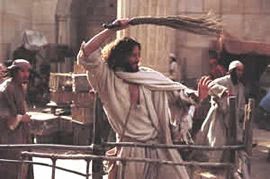
Matthew 21:13 "It is written, 'My house shall be called a house of prayer’; but you are making it a den of robbers."

John 2:16 "Take these things out of here! Stop making my Father's house a marketplace!"

Religion and religious leaders outraged Jesus, and rightly so. Outrage is the appropriate emotion when something is outrageous. And the sacrificial system in the temple in Jerusalem, as Jesus saw it, had become a religious racket. Today’s religions are no different.

Why Does Religion Appeal to People in the First Place?

Billions of people, including you and me if we are honest, are snookered by too-good-to-be-true religious spiels of one flavor or another. We human beings seem to be tailor-made suckers for it! And I think I know why.

It’s about your conscience. No, Sigmund Freud didn’t make that word up and stick it in our vocabularies. The word is in the Bible 30 times. The New Testament Greek word is suneidesis, and it refers to that “thing” inside of you that distinguishes what is good from what is evil. The Bible calls that thing your suneidesis. In English, that’s your conscience.

It is said that you should let your conscience be your guide, but the Bible disagrees. It’s not that your conscience isn’t a handy thing to have sometimes, but it can be wrong, warns Scripture. It speaks of a weak conscience, a defiled conscience, and even an evil conscience.

Hebrews 10:22 . . . let us approach with a true heart in full assurance of faith, with our hearts sprinkled clean from an evil conscience . . .

Wow! With a warning like that, it seems wise to use your conscience as a reference, not your guide. Your conscience can condemn you when no one else is, including God.

Remember the new covenant in Jesus' blood:

Hebrews 8:12 For I will be merciful toward their iniquities, and I will remember their sins no more.

If your sins are forgiven and forgotten as far as the Lord is concerned, then who do you think might be condemning you now? Why do you feel condemned all the time? What flawed interior judge constricts you and convicts you and contradicts God’s mercy to you in Jesus? It’s your conscience.

The Genesis story of “the fall” comes to mind. A friend of mine, Australian medical doctor Bruce Wauchope, points out something that makes perfect sense. In the story of Eden, what was the name of the tree that the Lord God tried to protect Adam and Eve from? It was the tree of the knowledge of good and evil. Bruce says that this story is describing how human beings came to have consciences! (Remember the Biblical definition of conscience. It’s the thing inside of you that distinguishes good from evil.) If Bruce is right, and I think he is, then our conscience is a product of “the fall.”

Do you still want to use your conscience as your guide? If so, consider this. In the story, the Lord God knew Adam and Eve would be better off without one! Why? There are many reasons why:

  1. Our consciences force us to judge ourselves as good or evil based on our performance, and when it comes to self-judgment, our consciences are unkind.
  2. Our consciences can over-function, restricting us unnecessarily, and robbing us of the freedom to enjoy life.
  3. Our consciences can project self-judgment onto others, damaging relationships and isolating us.
  4. Our consciences can be weak, forcing us to fight constantly to do the good thing rather than the evil thing.
  5. Our consciences may tell us what the good thing is, but when we find that we can’t do the good thing, our consciences judge us as not being a good person.
  6. Our consciences may tell us what the evil thing is, but when we find ourselves doing the evil thing, our consciences judge us as evil persons.
Your conscience, then, biblically speaking, is an unfortunate result of the fall in Eden. It’s a resource that can sometimes help you distinguish good from evil, admittedly. But it’s a merciless judge also, quick to condemn you for doing what is evil and failing to do what is good.

Let’s get back to religion. (Oh, joy!)

The story of Adam's and Eve’s “fall” depicts the birth of religion. We spend much of our lives hiding behind bushes and fig leaves, mightily struggling with right and wrong, seeing what is good but unable to do it, seeing what is evil and ending up doing it, and moment by moment condemning ourselves for our weakness and failure, ready to do anything to fix it all up. What in the world can we do to fix it all up?

Religion relies on your conscience. There is no religion without it. Religion counts on the undeniable fact that your conscience is both a spiritual hypochondriac and a hanging judge. Your constant internal self-uncertainty and self-condemnation have made you an easy mark for religious programming, even doomsday cults. Religion banks on your conscience forever preaching to you what is right and wrong, while forever condemning you for failing to do good and avoid evil.

Y’all, there is a counterfeit gospel out there—omnipresent in our culture—that is merely echoing the message of your own jittery, judging conscience.

That is why we are susceptible to religion. This unstable conscience of ours puts us in a panicked state, not unlike Adam and Eve in Eden. When they ate the fruit, they were shocked that the first thing and the most horrifying thing that they saw were themselves. They saw themselves, not through the eyes of their friend, the Lord God, but through the lenses of a fallible human conscience, this “thing” in us that has the ability to discern good and evil (sometimes). They looked such a mess to themselves, and they condemned themselves for their action, and they were certain that the Lord God was going to kill them for what they’d done.

Each of us are self-evident messes. We’re hurting, broken, confused, angry, vulnerable creatures who mess up. But we also, deep inside, want to be happy and free. So what can we do? We can try to be so good that our consciences will shut up. Or we can try to be so bad that our consciences will give up. Either way, we want the pain to go away, and we want to believe that it is possible to make that happen, somehow, someway. But how?

That’s where religion comes in. Religion promises a plan to fix everything. It has programs. But what too few realize is that religion uses our own consciences against us. With the encouragement of today’s scribes and Pharisees of Christian media, our weakness can be exploited. It’s not that hard, really, to convince us that the eyes of our consciences are the eyes of God. We tend to do that anyway.

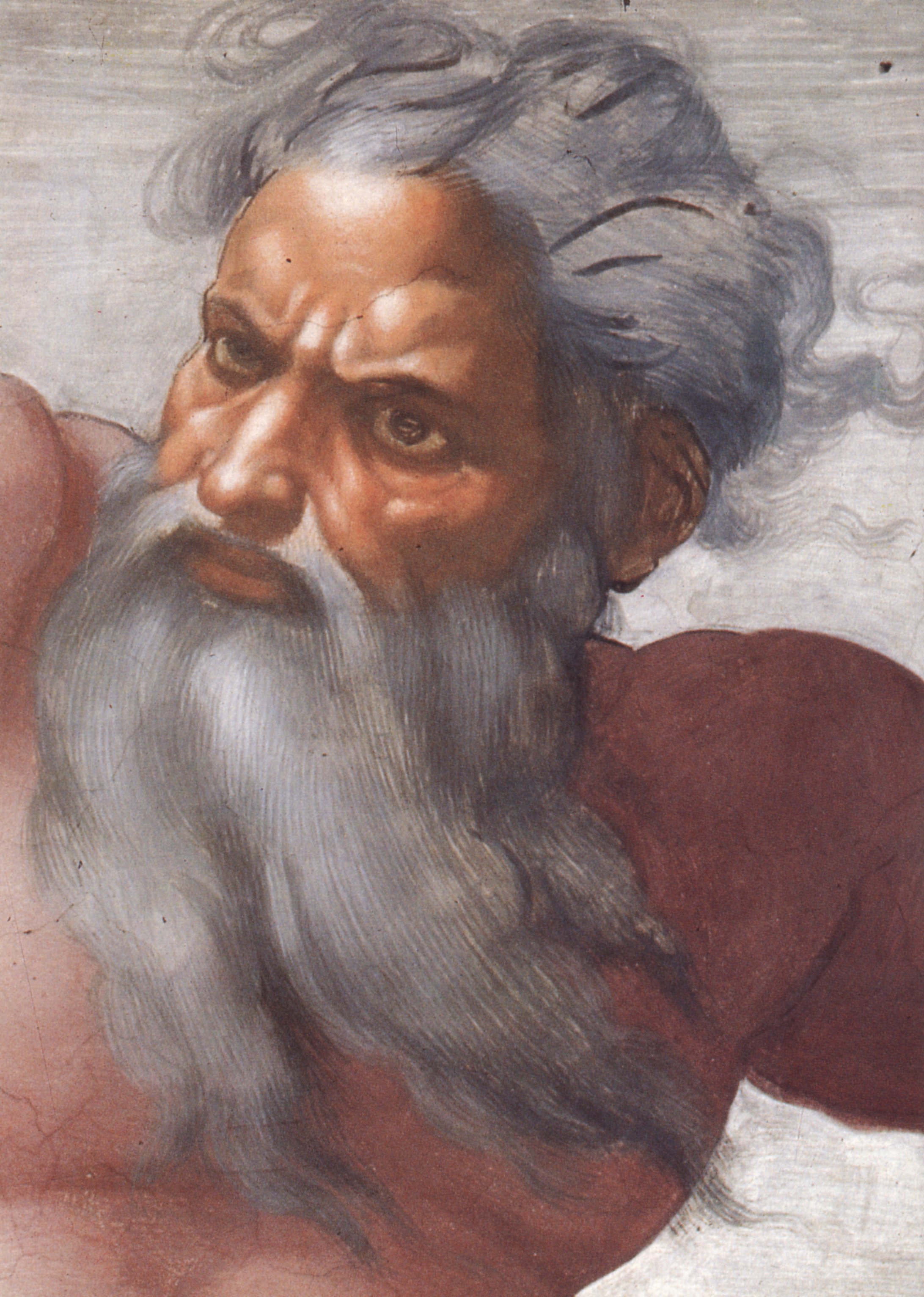
Religion, like the serpent in the garden, has no problem convincing us that we are not like God, or that we are not made in his image. The Christian religion, especially in modern evangelical circles, makes “God” in our own consciences’ image. He’s a legal “God” who is obsessed with good and evil, right and wrong. This conscience-god is a judge. And we stand before this judge condemned.

Once a person equates his own conscience with God, he’s primed for the hamster wheel. Just look at every book title from major televangelists today, even the subtle ones. They all give you a program. They tell you how to be the best you can be, how to know that you’re saved, how to unlock the storehouse of heaven, how to get your miracle, how to take your spirituality to the next level, and on and on.

The legal god of your conscience requires that you work yourself out of this mess, or I should say perceived mess. There are do-gooder lists to please “God.” There are steps to salvation. And there are keys to prosperity. Don’t laugh. These programs are selling. Add desperation to the condemning voice of your own conscience-god, and you are ready for religion.

Here’s modern evangelicalism’s hamster wheel:


The bad news is that you are separated from “God” because you are a sinner. You’ve displeased “God,” and you know it. “God” can’t come near you and your dirty sins, and he has no alternative but to punish you forever. (That’s the setup for the hamster wheel.)

BUT, “God” doesn’t really want to punish you, they say, though he will if you are unresponsive to his offer. There is a tiny loophole in the law. You have a chance to get saved from “God’s” punishment. It involves a procedure:

  1. The Sinner’s Prayer: To become a Christian, you must confess that you’re a sinner, and that you deserve punishment, and you must repent of every evil thing you’ve done, and state that you believe Jesus died for your sins and rose from the dead, and promise from this moment to change and do good, and ask Jesus to come into your heart and save you from the punishment of “God.”
  2. Church Attendance and Contribution: A real Christian, a person who has sincerely prayed the sinner’s prayer, joins and attends and gives money to a church. That’s walking the Christian walk. That’s the way to stay saved and thus avoid backsliding.
  3. Daily Prayer and Bible Reading: A real Christian has a daily discipline, preferably very early in the morning, of prayer time and Bible reading. At least thirty minutes.
  4. The Rules: A real Christian doesn’t smoke, drink, do drugs, have sex outside of marriage, gamble, or cuss. He obeys all of the Ten Commandments. And he listens only to Christian music.
What if you follow these steps, but you slip up? No worries. There are thousands of books and videos showing what you did wrong and how to fix it. Maybe you aren’t running hard enough. Maybe distractions, family curses, or addictions are causing you to fall off. Maybe it’s your attitude. Maybe it’s your lack of communication skills. Maybe you don’t know the Bible well enough. Maybe you weren’t as sincere as you should have been when you prayed the sinner’s prayer. Whatever your failure, there is a product to fix it. That’s what religion is for. It’s there to help you get and keep things fixed up with God to avoid his punishment.

Show Us the Father and We Will Be Satisfied

John 14:8-9  Philip said to him, "Lord, show us the Father, and we will be satisfied." 9 Jesus said to him, "Have I been with you all this time, Philip, and you still do not know me? Whoever has seen me has seen the Father.”

We have Philip’s disease. We think of Jesus and the Father as being different. We see God like our consciences: obsessed with good and evil, legalistic, judging, and condemning. But we see Jesus as a bit more user-friendly! He speaks of mercy and grace.

Do you know what modern evangelicalism does with this? Rather than correct Philip’s error, as Jesus did, it accentuates these false differences. The Father is an angry watcher-god who intends to punish you, they say. But, since somehow he still loves you(!), his loving side sends a sinner-friendly Jesus to the world to offer a stay of execution.

Do you see what this means? It means that “God” sent Jesus to save us from himself! And if that’s not crazy enough for you, some modern evangelicals go so far as to say that Jesus came to let “God” vent his anger on him instead of us!

It’s so easy to blow this boat out of the water. Actually, Jesus already did it 2000 years ago, and we’re still not listening because we have Philip’s disease. Jesus is just so different than what we expect God to be like. But Jesus came to show us exactly what God is like. He and the Father are One, he said. To see him, Jesus assured Philip, is to see the Father.

Jesus’ mercy and grace look nothing like our god-consciences’ legalism and condemnation, do they. So, something is wrong. If Jesus is the very image of the invisible God (Colossians 1:15), and if in him all the fullness of God was pleased to dwell (Colossians 1:19), then maybe we’ve got God the Father all wrong. Maybe our consciences fooled us. Unlucky for us, religion is tailor-made for fools.

The Un-Religion


True Christianity is the un-religion. It’s a non-religion. Moreover, real Christianity is the end of all religion. Religious people are dancing with a corpse and don’t know it. Here’s why.

Is it our desire to reach a distant God? In Jesus, God reached us. Is it our desire to make things right between us and God? In Jesus, we are reconciled to God making everything right. Is it our desire to escape the prison of sin and death? In Jesus, sin and death are defeated. This is the message of the Bible. No religious fervor necessary on our part. Jesus did it all.

But what about my conscience? It’s still going off! It still knows I’m not good enough. It knows oh too well that I’m a sinner, that I don’t do the right thing, that I often do the evil thing, that I hide these truths about myself, and that I pose myself, propping up my pretend-self. It may be true that Jesus has fixed everything up and religion is dead, but what if I don’t feel that way?

That’s where trust comes in. You can stop all the religious striving, and you can rest in the biblical message that God in Jesus has reached you, reconciled you, saved you from sin and death, and raised you. Or you can prefer to believe that your condemning conscience is right: that you are on death row begging for a deal.
The choice is yours, but before you make it, look at the Hebrews quote about an evil conscience once more.

Hebrews 10:22 . . . let us approach with a true heart in full assurance of faith, with our hearts sprinkled clean from an evil conscience . . .

Hebrews acknowledges that our consciences can be evil, condemning us when God is not. But he invites us to approach the Father who in the Son is already near. He invites us to have hearts full of assurance, hearts resting in God’s nearness and mercy. John put it like this:

1 John 3:19-21  And by this we will know that we are from the truth and will reassure our hearts before him 20 whenever our hearts condemn us; for God is greater than our hearts, and he knows everything. 21 Beloved, if our hearts do not condemn us, we have boldness before God;

Hebrews and John pretty strongly imply that we can have our hearts sprinkled clean of an evil conscience, and that we need not listen to our condemning hearts, and that we can trust that God is greater than our hearts, and that we can believe that it is even possible for our hearts to stop condemning us. How bold we might be if the voice of condemnation would stop!

The good news of The Un-religion is that you don't have to work your way to God the Father to get forgiven. He came to you with unconditional forgiveness in God the Son. So why not just say "thanks," and then ask him to help you make your condemning conscience shut up!


This blog was posted as a feature article in Plain Truth Magazine. Great layout: The UN-Religion