Showing posts with label gehenna. Show all posts

Saturday, April 4, 2009

Salted with Fire


-->
Why, after the amputation or Gehenna sayings, does Jesus speak suddenly of salt? Again it’s about Life and peace over against death and torment. If you have no salt, no fire, no peace, then you have no Life. Apparently there is a fire that consumes Life (fire in the dump of Gehenna), but there is also a fire that infuses Life (fire of the Holy Spirit). There is a fire that deadens and there is a fire of the Spirit that enlivens. This is the salt of which Jesus, again in figures, now speaks. What did he mean?

Though you are made to be the salt of the earth, you can become tasteless. To become a slave of your hand is to lose your salt. To become a slave of your foot is to lose your salt. To become a slave of your eye is to lose your salt. If the addiction of your hand or foot or eye robs you of the peaceful, passionate, salty, Life-filled, rich and abundant relational reality that Jesus called the kingdom of heaven, amputation is immeasurably better than that.

Salt equals Life.

Jesus is talking about spiritual death by blandness. Bland equals spiritual death and a hellish existence. Again, the symbol “=” means equals.

Spiritual slavery = blandness = hellishness = death
Spiritual freedom = saltiness = heavenliness = Life

How do you spell hell? Jesus spells it B-L-A-N-D. He wants to know, What’s your salt worth?

Mark 8:36-37 For what will it profit them to gain the whole world and forfeit their life (psuche)? 37 Indeed, what can they give in return for their life (psuche)?

The Greek word for life also means soul, and is often translated as such.

Mark 8:36-37 What good is it for a man to gain the whole world, yet forfeit his soul (psuche)? 37 Or what can a man give in exchange for his soul (psuche)?

Salt is Life. It means everything. The opposite of salt and Life is blandness and death. Blandness doesn’t seem like such a bad thing on the surface. But without salt, if you’re bland, you’re worm food!

Salt in you—spirit and fire, passion and love, freedom and soul—is the zest and savor and vigor and verve of Life. It’s the flavor and zeal and gusto of Life. Salt is vibrancy and vitality and intensity. Salt sharpens and heightens and enhances. It intensifies and accents and enriches. It brightens and enlivens and excites. It arouses and stimulates and sparks.

I caught a televised worship service from a downtown protestant church recently. The robed pastor from his lofty pulpit deposited his three dry imperatives. You must have peace. You must have hope. You must have joy. When the camera showed the congregants, they resembled a forest of stumps. A child was drawing on a bulletin. A teenager mindlessly twirled her hair. Zoned-out parents made mental to-do lists. A grandfather took a nap. Even when the preacher spoke of joy, it was clear that joy had left the building and gone to lunch. Where’s the salt? Where’s the zest? Where’s the gusto? Where’s the spice of Life?

Please don’t think that peppier music and a hip pastor necessarily fix anything. You could have jumping up and down and rolling in the aisles. You could have waiving hands and loud weeping. Outward appearances aren’t salt. And simulation salt seasons nothing. I have nothing against the salt substitute manufacturers. I’m sure that the good folks on a salt-restricted diet appreciate one of the various salt substitutes. But the cook in my life says that salt substitutes are sad substitutes for the real thing.

Real salt is what is needed. Real salt is what every person wants. And like the tiny mustard seed that becomes a tree-sized bush, and like a mere pinch of yeast that makes a whole fifty pounds of flour rise, a dash of salt makes all the difference in the world to your palate. Without it a meal is mere nutrition. Without salt a meal is just chewing and swallowing.

Only in four verses in the Bible does Jesus speak of salt. But these four little verses, like salt itself, make all the difference.

NET Matthew 5:13 "You are the salt of the earth. But if salt loses its flavor, how can it be made salty again? It is no longer good for anything except to be thrown out and trampled on by people.

NET Mark 9:49 Everyone will be salted with fire.

NET Mark 9:50 Salt is good, but if it loses its saltiness, how can you make it salty again? Have salt in yourselves, and be at peace with each other."

NET Luke 14:34 "Salt is good, but if salt loses its flavor, how can its flavor be restored?

From these four verses I glean four meanings:


1. People, including you, are the salt of the earth. That’s the way God made you. You were born the opposite of bland. You are the spice of Life. You season the world. You are the salt in God’s recipe.
2. But you can lose your God-given saltiness. Un-salty salt isn’t salt. Un-salty salt can’t fix bland. Bland is useless. Bland is trash. Bland belongs in Gehenna. Un-salty people may be living, but they aren’t alive.
3. Having salt in yourself is inseparable from being at peace in your relationships. Life and peace walk hand in hand. It’s God’s covenant promise and gift.
4. Everyone will be salted with fire because the Spirit will be poured out on all flesh. (Then afterward I will pour out my spirit on all flesh; your sons and your daughters shall prophesy, your old men shall dream dreams, and your young men shall see visions. Joel 2:28)

I could write here about being a spirit-filled person. I could list spiritual gifts, as Paul did in 1 Corinthians 12, and I could define them: wisdom, knowledge, faith, etc. I could list the fruits of the spirit, as Paul did in Galatians 5:22-23, and I could define them: love, joy, peace, patience, kindness, generosity, faithfulness, gentleness, and self-control. But I’d rather salt this paragraph with a picture everybody recognizes, even if you aren’t a cook. Let’s go into the kitchen and ask the cook about salt.


I have a friend who is a great cook; she should have her own show on the Food Channel. I asked her about salt. She said that salt brightens. It enhances what‘s already there. Salt brings out the natural goodness. In pickling, she said, salt draws out the juices leaving a concentration of flavors. It’s the base of any seasoning mix. You don’t even make cake without salt, she said, or it will be bland.

Folks, salt is the only cure for blandness. Salt is no mere additive. It is the spice of Life. Salt is Jesus’ poetic word for Life’s richness and zest. Life is what he came to give.

John 10:10 “I have come that they may have life, and that they may have it more abundantly."

John 10:28 28 "And I give them eternal life, and they shall never perish . . .”

So Jesus says that you are the salt of the earth. He says everyone is salted with fire. He says have salt in yourself, and be at peace. Is he talking about literal salt? Again, no. He’s contrasting being spiritually alive and being spiritually dead. Salt-ness is Life. Blandness is death. Salt is his gift of Life to the world, for he claims the he is the way, the truth, and the Life.

There is no such thing as a bland Christian. That’s an oxymoron. Blandness is spiritual death. Spiritual death is self-obsession, self-importance, self-exaltation, self-righteousness, and self-imposition on others. Spiritual death is blind, unaware, oblivious, and insensitive. Blandness (spiritual death) is everywhere. But salt (Life) makes all the difference. And all it takes is a pinch.

Paul wrote only once about salt. He advises to have salt in your conversations.

NRS Colossians 4:6 Let your speech always be gracious, seasoned with salt, so that you may know how you ought to answer everyone.

What could he mean but that gracious words are seasoned with salt, with Life and peace? No phony, artificial, bland religious jargon. But wonderful words of Life. Oh that our churches were filled with salty speech as Paul advised.

On the other hand, let’s keep it real. Were I you, I’d be on the lookout for the Bland Patrol from hell. They’re in our churches. Bland Christians (there’s really no such thing) attack people who have salt (because the bland are always blind). They hate the Life and liberty that is in you. The Patrol will be suspicious of you if you won’t wear their pseudo-holiness straightjacket, a repressed and rigid beige code of conduct born of a restrictive dull, flat, and tasteless religiosity.

The Bland Patrol is watching you. And their officers are probably the most religious people you know. I don’t know of a greater irony and tragedy than the predominant protestant, Christian voice in our culture, modern evangelicalism, is a child of Phariseeism. Too many of them are blind, bland religionist suspicious of anyone with light and liberty. They oppose Jesus and do it in Jesus’ name. The majority of the Pharisees did the same thing to Jesus and his followers. They opposed them in the name of God believing they were doing God’s will.

ESV John 16:2 They will put you out of the synagogues. Indeed, the hour is coming when whoever kills you will think he is offering service to God.

Jesus said that the Pharisees were mwroi. kai. tufloi, , which means “moronic and blind.” They see themselves as God’s gift to the world, but they are his enemies and don’t know it. With ironic humor and biting sarcasm Jesus said of the religious Bland Patrol of his day:

NRS Matthew 15:14 “Let them alone; they are blind guides of the blind. And if one blind person guides another, both will fall into a pit."

And Jesus hit them right between their blind eyes:

John 9:39-41 Jesus said, "I came into this world for judgment (krisis) so that those who do not see may see, and those who do see may become blind.” 40 Some of the Pharisees near him heard this and said to him, "Surely we are not blind, are we?" 41 Jesus said to them, "If you were blind, you would not have sin. But now that you say, 'We see,' your sin remains.

The Bland Patrol always presumes to see what is Godly and what is not, who is Godly and who is not. People enjoying Life and liberty are not Godly to their eyes. The institutionalized, zippered Bible, humorless, falsely humble, attendance pin wearing, hall monitoring religionists are Godly to their own eyes. The Pharisees asked him, You’re not calling us blind are you, Jesus? And Jesus replied, Yes, because you think you can see.


Jesus’ perspective on spiritual seeing is that the beginning of sight is the recognition of blindness. The problem with the Pharisaic Bland Patrol is that because they can’t see their darkness, they assume they are the light. This is not just sad. It’s dangerous. It leads to crucifixions of innocent people. The result is an arrogant, boastful airline in which every single pilot is blind and ready for takeoff.

Where are the Pharisees today? They’re where they always are in every generation. They are the officers and the ordained in religious institutions—churches and seminaries included.

Don’t worry about them, however, advises Jesus. They’re destined for the ditch. Focus instead on the log in your own eye. See clearly what’s dragging you into Gehenna. It’s better to be drowned or to endure amputation, said Jesus, than to be bland, to be without salt—the abundant and inexpensive spice of Life in the fire of the Spirit.

It’s about fire either way. Choose the altar of Christ or Gehenna. It’s the fire of destruction or the fire of the Spirit. It’s a salty peace or a bland hell. So far as I know, the only ingredient that fixes blandness is salt.

For more on Jesus' parables see my blogs The Absurd Parable of the Unforgiving SlaveThe God Who GamblesParable of the Vine and BranchesThe Crooked ManagerThe Friend at MidnightHeaven Is Like a Crazy FarmerHe Speaks Of . . .Salted With FireTalking Sheep and GoatsIs Your Eye Evil?Two Prodigals and Their Strange FatherThe Lazarus Parable Is Not About the Afterlife,and Jesus Used Parables Like a Sieve.

.

Sunday, February 1, 2009

The Lazarus Parable Is Not About the Afterlife


Adapted from Chapter 4 in Heaven for Skeptics by Bert Gary, Copyright 2010 for FaithWalk Publishing


Luke 16:19-31

Did you notice that a character in this parable has a name? Lazarus. Did you know that there are only two named persons in any parable told by Jesus in your Bible? And both are in this parable. They are Lazarus and Abraham. In none of his other parables are characters named. As my Australian friends say, “Funny that.”

Now it could be a coincidence, I suppose, but one of Jesus’ best friends just happens to be named Lazarus (mentioned 13 times in John 11:1-12:17); he had sisters named Mary and Martha; they lived in Bethany (near Jerusalem); and Jesus frequented their home. I count maybe a half dozen visits to their house recorded; I think there were more (not recorded) because I believe Jesus stayed over the years at their home when he visited nearby Jerusalem for festivals. John called Lazarus “the one whom Jesus loved.” (John 11:3) Obviously they were close. Mary and Martha’s scenes with Jesus always show that they too shared close friendships. (Luke 10:38-42; Mark 14:3; John 11:1-12:17)

I don’t think that Jesus named only one of his main parable characters (excluding Abraham’s supporting role) for nothing. I think Jesus’ sense of humor was in high gear. I believe the setting for the telling of this parable was in Bethany, in Jesus’ well-to-do friend Lazarus’ presence, perhaps in his very home, around his table, with Martha and Mary present too, and many disciples. Why? I think Jesus was being creative and having fun. (Gasp!)


In the context of Lazarus’ home, the naming of this character in the parable makes perfect sense. Lazarus of Bethany is probably well off financially. He has a spacious home able to accommodate many visitors at once. About $30,000 worth of nard happens to be stored in the cupboard. (John 12:3) Lazarus’ funeral drew a crowd of dignitaries, Judean officials from Jerusalem. (John 11:19) He was buried in an expensive rock-cut tomb similar to the one in which Jesus was buried---also a rock cut tomb made by another wealthy man, Joseph of Aramathea. (Matthew 27:57-60 and John 11:38) So, to give the name Lazarus to the poverty-stricken character would have brought a smile to everyone’s face, especially the way Jesus set it up.

“There was a rich man who was dressed in purple and fine linen and who feasted sumptuously every day.” (Luke 16:19)

Everyone at the table probably looked at the host, Lazarus, at that point, making a quick assumption that Jesus was connecting his beloved friend, Lazarus, with the wealthy man in the story. But they were too quick to judge. There’s a zinger in the second line.

I can imagine Jesus saying, And every day right there at the rich man’s gate, there was a poor man named . . . (Everyone probably got quiet. He’d never named a person in a parable before. Whose name will he choose?) . . . let’s see . . . what shall I call the poor man . . . oh, I’ve got it. His name was . . . Lazarus!

You know they all laughed. Lazarus was the poor man, not the rich bloke? There's a twist! They had to have laughed. Now they were glued to the story. (When were they not glued to Jesus’ stories? I would have been.) Jesus used the name of his rich best friend whom he raised from the dead for a “parable character” who is poor, lonely, diseased, defiled, licked on by dogs, and right away dies. What a whopper! You know that they laughed and loved it. But that was just the set-up.

Then the rich nameless guy in the parable also dies. And—get this—they don’t “go” to the same place after they die, says Jesus’ tale. In fact their afterlife experiences are a hodgepodge of Hebrew scripture and Greek mythology, both of which, as we will see again, Jesus was very familiar with, and his listeners must have recognized too—all the more reason not to take his story literally. Those present for the telling never would have.

Let’s start with the parable character Jesus named Lazarus after his buddy. He dies, but Jesus says, Poor Lazarus was carried away by angels to be with Abraham on the far side of a canyon (chasma in Greek – chasm in English – meaning a wide space).

Jesus may have been drawing on an image from a popular apocryphal scroll called today 4 Esdras:

4 Esdras ..7:36.. The pit of torment shall appear, and opposite it shall be the place of rest; and the furnace of hell (gehenna) shall be disclosed, and opposite it the paradise of delight.

Whether Jesus was familiar with and using 4 Esdras, he pictures the afterlife in a similar way. Gehenna (see my blog: Hell Defined 2), the burning Valley of Hinnom, is viewed by Esdras as a burning pit. On the far side of the burning valley is a paradise.


But Jesus’ parable throws in two curve balls. 1) Jesus doesn’t say that the canyon is burning. He says that on one rim or side of the canyon there is tormenting fire, and on the other rim or side there is paradise. And 2) Jesus doesn’t call the buring side Gehenna (the term 4 Esdras chose); he calls the burning side Hades, the boring mythological underground abode of the dead. Both of these details created strange, dare I say playful, contradictions. We’ll get to these in a sec.

Notice this irony too. Jesus’ listeners would have. The real Lazarus of Bethany was buried. The parable-Lazarus was not. He was carried away to the rim of the canyon by angels. (John 16:22).

So what is Lazarus doing in his new paradisaical location on the canyon rim? Nothing, it seems. He’s more being than doing. He’s standing next to Abraham—“in his bosom” means by his side or in his embrace. Parable-Lazarus does nothing in the afterlife. He says nothing. He’s just there, seemingly content in proximity to (in close relationship with) the Patriarch Abraham. Perhaps true contentment doesn’t have to do or say anything.

Then, Jesus said, the rich man, unlike Lazarus, was buried. Yet while his body is buried, somehow he’s also present in the Greek mythological underworld called Hades. Incredibly, Jesus places Hades on the opposite side of the aforementioned canyon. Jesus doesn’t place Hades underground! Which brings up the aforementioned contradictions.

When Jesus wants to speak of a place of suffering and fire, he always uses the word “Gehenna,” not “Hades” (see the blogs: Hell Defined 1 and Hell Defined 2). When he uses the word Hades, he is either referring to “the grave” paralleling the word “Sheol” in the Old Testament, though once he also referred intentionally to the Greek pagan mythological underworld. He did this at Caesarea Philippi:

And Jesus answered him, "Blessed are you, Simon son of Jonah! For flesh and blood has not revealed this to you (that Jesus is the Messiah), but my Father in heaven. 18 And I tell you, you are Peter, and on this rock I will build my church, and the gates of Hades will not prevail against it. (italics mine) (Matthew 16:17-18)

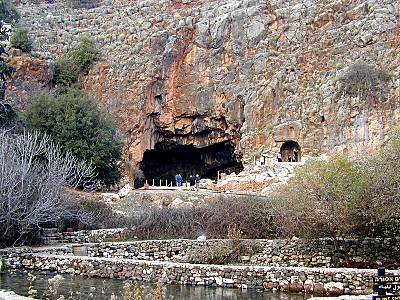
Caesarea Philippi was the ancient city of Paneas named for the god, Pan. Jesus would have seen the temple of Pan standing in front of a cave from which the headwaters of the Jordan River flowed. I’ve taught at this ruin many times, pondering the yawning cave that once greeted Jesus and his disciples. Within the cave there stood a huge statue of Pan. Pan is in the cave because it was his job, according to the myth, to guard the entranceway to Hades—the Greek mythological underground abode of the dead. Get the connection?

In Caesarea Philippi, a city dominated by the view of the temple of Pan—a Greek god who guarded the entrance to Hades--, Jesus refers to the gates of Hades as a metaphor for the church’s power to prevail even against death and the grave. One more time:

And I tell you, you are Peter, and on this rock I will build my church, and the gates of Hades will not prevail against it.” (italics mine) (Matthew 16:17-18) [a[|dhj hades {pronounced hah'-dace}]

All this is to say that when Jesus said Hades, even at Caesarea Philippi, he meant the grave. He was saying that his church will be victorious over death and the grave, using Hades in the Old Testament sense of Sheol (see Hell Defined 1 and Five Coincidences at Caesarea Philippi)

The term Hades occurs only ten times in the New Testament (Matthew 11:23, 16:18..; Luke 10:15, 16:23; Acts 2:27; 31; Revelation 1:18, 6:8, 20:13; 14—eleven if you include 1 Corinthians 15:55, which you can’t). In all but one of those ten occurrences Hades means the grave. Guess which one is different? That’s right. The one that’s different is in the Parable of Poor Lazarus and the Rich Man. There, as in all his parables, Jesus gets creative. There Hades means the abode of the dead, meaning the equivalent of Greek Mythology’s underworld.

Does Jesus believe in Hades, the Greek mythological underground abode of the dead? Of course not. And he proves it. He places Hades not underground in his imaginative story, but on the far rim of a canyon. And he does more.

To me what’s most peculiar is that Jesus adds the notion of tormenting flame being in the rich man’s Hades, which is downright humorous. Hades wasn’t a place of fiery torture in Greek mythology and philosophy. “Punishment for wrongdoing in the old (Pre-Plato) Greek stories . . . was not generally an after-death affair.” (Turner, 28) Hades was just drab.

Later, however, Plato did introduce some elements of suffering to Hades. While good souls went to the Elysian Fields to ride horses, play games, and play lyres in flowered meadows, bad souls went to a place in the basement of Hades called Tartarus (mentioned in 2 Peter 2:4—see Hell Defined 2). (29)

In utter contradiction to this dualism (good/bad; Elysian Fields/Hades), however, Plato sometimes sounded very Hindu or Buddhist, speaking of souls proving themselves worthy through a series of reincarnations to go finally up (!) to “the true Hades” to be bodiless forever with the gods. But bad souls are reincarnated as donkeys, wolves, ants, wasps, or the like. (31) The punishment in this sense is on earth.

Yet, back to the dualism, Plato saw souls that were neither particularly good nor bad being sent to Hades to be purified for a time. This may be where the concept of Purgatory comes from, though the Zoroastrian hell is also for purifying, and the Islamic hell is also purifying for some at death. It’s hard to tell who was borrowing from whom. But Plato claims that very bad people are thrown into Tartarus in the depths of Hades where the Titans are chained (32). It’s a prison. But he adds at the end of The Republic that in Hades sinners are met by wild men who “drag them off and flay them with scourges and thorns.” (33) But a fiery Hades? It’s not to be found.

“The Greek underworld is more like a musty closet than a furnace; it is a dark, sterile, and humorless realm, where the departed wander about aimlessly as shades of their former selves—the dead seem more devitalized and bored than tormented.” (Lewis, 174)

Gehenna [ge,enna geenna {pronounced gheh'-en-nah}] is a New Testament word that Jesus used just eleven times (and James once). It is definitely a place of fire. (On this 4 Esdras agrees.) No wonder. It was Jerusalem’s burning dump. Gehenna, or ge-hinnom in Hebrew, meaning The Valley of Hinnom, is a ravine that runs from the west side down and along the south end of Jerusalem’s Old City wall. Even though it’s not the safest place in the world today, I’ve walked its length. In biblical times, it is the place where garbage and sewage were burned. Continuously burning garbage and sewage is the perfect metaphor for a wasted life in a hellish existence, don’t you think?

Jesus—being intentionally and playfully contradictory in his Lazarus parable—places the rich man not in a fiery Gehenna Valley but in a nonsensical fiery Hades on a canyon rim. Why a fiery Hades for the rich man? You will not believe this:

Hades was the lord of the underworld and of the dead. His realm was also called Hades, and his name means unseen. But the ancient Greek god had two other names, both prominent in Roman times—the time of Jesus. The Romans called him Pluto, which means wealthy. Borrowing from the Celts, the Romans also called him Dives Pater (shortened to Dis Pater or just Dis). Dives Pater means Father Rich Man. (Turner, 36)

Hades/Pluto was equated with Dis Pater probably because in mythology he mined the earth for gold and such. Being the god of mining and underground wealth connected him to the underground abode of the dead. Therefore the god of mined wealth also became the god of the dead.

So let that sink in. Hades is Dives Pater, Father Rich Man. Jesus’ parable, “Poor Lazarus and the Rich Man,” is traditionally called, “Lazarus and Dives.” Folks, that is not a coincidence. Jesus put the rich man in his parable in Hades, a place in mythology that is ruled by the god Hades who is also called Father Rich Man! Are you getting this?

Upon death, the rich man (Dives) in Jesus’ parable is sent to Hades, the realm of Father Rich Man (Dives Pater). This playful parallel is not accidental. The layers of Jesus’ creativity and humor are astonishing.

But look at the many contradictions that occur when you literalize this parable. Lazarus dies. His burial isn’t mentioned, and he is transported by angels over to Abraham’s side of a canyon. He’s asked later in the parable to dip his finger in water, so wherever Lazarus is, Jesus portrays him as a physical being throughout, not a disembodied soul. The rich man’s body is buried, however. No transport is mentioned for him at all. Suddenly he’s in two places at once, in the grave and in Hades (which biblically should be the same thing, since Hades is the Greek word for Old Testament Sheol, meaning the grave). The rich man is definitely not a disembodied soul in either place. And note that Jesus’ parable-Hades isn’t underground. It’s on the opposite rim of the canyon from Lazarus. And the rich man is being tormented by flames physically in Hades, which introduces other inconsistencies. Hades is not known for flames. Moreover, Greco-Roman Hades was a place specifically for souls, not bodies. The rich guy asks for water on his tongue. So he definitely has a body in Hades, but he’s also buried—two bodies?

None of this is very sensical, is it? Taking it literally pushes it to absurd contradictions. But what if that is Jesus’ exact intention. It’s a clever parable, remember, a cartoonish and playful parable, just as Jesus meant for it to be. His listeners no doubt delighted in its colorful, comedic paradoxes and plays on words.

Does that freak you out? Sorry. But it’s clear to me that Jesus meant for his parables to be instructive and entertaining, not internally consistent and logical and factual. (Can a camel literally go through the eye of a needle?) Jesus’ audience that day, an audience of friends and disciples, probably enjoyed the hodgepodge of Hebrew, Greek, and Roman afterlife names and concepts as much as they enjoyed the use of rich, real life Lazarus’ name for a fictional poor man.

Why have we (in the church) intoned Jesus in somber voice and projected his image in super-seriousness on the screens of our minds? Take a deep breath and lighten up, for goodness sake. Relax. It’s a playful parable! Enjoy Jesus’ salty teaching at its best.

Jesus continues, From Hades the rich man looked way across to the other side of the gorge,* and there stood poor Lazarus (Now the rich man recognizes Lazarus! But he never recognized or acknowledged him, ironically, on the sidewalk of his own home while they were alive!) with Abraham.

But Bert, you might complain, it says that the rich man looked up to see Lazarus and Abraham, doesn’t it? Nope. The Greek New Testament reads evpa,raj tou.j ovfqalmou.j auvtou/, which literally translates as “he lifted up his eyes.” Those who interpret this parable literally assume that this means that the rich man literally looked up into the sky to see Abraham and Lazarus “in heaven.” That’s a misunderstanding of the phrase.

Yes, evpai,rw epairo {pronounced ep-ahee'-ro} can mean literally lift up, raise, or elevate. But frequently the term is used figuratively. Here are some examples from our New Testament Gospels. In Luke 11:27 a woman “raised her voice.” This cannot mean that she took her larynx from her throat and lifted it over her head! No, it’s an idiom, an expression that means something beyond the literal words. To raise your voice is to shout or cry out. In Luke 21:28 Jesus tells his listeners to “lift up your heads.” Does he mean to take your head off and hold it in the air? Does he even mean literally to look up at the sky? No on both counts. It’s an idiom. It means have courage or take heart, similar to our idioms in English to “hold your head up high” or “keep your chin up.” In John 13:18 Jesus said, “He who is eating the bread with me, did lift up against me his heel.” (YLT) Does Jesus mean that one of the disciples is going to stomp on him? Again, no. It’s an idiom. It’s often translated into English as “turned against me.” He’s speaking of Judas’ betrayal. Now look at Matthew 17:8:

6 When the disciples heard this, they fell to the ground and were overcome by fear. 7 But Jesus came and touched them, saying, "Get up and do not be afraid." 8 And when they looked up, they saw no one except Jesus himself alone. (italics mine)

By “looked up,” did Matthew mean literally that they looked up into the sky? No. Again, it’s an idiom. It means to look closely or to notice. It’s the same in our parable. Here’s Young’s Literal Translation of Luke 16:23:

YLT Luke ..16:23.. and in the hades having lifted up his eyes, being in torments, he doth see Abraham afar off, and Lazarus in his bosom, (italics mine)

Now we see that “having lifted up his eyes” is an idiom meaning to take notice. Besides, he can’t be literally looking up to the sky because Jesus places the rich man and Lazarus on opposite sides of a canyon. The characters are at eye level. Jesus is simply telling us that in his tale, the rich man looks around and notices that Lazarus and Abraham are over on the opposite rim of Jesus’ much misunderstood and much literalized gorge. (Friberg Lexicon; Thayer’s Greek Lexicon)

And the man cries out, “Mr. Abraham, sir, I beg you, show me a little compassion. Let Lazarus dip his finger in some water and come over here to cool my tongue. Man, it’s hot as hell over here!

This is ridiculous—intentionally. First, if you’re really on fire, you don’t use reason to try and talk your way out of it. Second, how much help is one drop on your tongue when your whole body is blazing? Third, how do Lazarus and Abraham hear him at such a great distance? Maybe it’s a really small chasm! Either that, or their cell phones have a good signal, for Abraham responds to the rich man’s finger-in-water request with a resounding No:

Son, remember how you had it good during your lifetime, and Lazarus had it really bad? But now he has it good here, and you have it really bad there. And this grand canyon separates us so that if anyone wants to cross from here to you, he can’t, and if you want to come over here, you can’t. [As if the rich man hadn’t already noticed all this! Maybe the reason he wants water is not to cool his tongue but to get the abundant life on the other side, referring to the “living water” mentioned by Jesus in John’s Gospel (4:10-14, 7:38) and in the Book of Revelation (7:17, 21:6, 22:1-2 and 17).]

So the rich man says, Sir, again I beg you, let me run home real quick and warn my five brothers so they won’t end up here. [Is he really concerned about his brothers, or is this another excuse used to escape his place of torment, or maybe just another attempt at a reprieve from the heat? Jesus’ listeners were probably saying, No, Abraham, No! Don’t let him go. He’s making an excuse to escape!]

Your brothers don’t need you, said Abraham to the rich man. They’ve got Moses and the prophets to show them the way.

No, Sir Abraham, I know those guys. They aren’t going to read old laws and prophesies. But I truly believe that if you let me go to them personally, when they see that I’m raised from the dead, I think they’ll believe me and change their minds. [That’s what repent means literally—mind-change.]

Here comes the zinger. Don’t you know Jesus’ friend Lazarus loved this last line?

Hey, Rich Boy, if they don’t listen to Moses and the prophets, they won’t listen even if someone were to rise from the dead! said Abraham. THE END.


Look at the levels of meaning. Not only had Lazarus of Bethany been raised from the dead causing many notables to believe (John 11:43-48 and John 12:10-12), but Jesus himself would rise. And Jesus cleverly ends the story with a humdinger referencing coming back to life. He tells the truth. Even the resurrection won’t impress or convince everybody. Obviously so, even today.So what’s this story about? You choose. Multiple choice. Luke 16:19-31 is:

A.     a literal description of a historical event.
B.     an eyewitness report from heaven and hell.
C.     a parable about failure to love your neighbor.

I go with C. It’s a parable about the danger of failing to love your neighbor. If you can’t love now, when are you going to do it? This parable says love today. Don’t blow your present opportunities to love. Because a compassionless existence is a living hell, though one may not realize it until it’s too late.

“The choice is between a living death and a dying life.” (Kreeft, p. 164)

The purpose of the parable is to awaken Life-filled, self-sacrificing compassion now, and to fulfill the law and the prophets by loving your neighbor now:

. . . you shall love your neighbor as yourself. . . (Leviticus 19:18)

As you probably know, this parable is often touted as a documentary on the afterlife. Why? Because there are too many humorless literalists in the world today, and because of them, the church has all but missed the fun. And moreover, the literalists are desperate for afterlife material, as there is much less afterlife emphasis in the Bible than people have been led to believe.

In the Parable of Poor Lazarus and the Rich Man, Jesus has given us a crafty afterlife cartoon designed to tickle and tease the imaginations of those who have ears. Jesus is piercing the heart with a playful drama. It’s a life and death caricature of the failure to love. How desperate must you be for afterlife “data” to turn this delightful, intimate, love-your-neighbor farce into an unsmiling eyewitness report on the hereafter news channel?

The chasm between greed and generosity, between callousness and compassion, between neighborly neglect and neighborly love can and must be crossed in this life.


Plain Truth Magazine published this article as The Lazarus Parable--Just for the Hell of It?

For more on Jesus' parables see my blogs The Absurd Parable of the Unforgiving SlaveThe God Who GamblesParable of the Vine and BranchesThe Crooked ManagerThe Friend at MidnightHeaven Is Like a Crazy FarmerHe Speaks Of . . .Salted With FireTalking Sheep and GoatsIs Your Eye Evil?Two Prodigals and Their Strange FatherThe Lazarus Parable Is Not About the Afterlife,and Jesus Used Parables Like a Sieve.

Friday, January 23, 2009

Hell Defined 2

Gehenna


Gehenna—geenna {pronounced gheh'-en-nah}—occurs only a dozen times in the New Testament. The term is a Greek transliteration of the Hebrew words ge hinnom meaning the “Valley of Hinnom,” or ge bene hinnom meaning “the valley of the sons of Hinnom.” (ISBE) Yes, it’s a real valley. It’s downhill from the southern wall of the Old City of Jerusalem. I’ve been there many times. I’ve explored its length. The valley was notorious for two things:


First, children were sacrificed to Molech there. There is not consensus on this Ammonite cult, but the traditional view is this:


Molech – “an idol of the Ammonites, to whom they burned and sacrificed their children, . . . [it’s] face was like a calf: his hands were ever stretched out to receive gifts: his priests were called Chemarims, (2Ki 23:5, Ho 10:5, Zep1:4).” (Geneva Bible Notes)


Kings Ahaz and Manasseh of Israel, in accommodation to local pagan rituals, reintroduced “children passing through the fire to Molech,” probably child sacrifice (2 Kings 16:3; 2Chronicles 28:3, 33:6; Jeremiah 7:31; 19:2-6). The Valley of Himmom was called Topheth (2 Kgs 23:10; Jer. 7:31f; 19:6, 11ff) which means “place of fire.” King Josiah outlawed the idolatrous and barbaric practice, (2 Kings ..23:10..) though it was already outlawed in Israel’s legal code:

NET Leviticus 18:21 You must not give any of your children as an offering to Molech, so that you do not profane the name of your God. I am the LORD!

Second, the valley, so defiled so by idolatrous human sacrifices, became “a receptacle of carcasses and criminals' corpses” of the city of Jerusalem. The Hinnom Valley (Gehenna) became Jerusalem’s burning dump and sewer. For practical reasons (Waste in Jerusalem flowed from the city into the Hinnom Valley.) and because of its defiled past (It was a pagan worship center that practiced child sacrifice.), the Hebrews made the place their sewer, their dump, and their body disposal site. In Old and New Testament times, the fires of Gehenna reportedly never went out.


Hinnom in the Old Testament occurs only eleven times in eleven verses, none of them in reference to anything other than the literal Hinnom Valley of south Jerusalem. (Joshua 15:8; Joshua 18:16; 2 Kings 23:10; 2Chronicles 28:3; 2 Chronicles33:6; Nehemiah 11:30; Jeremiah 7:31, 32; Jeremiah 19:2, 6; Jeremiah 32:35) None of these eleven references to the valley of Bar (son of) Hinnom in the Old Testament has anything to do with the afterlife. The Valley of Hinnom is a literal valley and is not referred to metaphorically.

Now the stage is set for Jesus’ few references to Jerusalem’s Valley of Hinnom, or Gehenna.

NAB Matthew 5:21-22  "You have heard that it was said to your ancestors, 'You shall not kill; and whoever kills will be liable to judgment.' 22 But I say to you, whoever is angry with his brother will be liable to judgment, and whoever says to his brother, 'Raqa,'will be answerable to the Sanhedrin, and whoever says, 'You fool,' will be liable to fiery Gehenna. (bold and italics mine)

Jesus gives us three words to ponder. These three little words could mean your destruction. Your life can be a living hell if you allow these three words to enslave you.

1. Orge - The word for anger (orge) also means wrath. Jesus says that the consequences for wrathful anger and judgmental words are severe. The judgment is the same for anger as for murder! Murder in your heart, just like adultery in your heart, is the same as if you had done the deed, spiritually speaking. Jesus doesn’t allow his followers to hide behind their good behavior, like the Pharisees did. He forces them to look inside. Inside, everyone is guilty. Inside, everyone has done evil and failed God. How dare you judge someone else when you yourself are not innocent? That’s his point. Those who are wrathful/angry to someone are answerable to judgment (krisis) for murder. The sentence is death.

2. Raca - Raca is an Aramaic word meaning empty-headed. No brains. If you judge someone to be stupid and call them Raca, you are answerable to the Supreme Court for murder, says Jesus. Spiritually,such name-calling judgment on your part is a killing, and your sentence is already pronounced; by pronouncing sentence on the brains of someone else,you’re already brain-dead and don’t know it. (How could you? You have no brain!) Those who judge others as brainless are answerable for murder. The sentence is death.

3. Moros – Moros means fool. It literally means moron. If you judge someone and call them a moronic nitwit, you will be answerable to the burning fires of the city dump (Gehenna) for murder. The sentence is death.

Now, how literally are you prepared to take Jesus’ three proclamations? Look at the three rulings. 1. Liable to judgment. 2. Answerable to Sanhedrin. 3. Liable to fiery Gehenna. Look at the middle one: Answerable to the Sanhedrin, ....Israel....’s Supreme Court. Do you really think Jesus is saying that the Sanhedrin will put you to death for calling someone stupid? Since when is name-calling a capital offense? It’s a silly idea if taken literally. Now think about the other two: Liable to judgment for being judgmentally angry? Liable to the burning dump for calling someone a fool? Both also silly ideas if taken literally.

It’s kind of funny, isn’t it, that anger and name-calling gets you the death penalty? But there is Jesus’ sense of humor again, often missed, but much appreciated when discovered. Jesus says, Forget about murder. You don’t have to kill someone to get the death penalty. I tell you truthfully, the sentence is death for harboring anger (orge), for calling someone stupid (Raqa), and for calling someone a fool (Moros).
 

Ridiculously harsh, you say? How can Jesus judge,sentence, and condemn someone like that, and toss them in the burning dump,just for an emotion and an unfortunate choice of words? No, that’s missing the point. Jesus isn’t judging and sentencing or tossing anybody. A person’s harbored anger and his judgmental, cruel words are symptoms that he already stands judged, condemned, and dumped spiritually. He’s exhibiting Gehenna behavior. He’s already sentenced himself to death and doesn’t know it. Jesus isn’t judging him or executing him. Jesus is pronouncing him DOA—already dead on arrival. He’s spiritually dead. He’s walking worm food.

Welcome to the real hell, the Gehenna of Scripture, Jesus’ Gehenna, the valley of burning sewage and garbage and dead bodies. Death valley. This hell is all around us. We live in the stench of it every day. You need more proof of its presence? Look at these two quotes from Jesus:

NAB Matthew 23:15 "Woe to you, scribes and Pharisees, you hypocrites. You traverse sea and land to make one convert, and when that happens you make him a child of Gehenna twice as much as yourselves.

NAB Matthew 23:33 “You serpents, you brood of vipers, how can you flee from the judgment of Gehenna?”


Notice Jesus says that the scribes and Pharisees are already children of Gehenna. Gehenna tragically defines whose they are and where they are from. They come from Gehenna, they are in Gehenna, and they belong to Gehenna. Why? Because they are hypocrites. Hypocrisy isn’t just the wrongdoing that earns you the death penalty in the burning dump. Hypocrisy is sewer born.Hypocrisy is a symptom that you are already dead in Gehenna. You are spiritually dead. Listen to another of Jesus’ pronouncements against these same leaders:

NAB Matthew 23:27-28 “Woe to you, scribes and Pharisees, you hypocrites. You are like whitewashed tombs,which appear beautiful on the outside, but inside are full of dead men's bones and every kind of filth. 28Even so, on the outside you appear righteous, but inside you are filled with hypocrisy and evildoing.”

Hypocrisy, born of Gehenna, is to live a lie. You put up the front of a devout and righteous person. Inside you’re filled with hate, anger, murder, adultery, idolatry.Gehenna is in you. You can’t hide what’s inside from God. That’s why Jesus says that they can’t “flee from the judgment of Gehenna.” Take a second look:

NAB Matthew 23:33 “You serpents, you brood of vipers, how can you flee from the judgment of Gehenna?”

They can’t flee it because Gehenna is inside of them. You can’t flee from yourself. Because wherever you go, there you are! That’s why the scribe and Pharisee snakes can’t flee Gehenna. They’re already in it, and it’s in them. They’re in death valley,and it’s in them. They’ve applied judgment to themselves by judging others. If they try to flee the judgment by running around showing off the appearance of cleanness, they only take Gehenna with them because it’s inside.

Allow me to ask you some questions. Is Jesus saying that the scribes and Pharisees are literally snakes? Is he saying that they’re literally whitewashed tombs? Is he saying that the literal penalty for calling someone a bad name is death? Obviously not. Then is Jesus saying that hypocrites and name-callers will be thrown into the literal burning dump in the Hinnom Valley (Gehenna)? Also, obviously not.

It’s not appreciated the extent to which Jesus used poetic pictures in his teaching. (See my blog He Speaks Of . . . .) Let me demonstrate by showing you Jesus’ best known quotes about Gehenna. They’re in Mark 9. Jesus salted his teaching with parabolic images, sounds, tastes, smells, and textures. For him, words that stir up your senses work better than abstract concepts. Mark 9:42-48, containing three mentions of Gehenna, is rife with such evocative words. (See also Matthew 5:29-30; 18:9; James 3:6) Here’s my outline of Jesus’ key teaching on Gehenna in Mark 9:42-48:


***
A. IF YOU CAUSE STUMBLING, . . . IT’S WORSE THAN DROWNING:
42 “Whoever causes one of these little ones who believe (in me) to sin, it would be better for him if a great millstone were put around his neck and he were thrown into the sea.”

B. IF A BODY PART CAUSES YOU TO STUMBLE, AMPUTATE . . .


1. IT’S EITHER YOUR HAND OR GEHENNA:

43 “If your hand causes you to sin, cut it off. It is better for you to enter into life maimed than with two hands to go into Gehenna, into the unquenchable fire.”

2. IT’S EITHER YOUR FOOT OR GEHENNA:


45 “And if your foot causes you to sin, cut it off. It is better for you to enter into life crippled than with two feet to be thrown into Gehenna.”

3. IT’S EITHER YOUR EYE OR GEHENNA:


47 “And if your eye causes you to sin, pluck it out. Better for you to enter into the kingdom of God with one eye than with two eyes to be thrown into Gehenna, 48 where 'their worm does not die,and the fire is not quenched.'” 

(Mark 9:42-48)


***

Let’s summarize. A. Jesus says that if you dissuade someone from believing in him (or in the Life that he brings), you’d be better off thrown overboard in cement shoes. (millstones excavated in Capernaum pictured) B. He says, you’d be better off maimed but alive than whole and dead in the dump.


What if Jesus wanted to warn those who might try to stop people from believing in him and in the Life that he embodies and brings? He could say, “It is wrong to dissuade people from entering Life by believing in me.” That sentence expresses his warning, but it’s not very evocative, is it? But Jesus says instead, and I’m paraphrasing, You’ll wish you’d drowned in cement shoes if you try to trip up those who are entering Life.


There’s humor again in this extreme penalty for a seemingly insignificant wrongdoing. To cause a little one to merely stumble is a drowning offense? Your hand, your foot, or your eye causing you to stumble is a burning offense? That’s what the man said.And boy does he bring vivid pictures to the mind!


In his evocative language in Mark 9, is Jesus threatening nonbelievers with literal afterlife punishment? Please allow me to answer that question with a question. How serious was Jesus about drowning someone by putting a millstone around his neck and throwing him into the sea? May I ask some more questions? How serious was he about amputating your hand? How serious was he about amputating your foot? How serious was he about plucking your eyeball? Are we talking about literally drowning someone, literally amputating hands and feet, and literally removing eyeballs? Obviously the answer to all these questions is No. He’s speaking figuratively about millstone drownings,hand and foot amputations, eyeball pluckings, and Hinnom Valley burnings—not literally.

Let’s take a commonsense approach. Look at each element in these verses and ask yourself: Is Jesus talking about a literal stumbling block? Are the “little ones” literally toddlers or children? Is a literal millstone hung literally around your literal neck? Is he talking about literally throwing you in the sea for putting a literal rock in front of literal children to literally make them trip and fall to the literal ground? No? Then I have two very serious questions for you:

1. If nothing else in this parabolic saying is literal, then why does Gehenna (the Hinnom Valley) have to be a literal afterlife place?

2. If we aren’t to take these things literally, then what is Jesus really saying?


To dwell in Gehenna is to become garbage, sewage, and filth. There was so much corruption and rot in that valley that the worms there, Jesus insists playfully, live forever!

NAB Mark 9:48 “. . . where 'their worm does not die, and the fire is not quenched.'”

Everyone who listened to Jesus knew the history of Gehenna (Jerusalem’s Hinnom Valley, meaning the Valley of Wailing). Everyone knew of the idolatrous cult involving burnt offerings of children to the god Molech. (2 Kings 23:10; 2 Chronicles 28:3, 33:6; Jeremiah 7:31, 32:35) Everyone knew that the place was called Topheth, meaning “a place of fire.” Everyone knew it was called Haragah, “a place of slaughter.” Everyone knew that people were slaughtered and burned there. For Jesus’ contemporary audiences, Gehenna was the perfect picture of a wasted life and a hellish existence. Who can live in Gehenna? The obvious answer to this rhetorical question is No one. Life is not possible in Jerusalem’s trash-burning ditch. But a hellish existence is, poetically speaking. Spiritual death is possible there. Gehenna—a place of pagan sacrifice, unclean corpses, raw sewage, burning entrails, and unmarked tombs—is Jesus’ perfect metaphor for people who reject Life.

So what’s Jesus getting at with these sayings? Why are your choices either Gehenna or amputation? Allow me, again, to answer a question with a question. Have you ever seen something take over a person’s life? More specifically, have you ever seen a person loose his family, his job, his life’s savings, his home, his car, his freedom, and even his life because of an obsession or addiction? Jesus’ insight is crystal clear about this kind of thing:

If your hand is addicted to something, it drags your whole self into slavery with it, resulting in enslavement in a living hell. If your foot is addicted to somewhere, it drags your whole self into slavery in that place, resulting in enslavement in a living hell. If your eye is addicted to an object, it leads your whole self into slavery to that object, resulting in enslavement in a living hell. Your hand, your foot, and your eye can enslave the rest of you in Gehenna. James wrote that your tongue can do the same:

NAB James 3:5-6 In the same way the tongue is a small member and yet has great pretensions. Consider how small a fire can set a huge forest ablaze. 6 The tongue is also a fire. It exists among our members as a world of malice, defiling the whole body and setting the entire course of our lives on fire, itself set on fire by Gehenna.

I’m inviting you to stop imposing a literal afterlife underground place of punishment on Jesus’ teaching and look at what he’s really saying. Dr. Jesus gives the diagnosis, warns what will happen without treatment, and recommends surgery. If your appetite,obsession, or addiction leaves you with nobody and nothing, your abode is Gehenna. He doesn’t say this to condemn anyone. Rather it’s his invitation to Life and freedom. It’s his prescription for beating Gehenna. And what he’s calling “Gehenna” is much more immediate, tragic, and deadly than some future afterlife underground punishment. It’s a living death here and now.

In his examples about amputating your hand or foot, or plucking out your eye, is Jesus telling you to literally remove these body parts? Obviously not, or sales of eye patches and prosthetic hands and feet would be booming! Then why literalize Gehenna? By Gehenna, Jesus means death by spiritual slavery here and now. And Jesus doesn’t sugarcoat it: You will either lose your life or a body part. You are either dead or maimed. The only way forward into Life is maimed.
 

You live maimed or not at all.

Let’s not turn what Jesus is saying back into a new legalism. He’s not saying, “Don’t stumble, or else!” “Don’t trip, or I’ll send you to hell forever.” To stumble isn’t to misbehave. Stumbling isn’t a black mark on your goody-two-shoes scorecard. In Christianity, to stumble is to be enslaved to something (or someone) that isn’t Jesus, he who scripturally is Life. All other enslavements are idolatry. All other enslavements are Gehenna.


Any recovering alcoholic will tell you that recovery begins with admitting you’ve got a problem with no free and easy way out. You don’t ever stop being an alcoholic; you’re alcoholic for life. You’re maimed. You’re forever scarred. Once an amputee, always an amputee. But you don’t have to be a slave to alcohol. Because you’re an alcoholic doesn’t mean you have to stay in a living Gehenna, thought that is a real possibility. The only option to death(spiritual or physical or both) is maiming. If your hand has to be holding a drink, then your hand has drug you with it into Gehenna. If your foot has to go to the racetrack, then it has drug the rest of you with it into Gehenna. If your eye is voyeuristic, then your eye has drug the rest of you with it into Gehenna. And the only option to Gehenna is maiming. It’s better to cut yourself off from the addiction and those things and relationships that support and enable that addiction, than to keep intact your current actions and relationships that steal your Life of freedom and peace. Jesus is saying that maimed is survivable; but a living death in the idolatrous burning dump is not.

We all have our battle scars. It’s no shame. But I hear Jesus asking, Wouldn’t you rather live scarred and free than unblemished and in chains? Wouldn’t you rather be a pain-free amputee than for your whole self to be tormented? Wouldn’t you rather see heaven with one eye than see Gehenna with two?

If you can manage to stop making the mistake of trying to take these verses literally, you can see what Jesus is really getting at about Gehenna:


Gehenna is our blind, desperate attachments that separate us from real Life and liberty.

Folks, the only two choices Jesus gives are Gehenna or body-part removal, and he says that body-part removal is infinitely and eternally better than Gehenna. Yes, hands and feet and eyes are literal body parts. Yes, Gehenna is a literal Jerusalem valley. But if Jesus isn’t talking about literal body-part removal, then he isn’t talking about literally being thrown into Jerusalem’s Hinnom Valley and its burning refuse and excrement either. They are “figures,” as he called his poetic parabolic images. (John 10:6, 16:25 & 29)


Tartarus


The term tartaroo {pronounced tar-tar-o'-o but often called tar-tar-oos} may be unfamiliar to you, first, because it occurs only once in the Bible, and, second, because it is usually translated incorrectly as “hell.” Look how our twenty-two English translations render Tartarus in 2 Peter 2:4.

hell 16 (ASV, BBE, ESV, GNV, KJV, NAS,NET, NIV, NKJ, NLT, NRS, PNT, RSV, RWB, TNT, WEB)
Tartarus 2 (NAB, YLT)
the lower hell 1 (DRA)
the deepest pit of gloom 1 (DBY)
the infernal regions 1 (MRD)
the underworld 1 (NJB)


The sixteen who translate it “hell” have missed the boat. To call it “lower hell” is closer because in Greek mythology, Tartarus is lower Hades. But the best way to translate it is not to translate it at all. Like the biblical words Sheol, Hades, and Gehenna, Tartarus should be left alone. The term Tartarus is what 2 Peter intended. Note that the only appearance of the word Tartarus is in one of the longest sentences in the Bible.

NAB 2 Peter 2:4-10   For if God did not spare the angels when they sinned, but condemned them to the chains of Tartarus and handed them over to be kept for judgment; 5 and if he did not spare the ancient world, even though he preserved Noah, a herald of righteousness, together with seven others, when he brought a flood upon the godless world; 6 and if he condemned the cities of Sodom and Gomorrah (to destruction), reducing them to ashes, making them an example for the godless (people) of what is coming; 7 and if he rescued Lot, a righteous man oppressed by the licentious conduct of unprincipled people 8 (for day after day that righteous man living among them was tormented in his righteous soul at the lawless deeds that he saw and heard), 9 then the Lord knows how to rescue the devout from trial and to keep under punishment for the day of judgment, 10 and especially those who follow the flesh with its depraved desire and show contempt for lordship. (bold italics mine)

The writer gives three examples from Jewish literature showing that God has well in hand the rescuing of the tormented and the punishment of the tormentors. He saved Noah’s family, yet punished his generation. He saved Lot’s family, yet punished Sodom and Gomorrah. He didn’t even give angels special treatment when some of them sinned, but put the bad ones in a prison. Second Peter called the prison Tartarus. Why? Because he’s referencing an ancient document that you may not have read.


The story of imprisoned angels isn’t biblical. And yet an ancient story is referenced in 2 Peter 2:4 and Jude 1:6 as if it were at least on a par with Scripture in the mind of the authors.

Jude 1:6
And the angels who did not keep their own position, but left their proper dwelling, he has kept in eternal chains in deepest darkness for the judgment of the great Day.

The story comes from Jewish apocalyptic writings that we call apocryphal. Apparently the writers of 2 Peter and Jude were familiar with the intertestamental Book of Enoch. Also called 1 Enoch, this book tells of the imprisonment of angels. 1 Enoch 20:2 specifically states that some angels were imprisoned in Tartarus.

So, 2 Peter, because of 1 Enoch, borrowed a pagan Greek term for the prison basement of mythological Hades. Tartarus, or lower Hades, was the prison for the mythological Titans.The Titans were chained there by Zeus after his successful rebellion. Apparently the readers of 2 Peter were expected to be familiar with Tartarus found either in 1 Enoch or Greek mythology or both.

Pagan Greek Tartarus, or lower Hades, was certainly not a place of fire, nor even a place of punishment (as in torture), but it was a prison for defeated gods called Titans. It is only in later mythologies that a select few humans were sent to Tartarus because they had deeply offended the gods, and individual punishments were imposed on these few humans. For example:

Sisyphus is condemned to roll a rock uphill forever.
Ixion is eternally bound to a fiery wheel.
Tantalus hungers and thirsts forever, standing in a pool of water beneath a fruit tree, "tantalized" by the presence of food and water that retreats every time he tries to eat or drink.


Again, punishment/torture really wasn’t the point anywhere in classical Hades, including the basement prison for the Titans called Tartarus. It wasn’t torturous pain that made the Greeks loathe Hades. It was eternal, lifeless tedium.

Tartarus then, the prison for Titans in Greek mythology, is retooled by the Jewish author of the non-biblical book of 1 Enoch as an angel lockup. Why then did Tartarus end up in the Bible's 2 Peter? It must have been because the place for angels and the place for Titans were both prisons that caused the author of 1 Enoch to poetically use the term Tartarus. The devout Jewish author of 1 Enoch in no way could have meant to be describing a literal underground prison containing the Titans of Greek mythology. He only used Tartarus as a nickname for God’s slammer for bad angels. The author of 2 Peter, then, was just quoting what he considered to be prophetic literature, though 1 Enoch is not considered scripture by almost all of the Christian church today.

Even though 2 Peter and Jude reference the angel prison idea from 1 Enoch, the early church did not include 1 Enoch in its canon. Second Peter only meant to use God’s imprisonment of angels in Tartarus as one of three examples demonstrating how God handled retribution in the past (2:4). He’s saying to his embattled church, Surely God will aid you in your torment, and surely God will punish your tormentors. God did so in the past, imprisoning even angels, and he will do so again.

Here is the single mention of the Greek word Tartarus in 1 Enoch.

1 Enoch 20:1-2 And these are the names of the holy angels who watch. 2 Uriel, one of the holy angels, who is over the world and over Tartarus. (The Apocrypha and Pseudepigrapha of the Old Testament, R.H. Charles, Oxford: The Clarendon Press.)

Then there is the author’s vision of Tartarus, the angel prison:

1 Enoch 21:9-10 Then I said: “How fearful is the place and how terrible to look upon!” Then Uriel answered me, one of the holy angels who was with me, and said unto me: “Enoch,why hast thou such fear and affright?” 10 And I answered: “Because of this fearful place, and because of the spectacle of the pain.” And he said unto me: “This place is a prison of the angels, and here they will be imprisoned for ever.”

The author of the Book of Enoch paints a picture of the afterlife that for perhaps the first time in history begins to resemble our modern English hell. Enoch is among the first Jewish writers to import pagan Greek concepts into Hebrew apocalyptic thought. It was the beginning of a slippery slope for both Jews and Christians. Plato’s nose was in the tent. The Christian canon today is contaminated, not within its own pages, but in the minds of we Christians who unwittingly wear Plato’s reading glasses when we read the Bible. Enoch helped start the contamination. So I’ve taken the opportunity to expose him in this appendix.

What’s my take on 1 Enoch? The writer of the Book of Enochis a syncretist,* compromising Hebrew views in merging them with pagan Greek views. His work still deserves no place in Scripture, and the pagan afterlife elements he brought in have no place in Christian afterlife belief. He (and his“friends”) successfully poisoned the well of Jewish and Christian thought for millennia. The well is still a mess today. That Christians today believe in both the resurrection of the dead and the immortality of the soul is direct evidence of Enoch’s tragic success.

*A syncretist is one who attempts “reconciliation or union of different or opposing principles, practices, or parties, as in philosophy or religion.” (Dictionary.com Unabridged)

I’ve committed more ink to Tartarus than is merited by its single mention in the New Testament. But in this appendix it requires definition and explanation no less than Sheol, Hades, and Gehenna.

Concerns and summary

I have two concerns about hell as taught widely in the church today:

1. I hear church people (pastors and lay people) claiming that hell is mentioned more than heaven in the New Testament. Why would they say that? They’re dead wrong. Heaven (ouranos) is mentioned 77 times in Matthew alone, more than 250 times in the New Testament. Gehenna occurs only a dozen times. Hades only ten. Tartarus just once. If you tally these you only get twenty-three. Heaven is mentioned more than ten times (10x) that. Even if you add 65 mentions of the word Sheol in the Old Testament, you still don’t top heaven’s 250-plus mentions in the New Testament alone. Why would modern evangelicalism want hell to top heaven? If there is a reason, it probably has something to do with my second concern:

2. Today, hell is number one in the playbook for much of modern evangelism. Do two dozen mentions merit top billing? And don’t forget, as I’ve made clear, the words Sheol, Hades, Gehenna, and Tartarus have been but should not have been translated into English as “hell” in the first place. No biblical mention of Sheol, Hades, Gehenna, or Tartarus is in reference to the afterlife.

For the sake of clarity, here is a summary of our four biblical words often wrongly translated into English as hell:

Sheol in the Old Testament means the grave.


Hades in the New Testament is a synonym for Sheol meaning the grave.


Gehenna in the New Testament is a literal valley south of Jerusalem used by Jesus as a poetic metaphor for how we end up due to our blind, desperate, idolatrous attachments that separate us from real Life and liberty.


Tartarus in the New Testament is a nickname borrowed from pagan Greece for an angel prison in an old, non-biblical Jewish document (Book of Enoch).


Go back and read about Sheol and Hades in Hell Defined 1.